David Zwirner ・forward-thinking art-world luminary

In a time of arguably increasing climate risk and concomitant regulatory risk, price risks, and prospective market adjustments, mega art dealer David Zwirner is a forward-thinking art-world pioneer and luminary. Mr. Zwirner has set a new environmental standard for art-related facilities while presenting a “a clean, elegant, modernist aesthetic that is very much about welcoming visitors today.”

During 2012’s Hurricane Sandy, more than five million gallons of water flooded the construction site of New York’s new Whitney Museum. In response, the engineering and construction of the museum building, the lobby of which is 10 feet above sea-level, and infrastructure were re-designed and re-engineered.

David Zwirner’s second Manhattan location, on West 20th Street, is situated in Chelsea close by the Hudson River. The 537 West 20th Street gallery opened in early 2013, mere months after Hurricane Sandy.

Designed by Annabelle Selldorf and design consultants Atelier Ten, the five-story, 30,000-square-foot structure is built to museum standards and to accommodate large-scale installations and the full range of artists the gallery represents. The gallery is also the first known commercial art gallery built to LEED Gold standards.

The building incorporates five green roof spaces, premium efficiency mechanical, maximized daylighting, and locally and responsibly-sourced materials.

Sound business sense.

See:

Frick Collection Names Selldorf Architects for Its Renovation” | Robin Pogrebin, The New York Times, 20 October 2016

This Quietly Elegant Architect is Now the Darling of the Design World” | James Tarmy, Bloomberg, 5 June 2015

Protecting Priceless Art from Natural Disasters” | John Whitaker, The Atlantic, 27 May 2015

Annabelle Selldorf Designs the New David Zwirner Gallery” | Samuel Cochran, Architectural Digest, 30 April 2013

David Zwirner Opens New Manhattan Gallery” | Tamara Warren, Forbes, 29 January 2013

David Zwirner 20th Street,” New York, New York | Selldorf Architects

David Zwirner

Selldorf Architects | Architects

Atelier Ten | Environmental Design Consultants + Engineers


#art #artmarket #architecture #design #DavidZwirner #AnnabelleSelldorf #AtelierTen #WhitneyMuseum #Whitney #HurricaneSandy #climatechange #climaterisk #regulatoryrisk #marketadjustments #finance #LEED #LEEDGold
the art market ・exclusive, with controlled access

While a “mature” market may be “fair” and present an even playing field for all market participants, the art market remains “exclusive,” with access controlled by market participants.

Five panelists who met during Art Basel to discuss the art market turned their attention to a number of topics, including market-defined hierarchies and market-controlled access.

I quote from the article that appeared in Artsy as the words are fun, worth reading in the original, and insightful:

Rennie, the veteran collector, described visiting Mary Boone’s gallery [Mary Boone Gallery] in the early 1990s, dressed in a ripped ski jacket, and asking two young men standing behind a desk and a woman sitting behind a typewriter whether Mary was in. Both men said no. As Rennie began to explain who he was and why he was visiting, the woman behind the typewriter jumped up, extended a hand and said, “Hi Bob, I’m Mary Boone.” That kind of selective attention, he said, happens routinely in the art world.

Further along in his collecting career, in 1999, Rennie said, things changed “very clearly” for him and his wife, after they acquired Mike Kelley’s John Glenn Memorial Detroit River Reclamation Project (Including The Local Culture Pictorial Guide, 1968-1972, Wayne/Westland Eagle).

“I found that when I mentioned that, I got into the club,” he said. “We all of a sudden got access to works that other collectors couldn’t be the custodians of.” He challenged anyone listening to “try and get a Mark Bradford.” You can’t, he said, unless you have a relationship with museums or an existing collection deemed strong or important enough to merit the opportunity to buy one of his works.

Observed Olav Velthuis of the University of Amsterdam,

“It is that part of the market that makes it attractive to people, the whole spiel about the waiting lists, and about getting access and not getting access.”

The art market presents a “a status mechanism,” an indicator of where people “are in this global cultural elite.”

See:

The Art Market Has Changed Dramatically – But Is It a Mature Industry?” | Anna Louie Sussman, Artsy, 8 July 2017

#art #artmarket #realestate  #collecting #collections #ArtBasel #luxury #smartluxury


Max Beckmann’s “Hölle der Vögel” (Birds’ Hell) (1937-1938) Sells for US$45,834,365

Max Beckmann’s “Hölle der Vögel” (Birds’ Hell) sold for US$45,834,365 at Christie’s London Tuesday evening (June 27).

The painting, executed in oil on canvas in 1937 – 1938, drew three bidders and sold to Larry Gagosian. It is understood that Mr. Gagosian was bidding on behalf of the New York collector Leon Black.

Art dealer Richard Feigen acquired the painting in 1983. Hölle der Vögel” (Bird’s Hell) has remained in his collection until now.

See:

Boosted by Gagosian’s Record Bid on Beckmann, Christie’s Notches a $190 Million Impressionist and Modern Sale” | Colin Gleadell, Artnet.com, 27 June 2017

Christie’s Impressionist and Modern Art Evening Sale, London, 27 June 2017, Results | Christie’s

Max Beckmann Hölle der Vögel, 1937-38 (special catalogue) | Christie’s


#art #artcollections #artmarket #MaxBeckmann #BirdsHell #HöllederVögel #Christie’s #LarryGagosian #LeonBlack #realestate #resilience #luxury #urbanluxury #NewYork #London

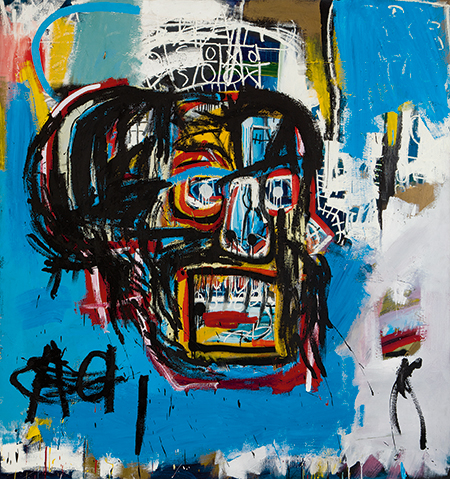
Jean-Michel Basquiat’s “Untitled” (1982)

Consigned by Lise Spiegel Wilks, the daughter of Jerry Spiegel, a real estate developer of Kings Point, N.Y., and his wife Emily, who as collectors of works by emerging artists bought the work in 1984 for $19,000, Jean-Michel Basquiat’s “Untitled” (1982, acrylic, spray paint and oil stick on canvas) was offered at auction by Sotheby’s on May 18, 2017 with a guaranteed price of at least $60 million.

The painting was purchased for $110,487, 500 (hammer price with buyer’s premium) by Yusaku Maezawa.

Yusaku Maezawa, 41, is the founder of Contemporary Art Foundation and of of Japan’s large online fashion mall, Zozotown.

Passionate about the works of Jean-Michel Basquiat, Mr. Maezawa acquired “Untitled” for a museum that he is planning for his hometown of Chiba, Japan.

“But before then I wish to loan this piece — which has been unseen by the public for more than 30 years — to institutions and exhibitions around the world, I hope it brings as much joy to others as it does to me, and that this masterpiece by the 21-year-old Basquiat inspires our future generations.”

Yusaku Maezawa

See:

Untitled” | Jean-Michel Basquiat, 1982, acrylic, spray paint and oil stick on canvas

A Basquiat Sells for “Mind-Blowing” $110.5 Million at Auction” | Robin Pogrebin & Scott Reyburn, The New York Times, 18 May 2017

How Basquiat Became the $60 Million Man” | Robin Pogrebin & Scott Reyburn, The New York Times, 17 May 2017

Sibling Rivalry Erupts Into $160 Million Art Auction Showdown” | Katya Kazakina, Bloomberg, 10 May 2017

Monumental Basquiat Leads Contemporary Art Evening Sale” | Sotheby’s, 18 April 2017

#JeanMichelBasquiat #Basquiet #artmarket #YusakuMaezawa #JerryandEmilySpiegel #LiseSpiegelWilks #Sotheby’s #GabrielaPalmieri #AlexRotter


art storage & protection @ $1+ billion globally

The global art market generated sales of about $65 billion in 2016 according to the TEFAF Art Market Report 2017.

The growing, global network of facilities to store art now generates revenues of over $1 billion a year. Many of these spaces serve multiple objectives – including security, environmental protections, and trade: Sto

  • security
    • video surveillance
    • retinal scanning
  • space | collectors have too much to keep at home
  • protection
    • climate-controlled environments
    • fire-resistant walls
    • air-filtration
    • flood control
    • LEED and BREEAM building certifications
  • investment purchases
  • tax benefits
  • tax-suspended transport to and from galleries | as long as works of art return to storage no duty is payable, even if ownership of the art has changed
  • “1031 exchange” friendly
  • gallery inventory between shows and art fairs
  • storage of art taken by banks as collateral against loans
  • viewing rooms that can be rented on a more permanent basis | in-house, private sales and transfers of ownership
  • passport free access (freeports within airport perimeters)

Simon Hornby, the president of Crozier Fine Arts, estimates that 80% or even more of all the world’s art is in storage at any one time.

The art storage business has doubled in size in eight years and continues to grow.

“Until about ten years ago, Modern and contemporary art collectors were mainly made up of art enthusiasts and amateurs, they had a real passion, spending their money on what they liked; they collected in order to simply enjoy the work in their home environment. Today you have to work with an increasing number of art funds or speculators buying art for investment. Art buying has become accessible to a much larger audience than before and is considered an asset. The result of this is that more work sleeps in warehouses rather than hanging in collectors’ homes.”

Stephane Custot, Waddington Custot Gallery, London

“In the last year, I only physically saw one piece of art that I negotiated. Everything else was bought and sold via jpegs and remained in storage. It was all for investment.”

New York dealer and appraiser

In order to protect the assets, moreover, built environment investment is attempting to keep up with the evolution of demand, including security and environmental protections.

A state-of-the-art storage facility with “foreign trade zone” (FTZ) status (a freeport), ARCIS Fine Art & Collection Care, is under construction on Manhattan’s West 146th Street. Developed by Cayre Equities, the project has taken two years and over $40 million. Executive Director Tom Sapienza and Tom Lay, both formerly with Crozier Fine Arts, were recruited by art collector, real estate developer, and Crozier founder Ken Cayre to manage the project.

The five-story, 110,000 square foot is scheduled to open next month (July 2017).  ARCIS is Latin for “fortress”. The facility is designed and engineered to provide and enhance both environmental and security protections.

With the objective of constructing a museum-quality, sustainable, state-of-the-art secure building, Sapienza and Lay took crash courses in thermal dynamics and consulted with the professional services branch of the Van Gogh Museum in Amsterdam. Works of art will be scanned as they move through the building. State-of-the-art air filters are installed; air will change three to six times an hour.  LEED and BREEAM certifications are to be achieved for the building.

See:

TEFAF’s 2017 Art Market Report” | Marion Maneker, Art Market Monitor, 6 March 2017

TEFAF Art Market Report 2017” | Prof. Dr. Rachel A.J. Pownall, TEFAF Chair in Art Markets, The European Fine Art Foundation, March 2017

Where does all the art go after a fair?” | Georgina Adam, The Art Newspaper, 16 June 2017

Picasso Finds Possible Digs in Harlem $2.5 Billion Art Port” | Katya Kazakina, Bloomberg, 2 March 2017

Will New York Get Its Own Freeport for Art? ARCIS Plans a Tax Haven in Harlem” | Eileen Kinsella, Artnet, 2 March 2017

One of the World’s Greatest Art Collections Hides Behind This Fence” | Graham Bowley & Doreen Carvajal, The New York Times, 28 May 2016

About Foreign-Trade Zones and Contact Info” | U.S. Customs and Border Protection, U.S. Department of Homeland Security

#realestate #resilience #smartluxury #art #LEED #BREEAM #finance #investments #artcollections #artmarket #VanGoghMuseum #museums


Andrew Goldstein on Great Art @ Art Basel

Andrew Goldstein, Editor-in-Chief of Artnet and formerly of Artspace, pronounces on “the ten best artworks at Art Basel 2017.”

Included are Francis Bacon’s painting “Study from the Human Body – Figure in Movement” (1982), offered by the Marlborough Gallery, New York, for $25 million and  Christopher Wool’s sculpture”Untitled” (2014), offered by Luhring Augustine, New York, for $2.2 million.

Mr. Goldstein observes that Bacon’s “Study from the Human Body – Figure in Movement,” obtained by the gallery directly from Francis Bacon just before he passed away,  features

“marquee elements of a major Bacon—the spooky transparent box (evoked memorably in the new “Twin Peaks”), vigorous coloration, and mutant figure in apparent agony—the painting advances Bacon’s interest in the body in movement, a subject he often painted from photos in sporting magazines.”

Of Christopher Wool’s “Untitled,” Mr. Goldstein recounts the inspiration that led the artist towards “a new way to translate his painterly aesthetics into sculpture”:

“some years back, the artist Christopher Wool was walking the wide streets of Marfa, Texas, when he came across an unusual tumbleweed that had formed in the desert out of barbed wire. Looping and gnarly, it reminded him of his abstract paintings …”

See:

The Best 10 Artworks at Art Basel 2017” | Andrew Goldstein, Editor-in-Chief, Artnet, 14 June 2017

#art #contemporaryart  #artcollections #artmarket #FrancisBacon #ChristopherWool #MarlboroughGallery #LuhringAugustine #Artnet #Artspace #collections #collecting #realestate #ArtBasel

楊詰蒼 | Earth Roots @ Ink Studio, Beijing

Beijing’s Ink Studio presents Earth Roots, a survey of Yang Jiechang’s One Hundred Layers of Ink series.

Born in Guangdong Province in 1956 and a 1982 graduate of the Chinese Painting Department of the Guangzhou Academy of Fine Arts, calligrapher Yang Jiechang (楊詰蒼) was selected to participate in the 1989 group exhibition Les  Magiciens de la Terre at the Centre Georges Pompidou in Paris.

Yang Jiechang arrived in Paris in April 1989 without works to show, however, as they had been detained at the Chinese border. So he responded extemporaneously.

Retaining his native medium, he distilled all that he knew and experienced into a simple procedure: the repeated application of ink with a brush on paper, day after day and layer upon layer, until the fibrous surface hardened into a thick, densely textured relief with a metallic sheen. As blackness turned paradoxically luminescent, it gained the dimensions of space and time, becoming a record of his actions and being. 

The resultant One Hundred Layers of Ink series departed strikingly from traditional ink paintings and resembled rather color fields and other modernist idioms,

but for Yang it was calligraphic practice in its bare essence, and was grounded moreover in the multilayered polychrome court painting of the Song Dynasty (960-1279).

Four large rectangular works were exhibited at Les  Magiciens de la Terre at the Centre Georges Pompidou.

Artsy describes Yang Jiechang’s multimedia works as combining  traditional Eastern and Western modes of representation, a confluence he calls “Eurasian.” Based in Paris and Heidelberg, Mr. Yang states, “Eurasia is the land I experience everyday in my life: I am from Canton, China, my wife is from Germany, our children are Eurasian. We feel this land; this disposition and lifestyle bear a lot of possibilities and power.”

Works from the One Hundred Layers of Ink series are in the permanent collections of the Brooklyn Museum; Cantor Center for the Arts, Stanford University; Deutsche Bank; Guggenheim Abu Dhabi; Hong Kong Museum of Art; M+, Hong Kong; and University Museum and Art Gallery, University of Hong Kong.

Other of his works are in the collections of Berkeley Art Museum, Berkeley; François Pinault Foundation, France; Fukuoka Art Museum; Guangdong Museum of Art, Guangzhou; Ministry of Culture, France; Rockefeller Foundation, New York; and World Bank, Washington, D.C.

See:

Earth Roots” | Yang Jiechang Paintings, 1985-1999, 10 June – 12  August 2017, Ink Studio, Beijing

Yang Jiechang | Artsy

#YangJiechang #InkStudio #Beijing #calligraphy #Artsy #artcollections #collectors #art #artmarket


Lévy Gorvy’s Brett Gorvy speaks

Lévy Gorvy, the gallery

What we do see ourselves as is a boutique, a haute-couture gallery that ultimately adapts itself and takes advantage of market changes and opportunities but is very sustained and has growth over a longer period of time.

It’s incredibly important to Dominique and myself that we are an individual company. We’ve committed ourselves financially to this project with the understanding that we can work with any business partner where it will be mutually beneficial, with no conflict of interest.

It will also be about painting, because what we really responded to in Dan’s studio is that he’s returning to his roots in a way that’s very much to our own tastes, where it’s less about the conceptual pieces and more about just really beautiful painting.

The only way these kinds of shows can be feasible is if you have a financial commitment and also a focus, which is how this kind of gallery works. Here I mean less from a purely curatorial aspect, and more curatorial in that it’s highly focused on our client base from a business point of view, and on the art-collecting sphere we feel very close to.

Auction background

Working at an auction house is a phenomenal training, obviously—you have access to great art, you have access to an amazing group of collectors who become your friends, and you learn how to work as a team, which is incredibly important within this environment. But you also learn ultimately how to understand the valuation of works of art and price them.

because of our strong auction background, we have very close ties with now all three auction houses. That gives us an understanding of how markets work and how values work, because we can dissect the results of the auctions at all three houses and know exactly what happened.

Art fairs

If you look at how an art fair can ultimately change, communication will be a large part of it. … So now they’re going to have to get to the fair in the first half hour, because that’s when these things happen. … The key is to get someone as committed as they would be to an auction picture, to the point where the only thing they need to do is see it physically, which is obviously a crucial part.

Asia

I’ve done a lot of work in Asia over the years, and we want to continue our position there. We believe very firmly in the strength of the market there, not just in China but all over Asia, and, having worked there, you know all of the nuances, and who are the people to deal with.

So, from our point of view, Hong Kong is where we’ll have the best access to the top collectors who we can ultimately develop. One of the most exciting aspects about Asia is that the learning curve of Asian collectors is phenomenal. I’ve never come across that speed of understanding markets and artists and desiring to learn more and read more.

And in Hong Kong too—we really need an office in Hong Kong in order to function, because a lot of clients want to have a base outside of mainland China, either because they want to have their assets outside of the mainland or because they prefer that way of buying. It’s like with a lot of West Coast collectors in America—they prefer to come to New York to buy, even if it’s from a dealer who has a gallery out on the West Coast. People buy more when they’re traveling.

See:

Former Christie’s Rainmaker Brett Gorvy on How He’s Creating a New Power Center in the Gallery World” | Andrew Goldstein, Artnet, 12 June 2017

#art #artmarket #LévyGorvy #DominiqueLévy #BrettGorvy #collectors #collections #Asia #HongKong #Christie’s #Sotheby’s