“for that’s the real way to learn to understand art better and better.
“Painters understand nature and love it,
“and teach us to see“
Vincent van Gogh, letter to his brother Theo, London, 1874
Vincent van Gogh (1853 – 1890), “The Pink Orchard” (Arles, beginning of April 1888, oil on canvas) Credits: Van Gogh Museum, Amsterdam (Vincent van Gogh Foundation
“The season of orchards in blossom is so short,
“and you know these subjects are among the ones that cheer everyone up.”
Vincent van Gogh, letter to his brother Theo, Arles, on or about 5 April 1888
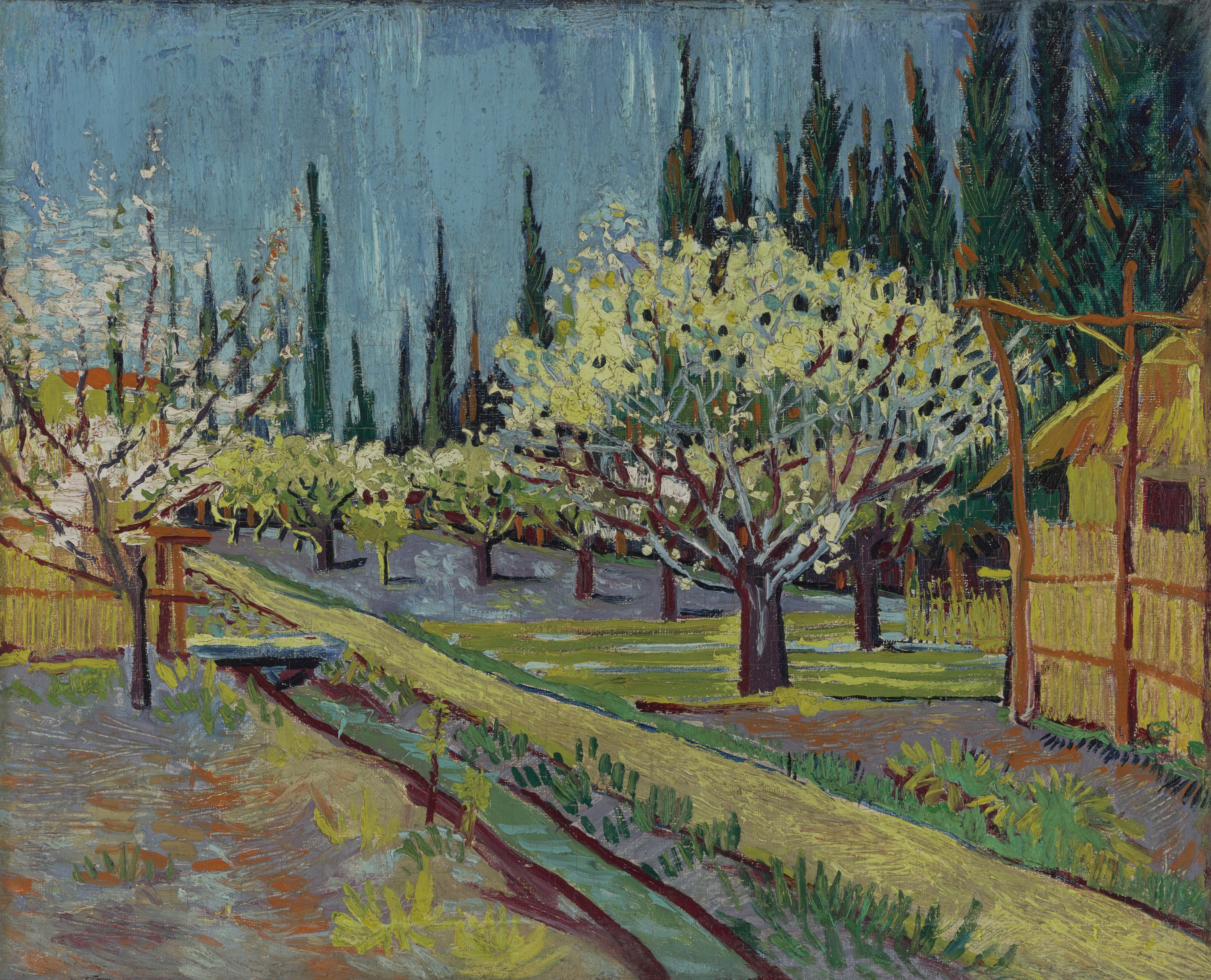
Vincent van Gogh (1853 – 1890), “Orchard Bordered by Cypresses,” (Arles, 1888, oil on canvas) Credit: Yale University Art Gallery, Promised Gift of William L. Bernhard, B.A.1954, and Catherine G. Cahill
· renewable energy sources are set to account for nearly 21 percent of the electricity the United States uses for the first time this year, up from about 18 percent last year and 10 percent in 2010
· renewable energy provides 18% of total U.S. power generation, up from 10% in 2010
· corporate PPA’s for renewal energy accelerated from 0.1 GW in 2010 to33.6 GW by year-end 2019, with a record breaking 13.6 GW in 2019 alone.
· the carbon intensity of the power sector continues to decline. From 2010 to 2019, power sector emissions fell nearly 25%
· total U.S. greenhouse gas (GHG) emissions have fallen 4.1% over thepast decade, and now sit at roughly 12% below 2005 levels
Art, philanthropy, energy. The relationships between them have history. As the way we generate energy evolves, the relationships between art, philanthropy, and energy will, in all likelihood, evolve as well.
Yves Tanguy (French, 1900-1955), “What” (oil on canvas, 1940), in the collection of the Museum of Fine Arts, Houston. The Joseph and Sylvia Slifka Collection. Object Number: 2004.146
“Houston,” observed Gary Tinterow, Director of the Museum of Fine Arts, Houston, in 2019, “is a cultural capital largely thanks to the discovery of oil.” (Houston Chronicle)
Yet, the energy economy is shifting in Texas. Renewable energy constitutes an ever increasing percentage of energy produced and used in Texas.
Texas, a competitive rather than regulated energy market, is first in the United States in wind power capacity and near to having the second-most capacity for solar PV after California.
Solar energy has a significant (“marvelous”) cost advantage over gas-fired power plants: the marginal cost of solar is zero. Texas is on course to build a quarter of the record new industrial-scale solar capacity being installed across the United States in 2020.
As the energy economy evolves, how will the philanthropy that supports so many museums and cultural institutions evolve?
Let’s begin our quest for understanding by taking a look at relationships between art, philanthropy, and energy. We’ll start by looking to Texas.
The U.S. state of Texas consumes the most electricity in the United States. Demand for energy in Texas has grown over five percent over the past five years even as it has declined nationwide (EIA as reported in the FT).
Adding
solar power through the incentives of a competitive electricity
market, Texas is near to having the second-most capacity for solar PV
after California. Texas, further, now ranks first in the United
States in wind power capacity.
Texas is home to the Museum of Fine Arts, Houston (MFAH). The MFAH is one of the largest museums in the United States. As of late 2011 it had the third-largest museum endowment.
The permanent collection of the MFAH consists of nearly 70,000 works from throughout the world, from antiquity to the present day (MFAH) .
Gary Tinterow, Director of the MFAH, grew up in Houston. He worked at New York’s Metropolitan Museum of Art for 28 years, serving from 2008 until his departure for Houston as chairman of the department of 19th-century, modern and contemporary art. Mr. Tinterow’s appointment as Director of the MFAH was finalized by the museum’s board of trustees in late November 2011. He started his new position in early 2012.
Richard D. Kinder, co-founder (February 1997) and now Executive Chairman of Kinder Morgan, Inc., one of North America’s largest energy infrastructure companies, serves as Life Trustee of the museum and Chairman of the Board of Trustees. Mr. Kinder served as chairman of the museum’s search committee that identified Mr. Tinterow as a candidate for the directorship of the museum.
The business of Kinder Morgan is involved primarily with oil, gas, and petroleum products. Kinder Morgan “owns an interest in or operates 83,000 miles of pipelines and 147 terminals. The company’s pipelines transport primarily natural gas, refined petroleum products, CO2 and crude oil and its terminals store, transfer and handle such products as gasoline, ethanol, coal, petroleum coke and steel.” (Kinder Morgan)
Mr. Kinder commended Mr. Tinterow: “Gary’s passion for the job and his encyclopedic knowledge were what convinced us. He has so many good ideas, and there is so much potential to make this one of the outstanding museums of the world.” (NYTimes)
For his part, Mr. Tinterow explained, “As sorry as I will be to leave the Met after 28 years, I think I’ve landed the best job in the world. It’s a matchless combination: a committed board, a passionate audience, a fine collection and an institution with the third-largest endowment in the country.” (NYTimes)
Mr.
Tinterow observed that the endowment of the Museum of Fine Arts,
Houston stood at $1 billion in December 2011 after the J. Paul Getty
Trust in Los Angeles, which oversees the J. Paul Getty Museum
(endowment: $4.8 billion) and the Metropolitan Museum of Art, New
York (endowment: $2.6 billion).
Asked in June 2019 after the relationship of the museum to energy companies and oil, Mr. Tinterow replied that he has “enormous respect for the energy industry.”
“Houston,” he continued, “is a cultural capital largely thanks to the discovery of oil.” (Houston Chronicle)
The Nancy and Rich Kinder Building, dedicated to art after 1900 from the MFAH collections, is scheduled to open in November 2020. Consisting of two floors and more than 100,000 square feet of exhibition space,the building will increase overall MFAH exhibition space by nearly 75%. (MFAH)
While the MFAH has benefited, and continues to benefit, from the business of oil, the mix of Texas energy is changing.
First in the United States in wind power capacity and near to having the second-most capacity for solar PV after California, Texas will build a quarter of the record new industrial-scale solar capacity being installed across the US in 2020 (EIA, FT).
The cost of solar has plummeted, with the average industrial-scale PV project just $0.80 per installed watt last year compared to $3.53/Win 2010, according to the “2020 Sustainable Energy in America Factbook”, produced for the Business Council for Sustainable Energy by BloombergNEF, that looks at the U.S. energy transition over the decade 2010 – 2020.
Solar has a significant cost advantage over gas-fired power plants. The marginal cost of solar is zero. “The key thing is they have a magnificent cost advantage over gas-fired power plants,” observes Edward Hirs, energy fellow at the University of Houston. “The marginal cost of solar is zero.” (FT)
Investors in renewable energy, with time horizons of more than a decade, moreover, like the stable returns of projects backed by long-term contracts. (FT)
Corporations are taking advantage of falling costs to sign long-term solar power purchase agreements. Of the record 13,600MW of clean energy deals that companies completed in the US in 2019, 5,500MW of deals were generated in Texas. The majority of the deals closed were based on solar energy according to the “2020 Sustainable Energy in America Factbook”.
Google, for instance, is committing to buy power from Texas solar plants.
Neha
Palmer, Google’s director of operations and head of energy
strategy, observes that “[Texas]
is a large, deregulated market. Users of electricity have a choice in
who they buy electricity from and the type of energy that they buy. I
think that’s been another driver of the large uptake of renewables
in the state.”
The solar energy travels from the Permian Basin in west Texas, where much of the investment in solar energy is taking place, to cities such as Dallas and Houston aided by special transmission lines. The state of Texas authorized the lines 15 years ago. Designed to handle wind power, they are now enabling the flow of solar also.
Largely disconnected from the interstate transmission networks to the east and west of Texas, the grid is exempted from federal oversight. It is operated by the non-profit body Ercot (Electric Reliability Council of Texas.
“The Ercot power market is designed to be the ultimate competitive market,” Mr Archer says. Chris Archer, head of Americas at Macquarie’s Green Investment Group, a solar and wind developer with projects in Texas.
“Generators are only paid for the energy that they sell, not for having capacity at the ready. Wholesale prices that average about $40 per megawatt-hour are allowed to climb as high as $9,000 per MWh when demand surges on the hottest afternoons, a potential windfall for generators. Solar farms’ output crests when the sun is highest, enabling them to participate in these sales.” (FT)
As renewables grow as a percentage of the energy mix in Texas, and elsewhere, we will follow the evolution of the relationship between art, philanthropy, and energy.
As
latent risks emerge, industry, business, and individuals adapt.
Opportunities, and benefits, are discovered in and developed from
such adaptation. Opportunities and benefits are discovered also in
forward-looking mitigation.
Inaugurated in 1970 by Basel gallerists Ernst Beyeler, Trudi Bruckner and Balz Hilt, owned and managed by Switzerland-based MCH Group, art fair giant Art Basel, facing health, travel, and concomitant business risks posed by the emergent Covid-19 virus, cancelled Art Basel Hong Kong 2020.
The Art Basel fairs, offered in Basel, Miami Beach, and Hong Kong, have succeeded as an effective venue for introducing galleries, works of art, and collectors to each other.
The fairs, while offering face-to-face interactions, are, however, premised on travel, often long-distance. The fairs are premised further on the gathering of large numbers of people together in one place at one time.
The travel and costs (staff, booth rentals, insurance, hotels and lodging, shipping of works of art, …) involved with the fair – and the many art fairs that have developed over the years – are expensive for galleries and collectors alike.
The travel, further, can increase risk. Combustion of hydrocarbon-based fuels releases carbon dioxide into the atmosphere.
Carbon dioxide molecules are precisely calibrated to attract and retain, in our atmosphere, photons of thermal energy that reach the earth from the sun. (See infographic.) Increasing levels of carbon dioxide in our atmosphere leads therefore to greater thermal energy (heat) in the atmosphere.
Increased atmospheric heat leads to consequences such as melting of arctic permafrost, melting of glaciers, sea level rise, fires, storms, the release of pathogens and concomitant health risks. (See infographic developed by Zurich-based reinsurance giant Swiss Re.)
With regard to large numbers of people gathering together in one place at one time, this currently may pose a risk of transmission of the emergent coronavirus (COVID-19).
To reduce such risk, the Swiss Federal Council, on 28 February 2020, issued an ordinance forbidding the holding of public or private events in Switzerland where more than 1,000 people are present at the same time.
MCH Group has, accordingly, not only cancelled Art Basel Hong Kong 2020 but has also postponed further events and trade shows such as the Baselworld Watch and Jewellery Show 2020 (until January-February 2021), the garden exhibition Giardina in Zurich, and Habitat-Jardin in Lausanne.
Fortunately there are means of bringing galleries, works of art, and collectors together that are premised neither on long-distance travel nor on the gathering in one place of multitudes of people.
Art Basel has been developing such a means, an initiative that, as “the art market continues to evolve, exemplifies its longstanding commitment to fostering a healthy art world ecosystem by creating new ways for its galleries to reach collectors from across the globe.”
The
initiative is a digital-only platform for Art Basel’s galleries and
collectors. The inaugural edition of Art Basel’s Online Viewing Rooms
are planned to go live on 20 March 2020.
“Online Viewing Rooms will give visitors the opportunity to browse thousands of artworks presented by Art Basel participating galleries, many of which will be online exclusives. The exhibiting gallery can then be contacted directly for sales inquiries. The Viewing Rooms will run in parallel to the three shows in Basel, Miami Beach, and Hong Kong.”
While recognizing “’the essential personal interactions that continue to underlie the art market,’” Art Basel Global Director Marc Spiegler notes that “’the Online Viewing Rooms will provide galleries with a further possibility for engaging with our global audiences.'”
All the galleries that were accepted for the cancelled 2020 Art Basel Hong Kong have been invited to participate, at no cost, in the launch of the Online Viewing Rooms.
Art
Basel is not the first to organization to provide a means for
galleries, works of art, and collectors to meet online. New
York-based Artsy has been doing so for several years.
The process of selecting works of art, acquiring them, and developing a collection requires intent, effort, patience, and work. Such work is conducted in increments over a long-term.
Relationships of mutual trust and reliance, between collectors, galleries, and dealers, some private, are developed.
Qualifications of all parties are established. Buyers and sellers alike vet each other for acknowledgement and understanding of contract law as well as willingness to agree and adhere to contractual terms.
As works of art are identified for purchase, high-resolution images taken from multiple angles can be shared. Condition reports, provenance, and valuations provided.
The process enables collectors to learn and value not only the aesthetic, historical, and, increasingly, financial qualities of such works of art but also the supply chain logistics.
Supply chain logistics are themselves complex, often crossing cultures, history, collections, sovereign entities such as cities, states, and nations, and laws.
Supply chain logistics and the logistics of collections management evolving to include collaborations not only with art professionals but also with those with in a variety of industries. These industries include science, tech, law, engineering, energy, water, design, architecture, finance, and, insurance.
Insurance especially in a new iteration: in regard to transparent, data-driven identification of risk together with public/private collaborations structured to foster preemptive mitigation of risk.
From quattrocento to early 19th century Europe, the term “Old Master” generally refers to artists of skill who, in theory, were fully trained “Masters” of their local artists’ guilds and worked independently.
In practice, works produced by pupils, workshops, and studios of Masters are included in the term.
The
term does not refer to a specific art historical style or movement.
Christie’s, using the term “Old Masters” to denote a category of painting that spans 500 years, is “redefining old masters for the 21st century global art market.”
Redefining, and re-positioning, the category for the 21st century global art market, the auction house is drawing interest from buyers in the contemporary art market and from around the world.
Prices for Old Masters paintings realized at Christie’s range from a few thousand dollars to the hundreds of millions.
An exceptional $450,312,500 /£342,182,751 (including buyer’s premium) was realized in New York on 15 November 2017 for “Salvator Mundi”.
“Salvator Mundi” (c. 1500), attributed to Leonardo da Vinci, was sold to Prince Bader bin Abdullah bin Mohammed bin Farhan al-Saud of Saudi Arabia, friend and associate of crown prince Mohammed bin Salman. The painting was earlier included in the National Gallery’s 2011-12 exhibition of Leonardo’s surviving paintings.
Artist
“Is the artist an established name? Is the work from a good or particularly pivotal moment in the artist’s career or development? Is the attribution given in full (or qualified as ‘Studio’/‘Circle’/ ‘Follower’ of the artist)? Is the work included inthe key literature on the artist — and if not, have the currentexperts been consulted? Has the work been included in any recentseminal exhibitions on the artist?”
Christie’s, “Old Master paintings: 5 things for a new buyer to consider”
Provenance
Which
collectors have been drawn to the work and “considered it worthy of
their collections”?
Which exhibitions has the work been included in and where?
Restored?
“Slightly neglected?” Rare?
“It is better to invest in a slightly neglected work, which can be treated relatively easily with sensitive restoration, than in one that has been subjected to numerous campaigns of restoration in the past, some of which may have resulted in the original surface beingabraded and over-painted. If in doubt, consult a restorer.”
Christie’s, “Old Master paintings: 5 things for a new buyer to consider”
In
terms of rarity, research how prolific the artist was and how
frequently his work appears on the market.
When
excellent condition and rarity combine, magic happens. Works can
realize exceptional prices.
Subject matter
Subject
matter includes royal sitters, historical figures, topographical
views, city views, university towns, landscapes, still lifes.
“‘Because we believe its physical products are going to be in increasing demand in the global economy over the coming decades,”
Harvard Management Co., the Harvard University endowment manager, likes the natural-resources asset class.
“In a warming planet, few resources will be more affected than water, as droughts, storms and changes in evaporation alter a flow critical for drinking, farming, and industry.
“Even though there aren’t many ways to make financial investments in water, investors are starting to place bets.
“Buying arable land with access to it is one way.
“In California’s Central Coast, ‘the best property with the best water will sell for record-breaking prices,’ says JoAnn Wall, a real-estate appraiser specializing in vineyards, ‘and properties without adequate water will suffer in value.'”
The Harvard Management Co. has, since 2012, been buying agricultural land, with rights to sources of water, on California’s Central Coast. The idea was pitched to Harvard by agricultural investment advisory firm Grapevine Capital Partners LLC, founded by Matt Turrentine, formerly of his family’s Central Coast grape-brokerage business, and James Ontiveros, a local vineyard manager.
“Harvard’s investing guidelines say respecting local resource rights are of increasing importance ‘in the coming decades as competition for scarce resources, such as arable land and water, intensifies due to increasing global population, climate change, and food consumption.’”
“Investors who see agriculture as a proxy for betting on water include Michael Burry, a hedge-fund investor who wager against the U.S. housing market was chronicled in the book and movie ‘The Big Short.’ In a 2015 New York Magazine interview, Mr. Burry was quoted as saying: ‘What became clear to me is that food is the way to invest in water. That is, grow food in water-rich areas and transport it for sale in water-poor areas.'”
“In California vineyards, the water-proxy math is compelling. When grapes are harvested, about 75% of their weight is water. Owning vineyards effectively turns water into revenue.”
“Kat Taylor, an environmentalist and wife of hedge-fund billionaire and liberal activist Tom Steyer, resigned earlier this year from Harvard’s board of overseers in protest of the endowment’s investments in things such as fossil fuels and water holdings she says threaten the human right to water.
“‘It may, in the short run, be about developing vineyard properties,’ she says of Harvard’s California investments. ‘In the long run, it was a claim on water.'”
Gerhard Richter’s “Schädel” (oil on canvas), the first of a series of eight skull paintings painted in 1983, was held in the same collection for 30 years after a last public exhibition in 1988.
Based on a photograph taken by Richter himself, the painting demonstrates a “dialogue between painterly abstraction and photo-realist representation that had been simmering across separate stands of Richter’s practice for nearly two decades.”
This painting led the Post-War and Contemporary Art Evening Sale held at Christie’s London on 4 October 2018.
With an unpublished estimate, the painting was expected to sell for between £12 and £18 million (US$15 – US$23 million).
Bidding reached £11.5 million. The painting was not allowed to change hands.
Note also the instance of Edward Hopper’s 1972 painting, “Portrait of an Artist (Pool with Two Figures)” that sold at Christie’s in New York on 15 November. It closed narrowly, at what may have been a precisely agreed threshold of $80 million – with what appeared to be Christie’s bidding against itself to reach the sales price.
“It’s really about bringing everyone together as an industry, and instead of having a few people talk about it, it’s having everyone talk about it and the leaders… actually taking responsibility, putting our money where our mouth is and making an amazing change together.”
– Stella McCartney, founder of eponymous fashion company and brand
Consumers, investors, and the fashion industry, when deciding how to spend and where to put their money, are demonstrating a commitment to changing lifestyle choices, changing behaviors, redefining value, reducing emissions of atmospheric CO2 and greenhouse gases, and mitigating human-induced climate change.
The broader textile, clothing and fashion industry have worked during 2018 to specify ways in which, drawing on methodologies from the Science-Based Targets Initiative, they can direct themselves towards a holistic commitment to climate action, achieving net-zero emissions of atmospheric CO2 and greenhouse gases by 2050, while expanding economic opportunity and driving economic competitiveness and innovation.
The apparel and footwear industries together accounted in 2016 for an estimated 8.1% of global climate impacts with emissions of 3,990 million metric tons CO2eq (including emissions generated by processes used for raw material extraction, raw material processing, manufacturing, assembly, packaging production, transportation/distribution, and end-of-life).
The Ellen Macarthur Foundation estimates that “if nothing changes, by 2050 the fashion industry will use up a quarter of the world’s carbon budget.”
“It’s really about bringing everyone together as an industry, and instead of having a few people talk about it, it’s having everyone talk about it and the leaders… actually taking responsibility, putting our money where our mouth is and making an amazing change together.”
“There is no shortage of capital in the world that wants to go in this direction. The hearts and minds argument of the common man on the street, has been won. My feeling is that what the financial services business needs to do, is to be working with the real innovative companies of today,” said David Fass, Macquarie Group CEO for Europe the Middle East and Africa.
The founding signatories to the Fashion Industry Charter for Climate Change Action are: adidas, Aquitex, Arcteryx, Burberry Limited, Esprit, Guess, Gap Inc., H&M Group, Hakro Gmbh., Hugo Boss, Inditex, Kering Group, Lenzing AG, Levi Strauss & Co., Mammut Sports Group AG, Mantis World, Maersk, Otto Group, Pidigi S.P.A, PUMA SE, re:newcell, Schoeller Textiles AG, Peak Performance, PVH Corp., Salomon, Skunkfunk, SLN Textil, Stella McCartney, Sympatex Technologies, Target and Tropic Knits Group.
· the Paris Agreement represents a global response to the scientific consensus that human activity is causing global average temperatures to rise at unprecedented rates
· goals agreed in the Paris Agreement translate to reaching climate neutrality [read: reduced to zero emissions of atmospheric CO2 and other greenhouse gases from sourcing, manufacturing, distribution, use, and end-of-life of materials and products; reduced to zero use of hydrocarbon-based sources of energy in operations, manufacturing, distribution, retail, transport, etc.] in the second half of the twenty-first century. The fashion industry, as a major global player, needs to take an active part in contributing to the realization of these goals
· all companies, within fashion, retail and textile global value chain, regardless of size and geography, have opportunities to take actions that will result in a measurable reduction in greenhouse gas (GHG) emissions
· establish a closer dialogue with consumers to increase awareness about the GHG emissions caused in the use and end-of-life phases of products, building towards changed consumer behaviors that reduce environmental impacts and extend the useful life of products
· current solutions and business models will not be sufficient to deliver on the current climate agenda. Fashion industry needs to embrace a deeper, more systemic change and scale low-carbon solutions
· the fashion industry stakeholders have a role to play in reducing climate emissions resulting from their operations, with an awareness that the majority of climate impact within the industry lies in manufacturing of products and materials
· all companies, within fashion, retail and the textile global value chain, regardless of size and geography, have opportunities to take actions that will result in a measurable reduction in greenhouse gas (GHG) emissions
· actions that reduce GHG emissions are consistent with, among other things, expanding economic opportunity, using resources more efficiently, driving economic competitiveness and innovation, and strengthening resilience
· responding to climate change requires action on both mitigation and adaptation
[Signatories agree to]
11. Establish a closer dialogue with consumers to increase awareness about the GHG emissions caused in the use and end-of-life phases of products, building towards changed consumer behaviors that reduce environmental impacts and extend the useful life of products;
12. Partner with the finance community and policymakers to catalyse scalable solutions for a low-carbon economy throughout the sector
Plants need carbon dioxide to live, but its effects on them are complicated.
As the level of carbon dioxide in the air continues to rise because of human activity, scientists are trying to understand how the plants we eat are being affected.
According to recent studies, rice, wheat, and other staple crops lose nutrients when exposed to levels of carbon dioxide in the atmosphere expected by 2050.
Samuel Myers, principal research scientist at Harvard’s School of Public Health and director of the Harvard-based Planetary Health Alliance and colleagues have conducted studies in which crops are grown bathed in air that simulates the predicted atmospheric conditions expected both by 2050 and by the end of the 21st century. The studies showed declines in protein, iron, and zinc in wheat, and declines in iron and zinc in soybeans and field peas.
The scientists compared nutrient levels in field crops grown in ambient CO2 levels, about 380-390 parts per milliion (ppm) at the time of the work, with those grown in the elevated CO2 levels expected by 2050. The latter level, 545-585ppm, is expected even if substantial curbs on emissions are put in place by the world’s governments. In order to take account of variable growing conditions, the researchers analysed 41 different strains grown in seven locations on three different continents.
Wheat grown in high CO2 levels had 9% less zinc and 5% less iron, as well as 6% less protein, while rice had 3% less iron, 5% less iron and 8% less protein. Maize saw similar falls while soybeans lost similar levels of zinc and iron but, being a legume not a grass, did not see lower protein.
The precise biological and physiological mechanisms that cause nutrient levels to fall when CO2 levels increase are not yet well understood.
California, in so many ways, could learn from the US Northeast.
To reduce CO2 and and greenhouse gas emissions from cars, a continuing and increasing issue in California and elsewhere, cities need data—ways to accurately measure emissions, pinpoint sources, and monitor change over time; cities need to know how much CO2 they are producing and reducing.
A tool called ACES (Anthropogenic Carbon Emissions System) was developed in response to the requirement for data by researchers at Boston University and Harvard. ACES offers finely-grained maps of CO2 emissions, with a resolution of 1km2, totaled hourly.
As we know, per our atmosphere – the air, its particular mix of gaseous elements, and its temperatures, together vital to life, inclusive of human, animal, and plant – CO2 and other greenhouse gases are an issue, in many ways.
California has “targets” to meet by the year 2020 for limiting the greenhouse gases associated with the driving that people do on a daily basis. The approach to greenhouse gases associated with the driving that people do on a daily basis has a heightened level of complexity in California. Driving a car, rather than availing oneself of public transportation such as a subway, metro, or bus, is a norm that people are highly unwilling and actually afraid to examine and rethink. The many localities within the state have made limited investment in public transportation in significant part because taking such modes of transportation is largely considered to be beneath the dignity – whether personal, social, or professional – of and compromising to anybody with a sense of self esteem.
While the “hope” has been that climate emissions might be curbed largely by promoting regional planning of denser development along transit lines ( S.B. 375, the Sustainable Communities and Climate Protection Act, a landmark 2008 deal, with the California legislature recognizing the critical role of integrated transportation, land use, and housing decisions to meet state climate goals), the California Air Resources Board 2018 Progress Report released in November documents that driving of cars has skyrocketed statewide during the years following the recession of 2008 – 2009 through 2016.
A “key finding of this report is that California is not on track to meet the greenhouse gas reductions expected under SB 375 for 2020, with emissions from statewide passenger vehicle travel per capita increasing and going in the wrong direction” (page 4) and “emissions from the transportation sector continuing to rise despite increases in fuel efficiency and decreases in the carbon content of fuel” (page 5).
Top air quality officials in California state they currently have no way to fully assess whether regions from San Diego to Sacramento are on track to meet 2020 targets for reigning in greenhouse gases associated with daily driving. While “greenhouse gas emissions considered under the SB 375 program reflect carbon-dioxide (CO2) emissions only from light-duty passenger vehicles” (page 21, footnote 22), the California Air Resources Board 2018 Progress Report states, “SB 375 passenger vehicle greenhouse gas emissions reductions cannot be directly measured because greenhouse gas emissions come from many sources” (page 21).
Air board officials said that while they tracked the key metric of vehicle miles traveled, or VMT, available statewide through fuel sales, that same information wasn’t available regionally. Without that, officials say there is no consistent way to extrapolate greenhouse gas emissions from driving for each region.
“There’s no unifying way to bring it all together and say ‘You’re at this particular performance metric,’” said Nicole Dolney, chief of the air board’s transportation planning branch. “Our hope was that we would have VMT data that we could rely on, but it wasn’t there.”
So what might California learn from ACES?
“For cities to cut down CO2, they need to know how much they are producing and reducing. Most cities get rough estimates with “carbon calculators” that account for the size and population of a city, electricity used, and an estimate of how many cars zip (or crawl) through the city streets.
“The calculation would be fine except for all those cars. Cars are the hardest part of the emissions equation to quantify. They are moving all the time at different speeds, and there are different cars on the road at different times of day.”
“There are other factors to consider. There’s the make of the car, of course: a Toyota Prius gives off less CO2 than a Chevy Silverado. There’s also the speed; most cars give off the least CO2 when cruising in a “sweet spot” between 40 and 60 miles per hour.”
(Conor Gately, co-developer of ACES; PhD, Geography and Environment, Boston University, 2016; lead author on a study examining cities, traffic, and CO2,published in the Proceedings of the National Academy of Sciences (PNAS) in April 2015.)
ACES (Anthropogenic Carbon Emissions System) has been developed by Lucy Hutyra of Boston University and Conor Gately, now a postdoctoral associate working jointly at Boston University and Harvard. A tool for measuring and mapping CO2 emissions, ACES offers finely-grained maps of CO2 emissions, with a resolution of 1km2, totaled hourly, is relevant and could be helpful to the cities and the state of California.
“Cities have the political will to change emissions, and they have policy levers to pull,” says Lucy Hutyra, a Boston University College of Arts & Sciences (CAS) associate professor of Earth and environment. And because cities are responsible for 70 percent of greenhouse-gas emissions, according to the United Nations, their actions matter. But to take effective action, cities need data—ways to accurately measure emissions, pinpoint sources, and monitor change over time. And so Hutyra and her colleague Conor Gately have developed a tool called ACES, for Anthropogenic Carbon Emissions System, that offers the finest-grained maps of CO2 emissions in the Northeastern US to date, with a resolution of 1km2, totaled hourly. The tool, funded by NASA’s Carbon Monitoring System and detailed in the October 12, 2017, issue of the Journal of Geophysical Research—Atmospheres, could provide valuable data to cities nationwide.
“‘The goal was to take the finest grained, most local data possible and build a ‘bottom-up’ inventory,” says Gately. The research team started by divvying up the sources of emissions on a giant whiteboard. “We did every sector of emissions of CO2,” he says. “Roads, residential buildings, commercial buildings, industrial facilities, power plants, airports, marine ports, shipping, and railway.” The group searched for data from 2011, scouring every source they could find: city and country records, household fuel estimates, EPA databases, hundreds of traffic sensors located around New England. All of these data, when combined with the amount of fossil fuels consumed in the region (gasoline, diesel, home heating oil, coal and natural gas for power generation), allowed the team to calculate CO2 emissions for all of the major sources. The team then calculated emissions for every hour of the year.
“Gately, working with a three-year, $1.5 million grant from the National Oceanic and Atmospheric Administration, is now expanding ACES to cover the entire continental United States and meeting with government, scientific, and policy stakeholders to help create a core set of methods and data products.”
DARTE might also be helpful. DARTE, the Database of Road Transportation Emissions (Conor Gately, Lucy Hutyra, Ian Sue Wing) is available for free download from the Harvard Dataverse
Funded by grants from the National Aeronautics and Space Administration (NASA), the National Science Foundation (NSF), and the Department of Energy (DOE), Gately has developed a more precise way to tally CO2 emissions from vehicles. He used 33 years of traffic data to build the Database of Road Transportation Emissions (DARTE), which displays CO2 data for the contiguous US on a finer scale than ever before—a one-kilometer grid. (He hopes to add Alaska and Hawaii later.) Available for free download, DARTE could change the way cities and states measure greenhouse gas emissions.
“The science is coming together to bring us very fine measurements in a way never possible before,” says Lucy Hutyra, an assistant professor of earth and environment and a coauthor on the PNAS study. Hutyra says that DARTE complements NASA’s Orbiting Carbon Observatory 2, which is collecting global data on atmospheric carbon dioxide. “We need good bottom-up data to match what we’re measuring looking down from space. That’s what we need to really advance greenhouse gas policies.”
While the olive tree was first domesticated in the Eastern Mediterranean between 8,000 and 6,000 years ago, the earliest written mention of olive oil that we have on record is on cuneiform tablets of the twenty-fourth century BC at Ebla (in today’s Syria, about 55 km southwest of Aleppo).
Olive oil took a central place in Greek sports, performed in the nude. Nigel Kennell, a specialist in ancient history at the American School of Classical Studies at Athens, links that centrality to the rise of bronze statuary in the sixth century B.C. “A tanned athlete, shining in the summer sun, covered with oil, would really resemble a statue of the gods.”
Olives were a cash crop in the Roman Empire by the first century AD, olive oil was traded internationally. The family of Septimus Severus, emperor of Rome from 193 to 211 AD, traded olive oil from Leptis Magna, a city in the Tripolitania region of North Africa (now Libya). Emperor Septimus Severus was the first to introduce regular free distribution of olive oil in Rome.
Today, demand for high-quality olive oil is on the rise. As of 2012, the American market, the largest outside Europe, was worth about $1.5 billion and growing at a rate of about 10% per year.
Over a five-year projection period of 2017-2022, the global olive oil market is projected to reach approximately US$11 billion by end-2022.
So, what is olive oil? What is meant by “extra-virgin” olive oil?
The olive is a “dupe.” A dupe is a stone fruit with a pit, like a cherry.
The olives are harvested at the moment of the invaiatura, when they begin to turn from green to black; ideally they are picked by hand and milled within hours, to minimize oxidation and enzymatic reactions, which leave unpleasant tastes and odors in the oil.
There are approximately seven hundred olive varieties, or cultivars, whose distinctive tastes and aromas are evident in oils that are made properly, just as different grape varietals are expressed in fine wines.
The best olive oils are unlike most vegetable oils that are extracted in a refinery from seeds or nuts, using solvents, heat, and intense pressure.
More like fresh-squeezed fruit juice, the best olive oils are made using a simple hydraulic press or centrifuge.
Extra-virgin olive oil, that must be totally unprocessed, is the highest-quality olive oil. During the physical extraction process, extra-virgin olive oil must be kept below 75 degrees Fahrenheit at all times. Extra-virgin olive oil must, further, meet strict chemical criteria as defined by the International Olive Oil Council and adopted by the European Union and USDA, and have flavor and aroma as determined by a certified tasting panel.
According to E.U. law, extra-virgin oil must be made exclusively by physical means (by a press or a centrifuge) and meet thirty-two chemical requirements, including having “free acidity” of no more than 0.8 per cent. (In olive oil, free acidity is an indicator of decomposition.)
According to the E.U. regulations, extra-virgin oil must have appreciable levels of pepperiness, bitterness, and fruitiness, and must be free of sixteen official taste flaws such as “musty,” “fusty,” “cucumber,” and “grubby.”
The next lower grade of olive oil is virgin oil. Virgin oil must have no more than two percent of free acidity. Oil that has a greater percentage of free acidity is classified as lampante.
New milling technologies—stainless steel mills, high-speed centrifuges, temperature- and oxygen-controlled storage tanks—are making it possible to produce the best extra-virgin olive oils in history: fresh, complex, and every bit as varied as wine varietals. (There are about seven hundred different kinds of olives.)
There’s also massive output of low-grade olive oils. Some producers are selling these as extra-virgin olive oil even though these low-grade oils do not meet the requirements of the extra-virgin grade. (E.U. and U.S. trade standards require extra-virgin olive oil to be free of sensory defects, and these oils are deeply flawed.) This is creating a downward pressure on olive oil quality.
Given that so many “extra-virgin” oils are actually inferior oils cut with other products, where should the average shopper buy his oil?
Ideally, at a mill, where you can see the fresh olives turned into oil, and get to know the miller—in an industry where the label means so little, personal trust in the people who have made and sold it is important. Barring this, try to visit a store where you can taste before you buy; an increasing number of olive-oil specialty stores exists throughout America, even in small towns and unexpected corners of the country. In a conventional retail store, certain characteristics of labelling and bottling suggest (though they don’t guarantee) high quality: a harvest date (as opposed to a meaningless “best by” date), a specific place of production and producer, mention of the cultivar of olives used, dark glass bottles (light degrades olive oil), a D.O.P. seal on European oils, and a California Olive Oil Council seal on oil made in the U.S.