
‘Construction fever’ responsible for one fifth of China’s CO2 emissions

‘Construction fever’ responsible for one fifth of China’s CO2 emissions

Carbon Brief, Josh Gabbatiss

***

The construction and demolition of buildings in China was responsible for nearly a fifth of the nation’s annual CO2 emissions in 2015, according to a new study.

The world’s largest emitter has seen building rates soar as existing structures are torn down and replaced with skyscrapers to house the nation’s rapidly urbanising population.

All of this comes with a significant carbon footprint, both to produce the cement, steel and other materials required and from the emissions produced once the project is underway.

The researchers behind the new study, published in the Journal of Cleaner Production, say this has not received enough attention in China, despite being an “unignorable and critical” component of the nation’s emissions.

However, other academics Carbon Brief talked to said that while China’s construction “boom” is undoubtedly carbon-intensive, there are “issues” with the methods used in this analysis.

‘Construction fever’

A growing urban population and land scarcity have contributed to significant growth in construction – particularly of high-rise buildings – across China.

Since 2010, China has been responsible for around half of the world’s growth in construction, with many buildings only standing for around 30 years before being demolished. 

Their construction, maintenance and demolition all come with a carbon cost. Previous studies have estimated that the energy consumption of China’s building sector has more than tripled since 2001.

Xinyi Shen from Greenpeace East Asia tells Carbon Brief that, given this, it is not surprising that China’s “construction fever” is a primary driver of its emissions.

However, in the new study, a team led by PhD candidate Weina Zhu of Tsinghua University, make the distinction between “operational” and “embodied” CO2 emissions, emphasizing the need to focus on the latter.

Embodied CO2 is defined in the paper as total emissions from “building materials manufacturing and transportation, building construction, maintenance and demolition”. Operational emissions are those arising from day-to-day energy use – for example, lighting, heating and cooling.

The authors say that operational carbon is generally assumed to be the primary contributor to the sector’s emissions, meaning strategies have focused on improving the energy efficiency of buildings.

However, they say that if China is to hit its climate target of peaking emissions in 2030, it will need to make embodied emissions a priority.

Time lapse showing the development that has taken place in Shanghai between 1984-2018. Source: Google Earth Engine

Bottom-up and top-down

The researchers looked at building activity throughout 2015, a year when Chinese economic stimulus – and the construction it helps drive – was reportedly at relatively low levels.

To estimate the embodied CO2 for construction that year – excluding civil engineering projects, such as bridges and roads – the researchers used two different approaches.

First, they used a process-based assessment. This was a “bottom-up” method that involved working out the total emissions of all the processes feeding into Chinese construction, from chemical reactions in cement factories to machinery used on building sites.

For the second assessment they used an input-output model. This was a “top-down” approach for which the team took national data and isolated the relevant components.

One of the paper’s co-authors, Dr Wei Feng, tells Carbon Brief this is “the first systematic analysis” of China’s embodied CO2 emissions using both of these methods.

Results based on the process approach showed that the embodied carbon in the Chinese building sector for that year was 1,422m tonnes of CO2 (MtCO2), while the input-output method settled on 1,600MtCO2.

Based on the upper estimate, they note this was approximately 18% of total Chinese emissions reported in 2015.

Residential buildings had around twice the emissions cost of non-residential buildings. The study notes how China’s housing has shifted from brick and wood to reinforced concrete and steel high-rise structures.

Crucially, the researchers say their estimate puts embodied CO2 roughly on a par with past estimates of operational CO2.

Dr Francesco Pomponi, an engineer at Edinburgh Napier University who was not involved in the study, tells Carbon Brief this seems more plausible than many other comparisons between operational and embodied CO2:

“Previous assessments we have had suggested 20% embodied, 80% operational or less than that, whereas this study is pointing towards a more realistic picture – about half and half.”

As a comparison, a report from last year by the World Green Building Council concluded 11% of annual global emissions were from carbon embodied in building construction processes. Nearly three times as much came from operational building emissions.

While around 10% of European states’ annual emissions can be traced to embodied building carbon, Pomponi says a value of roughly double this seems accurate for an economy such as China.

“I go every year so I see the difference year after year in how much built stock was added in 12 months,” he says.

‘Red flags’

However, Dr Jannik Giesekam, an industrial climate policy researcher at the University of Leeds who has worked extensively in this area but was not involved in the study, tells Carbon Brief he identified numerous “red flags” in the research.

While he thinks the researchers probably arrived at the right “ballpark figure”, he has “major” issues with the paper that he thinks compromise the results.

One of the key points he identified was that the paper overlooked a lot of pre-existing work on embodied carbon, including databases prepared by industry “in favour of a selective set of case studies”.

He also says the paper does not make a comparison with previous estimates for China or to previous systematic reviews prepared by the likes of the International Energy Agency (IEA).

While acknowledging some of these points as valid, Feng says they chose case studies that reflect current Chinese common practices and that they could not retrieve the relevant emissions data from the industry databases Giesekam suggests. 

“Overall, it would be different and unrealistic to use international emission data and best practices to represent China’s emission in 2015,” he tells Carbon Brief.

For his part, Pomponi says that while Giesekam’s criticism is valid, he sees things “slightly differently”. He says: “I think it’s impossible that a study incorporates everything that’s out there.”

Giesekam also notes what he sees as some unusual choices in the way the researchers carried out the study, including a lack of detail in both their “bottom-up” and “top down” calculations – for example, giving all steel the same “carbon factor”.

Feng says that while they would “love this study to go deeper” and describes his team’s work in this area as on-going, he notes they used a “simple approach” that involved taking averages of steel and cement data:

“That is why we also employ a top-down method to cross-validate the bottom-up method calculation to make sure the total emission results match with each other.”

To this point, Pomponi tells Carbon Brief it is “inevitable to sacrifice depth for breadth in academic research” and says that, while there are certainly issues with the paper, he thinks it is valuable to see different methods being used to assess embodied carbon:

“It’s really good they used two [approaches] and compared them. They are extremely different methods so it’s good that they seem to point to the same number.”
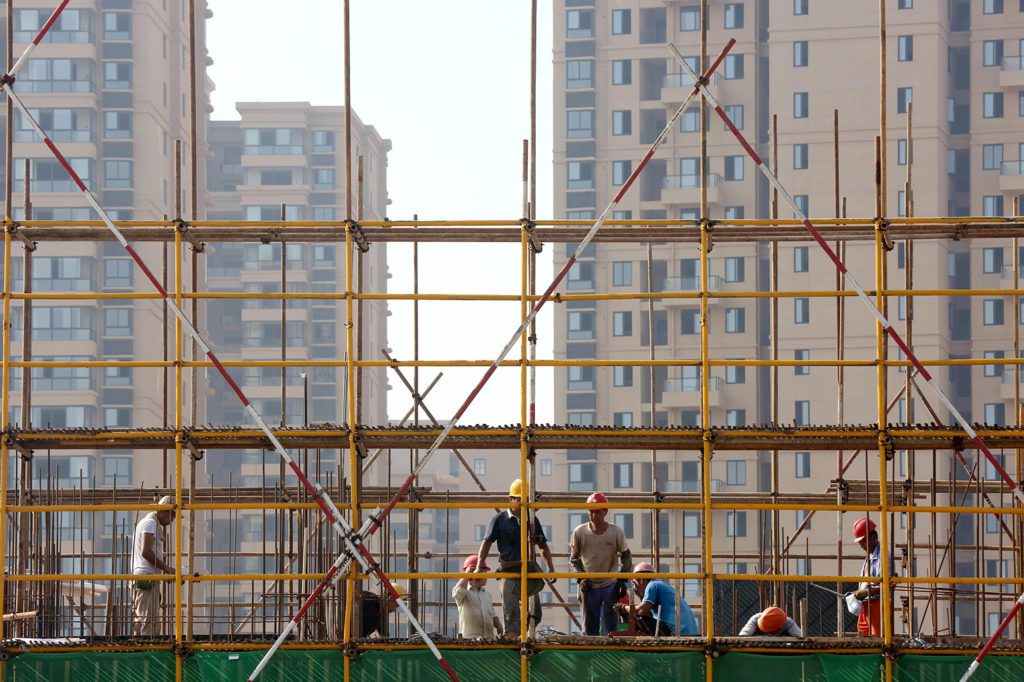
Construction workers on a residential building site in Huaian city, China. Credit: Imaginechina Limited / Alamy Stock Photo.

Cutting embodied CO2

The researchers say that on a global scale, the relatively limited attention paid to embodied carbon is preventing an accurate assessment of the building sector’s environmental impacts.

Dr Danielle Densley Tingley, an architectural engineer at the University of Sheffield who was not involved in the work, says these emissions are generally not given sufficient attention by nations setting climate targets. She tells Carbon Brief this is partly due to the way they are reported:

“They’re often lumped into ‘industrial emissions’. This focuses on the production of the materials – where there are only small efficiencies left to gain – but doesn’t really look at how the materials are then used, what is driving their consumption etc.”

She says better design and a focus on “deep retrofits” instead of demolition would help cut embodied emissions in buildings. Pomponi agrees that design lies at the heart of this issue:

“At the moment we are inefficient in the sense that we put more material than is actually needed into buildings … Firms tend to go with ‘rules of thumb’ or things that worked in the past rather than starting from scratch.”

Measures have been proposed to cut these emissions in some countries. The World Green Building Council has set a target of 40% less embodied carbon in all new buildings, infrastructure and renovations by 2030.

The authors of the new study estimate that, despite a focus on operational carbon emissions in China, the annual potential for reductions in the building sector could actually be larger for embodied than operational CO2.

Greenpeace East Asia’s Shen says that after years of intensive construction the situation is shifting and, going forward, the Chinese authorities are going to have to be “extremely careful” about what they build:

“The country has entered into a new stage of development in that blindly putting up more infrastructure is not only environmentally unsustainable but also will not keep the same investment return the country yielded in the last decades.”

Zhu, W. et al. (2020) Analysis of the embodied carbon dioxide in the building sector: A case of China, Journal of Cleaner Production, doi.org/10.1016/j.jclepro.2020.122438

***

‘Construction fever’ responsible for one fifth of China’s CO2 emissions

Josh Gabbatiss

Originally published under a CC license by Carbon Brief on 9 June 2020

Published under a CC license. You are welcome to reproduce unadapted material in full for non-commercial use, credited ‘Carbon Brief’ with a link to the article.

elegance in design & engineering meets recycling

Ten years in the making, a public-private partnership between the New York City Economic Development Corporation and Sims Municipal Recycling, a division of Sims Metal Management, designed and master-planned by Selldorf Architects, New York City’s 11-acre South Brooklyn Sunset Park Material Recovery Facility performs.

Opened in December of 2013, the 140,000-square-foot facility is the principal processing facility for all of New York City’s residential metal, glass, and plastic recyclables. The facility has the capacity to process 1,000 tons of recyclable material every day.

Selldorf Architects (architect to museums and galleries worldwide, including the Museum of Contemporary Art San Diego) organized the buildings to create the site’s own urban context and designed the facility to optimize environmental performance.

The buildings are made from 99% recycled American-made steel. The buildings, wharf, recycling equipment, and electrical substations are elevated four feet – using a blend of recycled glass and crushed stone from Second Avenue subway tunneling operations – to prevent damage from sea level rise and storm surges. New York City’s first commercial-scale (100 kW) wind turbine and the City’s largest solar installation (600 kW) generate energy on site. On-site storm water management is included as are two acres of native plantings.

Access by barge will help eliminate 150,000 annual truck trips (240,000 truck miles). Newly-renovated freight rail will be used for the export of processed recyclables.

See:

Sustainability and Design Tour of Sunset Park Material Recovery Facility” | AtlasObsura, May 2017

Selldorf Architects’ Sunset Park recycling facility in Brooklyn sets a new standard in sustainable design” | Pei-Ruh Keh, Wallpaper, 13 December 2013

Mayor Bloomberg, Deputy Mayor Holloway and Sanitation Commissioner Doherty Announce Opening of New State-of-the-Art Recycling Facility – Able to Process Metal, Glass and All Plastics in One Location” | Office of the Mayor, City of New York, 12 December 2013

Sunset Park Material Recovery Facility” | Selldorf Architects

Sims Municipal Recycling

Sims Recyling Solutions

Sims Metal Management

#sunsetparkmaterialrecoveryfacility #Brooklyn #NewYork #NewYorkCity #SimsMetalManagement #SimsMunicipalRecycling #SelldorfArchitects #NYCEconomicDevelopmentCorporstion #recycling #architecture #design #art #museums #galleries #luxury #smartluxury #urbanluxury #resilience #energy #solar #solarenergy #windenergy #engineering #construction #buildingtech #tech #sealevelrise #stormsurge #CO2 #H2O #realestate #commercialrealestate #CRE #finance #ROI

SFMOMA・optimizing for sustainability was the fun part

After three years of construction under the direction of architectural firm Snøhetta and environmental design firm Atelier Ten, the expanded and high-performing San Francisco Museum of Modern Art (SFMOMA) opened to the public in May of 2016.

Doubling the size of the museum and tripling gallery space, the museum achieved and surpassed LEED gold, working towards maximum sustainability. Optimizing for maximum sustainability was the fun part.

Building on the the science of conservation, born out of the World-War-II-era movement of London artworks to slate caves in Wales, and on the San Francisco mandate that all new construction meet USGBC LEED gold criteria, the SFMOMA initiated a Sustainability Roundtable to research solutions that would work for the museum. Participants in the Sustainability Roundtable included museum staff and representatives from Atelier Ten, Snøhetta, Taylor Engineering, The Getty, Boston’s Museum of Fine Arts (MFA), the Indianapolis Museum of ARt, and Stanford University’s Anderson Collection.

Testing approaches and combinations of approaches iteratively, the group determined to optimize “seasonal set points” and customized every aspect of the structure’s design and systems including mechanical, lighting, water, and HVAC.

See:

Optimize, Optimize, Optimize: Museum Conservation in the LEED Era” | Lindsey Westbrook, freelance editor and writer specializing in art, architecture, and design; clients include SFMOMA, SFMOMA

SFMOMA reopens with Snøhetta extension that triples its gallery space” | Dan Howarth, Dezeen, 28 April 2016

#art #museums #artmarket #SFMOMA #SanFrancisco #architecture #design #resilience #builtenvironment #buildingtech #construction #tech #energy #conservation #luxury #smartluxury #urbanluxury #realestate #LEED #Snøhetta #AtelierTen #TaylorEngineering #Getty #MFABoston #IndianapolisMuseumofArt #AndersonCollection #CO2 #H2O #collectionsmanagement #contemporaryart #engineering

towards ‘net zero’ construction for all buildings

“Our vision is to create possibilities to make net zero construction in an efficient way, giving everyone the possibility to do so.”

So articulates Jonathan Karlsson, Founder and CEO (with degrees in theoretical and construction physics) of Innenco, an international company based in Malmö, Sweden that performs.

Reports Inhabitat,

“It starts with their active systems: pipes are integrated into the frame construction to utilize a building’s thermal mass. Adding heat pumps and chillers to the system allows Innenco to get four to six times greater efficiency in heating and cooling. At this point they’re able to reduce energy by 85%, so to cover the last 15% they install Innenco Quantum Solar panels. ‘This makes an investment in solar cells much lower than a traditional system, and we can get net zero for a really cost-efficient investment.'”

See:

This new energy concept from Sweden can make any building net zero” | Lacy Cooke, Inhabitat, 11 October 2017

Innenco

#Innenco #Malmö #Sweden #JonathanKarlsson #architecture #design #energy #netzero #CO2 #H2O #buildingtech #tech #physics #builtenvironment #resilience #thermalmass #efficiency #energyefficiency #costefficiency #performance #luxury #smartluxury #urbanluxury #urbanliving #realestate #finance #ROI #construction #Inhabitat

valuing climate-related risks, investing well, & avoiding stranded assets

The Task Force on Climate-Related Financial Disclosures (TCFD, @FSB_TCFD) has published a new report on June 29. The report is published as part of a G20 initiative led by the governor of the Bank of England Mark Carney and the former mayor of New York City Michael Bloomberg.

The report provides a framework for companies to disclose in their financial filings all of their direct and indirect greenhouse gas emissions and describe the risks and opportunities caused by climate change under a range of potential scenarios. The objective of such disclosures would be to allow economies to properly value climate-related risks and to help minimize the risk, to investors, banks, and insurers, that market adjustments to climate change will be incomplete, late and potentially destabilizing.

Importantly, the report recommends that banks should disclose lending to companies with carbon-related risks.

Climate change presents global markets with risks and opportunities that cannot be ignored. The framework can be of assistance to investors (such as banks, pension funds, sovereign wealth funds, university endowments, investors in commercial real estate, and homeowners) as they evaluate the potential risks and rewards of a transition to a lower carbon economy and avoid investing in assets that might become stranded, non-performing (such as non-performing loans made to entities that are cash-strapped due to rising carbon costs or houses and buildings that themselves cannot perform and/or are difficult or impossible to sell).

While the report’s recommendations are intended to be adopted by all companies, extra guidance is given to the financial sector. Other sectors, likely to be most affected by climate change and/or the transition to a lower carbon economy, are also given extra guidance. The other sectors likely to be most affected by climate change and/or the transition to a lower carbon economy include energy, transportation, construction, and agriculture, food, and forestry.

Christian Thimann, Group Head of Regulation, Sustainability and Insurance Foresight, AXA Group and a member of the TCFD, observes that insurers “see the frequency and intensity of natural disasters linked to climate change augmenting every year.” “Insurers,” Dr. Thimann says,
consider a world of plus two degrees may still be insurable but a world of plus four degrees might not be.”

Dr. Thimann notes that while banks have a shorter outlook than insurers

  • Banks “too can use these recommendations because they will need to steer their lending between sectors aligned with a 2-degree world and sectors not aligned. They need to know which are the sectors with a high risk of stranded assets in the future and those with a low risk of stranded assets in the future.”


See:

Banks should disclose lending to companies with carbon-related risks” | Michael Slezak, The Guardian, 29 June 2017

#TCFD #MarkCarney #BankofEngland #NYC #MichaelBloomberg #climatechange #climaterisk #strandedassets #banks #investors #finance #insurance #AXA #lowcarboneconomy #energy #transportation #construction #agriculture #food #forestry#realestate #homeownership #museums #artcollections #art

21st c building design & construction ・re-exploring wood & rammed earth

While concrete, glass structures, polished stone walls, brick facades and steel beams now prevail in urban design, wood and rammed earth are getting attention.

The use of steel in urban buildings began with the production of steel in bulk. Mass production of steel was enabled by Henry Bessemer’s development of the Bessemer converter in 1857. Once steel could be produced in bulk, it became cheaper and easier to obtain.

The 10-story Home Insurance Building, completed in 1885 in Chicago, was the first building in the world to use structural steel in its frame. Due to its architecture and weight-bearing frame, the building is considered the world’s first “skyscraper.”

The 16-story Ingalls Building, built in Cincinnati, Ohio in 1903, became the world’s first reinforced-concrete skyscraper.

The production of steel and the production of concrete are, however, both energy intensive and carbon intensive. Steel and concrete have high levels of embedded energy. Neither steel nor concrete are renewable.

As of 2014, 54% of the world’s population lives in urban areas. The world’s urban population has grown rapidly, from 746 million in 1950 to 3.9 billion in 2014. The world’s urban population is expected to continue to grow – to 66% of the world’s population by 2050, surpassing six billion people by 2045.

With more people moving into urban areas, the demand for big buildings is likely to grow. The building industry (materials production, building technology, architecture, construction, …) is increasingly exploring the ratio of demand for buildings with the environmental impact of building materials.

Two building materials that are coming to attention are wood and rammed earth.

Wood is manufactured into large cross-laminated timber panels for purposes of tall building construction. Cross-laminated timber panels, a layered composite like a super-strong plywood, are made by gluing pieces of smaller wood together.

In order to build tall buildings, large wood panels that can be as large as 64 feet long,  eight feet wide, and 16 inches think  are engineered. Builders use concrete and steel only at high-stress locations like joints.

Architects are now able to build with timber, in tandem with precision digital manufacturing processes like CNC milling, to heights that have hitherto been unimaginable.

The environmental properties of cross-laminated timber panels make it even more attractive. As trees grow wood stores carbon dioxide, sequestering CO2 from the air. Michael Green of Michael Green Architecture in Vancouver, British Columbia, whose firm who recently completed T3, a seven-story building in Minneapolis that is now the tallest wooden building in the US, observes that wood is manufactured using solar power:

“Steel and concrete don’t grow back. They are not renewable materials. They are not even remotely renewable materials—they use massive amounts of energy in their creation, whereas the most perfect solar power system of making any material on Earth is the making of our forests.”

Rammed earth can be used for both residential and commercial buildings. Rammed earth walls are solid masonry walls. These walls are massive, built for the long term, and not easily replaced. That said, they are beautiful and contain a fraction of the embodied energy of manufactured wall products such as fired bricks or concrete blocks. Rammed earth walls also possess unique thermal qualities that keep residents cool in the summer and warm in the winter.

The market for rammed earth now includes both residential and commercial buildings. Commercial buildings built with rammed earth walls include wineries, resorts, offices, and university buildings.

See:

The Next Wave of Building Materials” | Emma Kantrowitz, CBRE, 6 July 2017

Get Ready for Skyscrapers Made of Wood (Yes, Wood)” | Elizabeth Stinson, Wired, 30 May 2017

Will Skyscrapers of the Future Be Built From Wood?” | Natasha Geiling, Smithsonian.com, 20 June 2016

World’s population increasingly urban with more than half living in urban areas” | United Nations, 10 July 2014

Chadwick Dearing Oliver, Nedal T. Nassar, Bruce R. Lippke & James B.

McCarter (2014) Carbon, Fossil Fuel, and Biodiversity Mitigation With Wood and Forests, Journal of Sustainable Forestry, 33:3, 248-275, DOI:

10.1080/10549811.2013.839386

“History of the steel industry (1850-1970)” | Wikipedia

Ingalls Building” | Wikipedia

Home Insurance Building” | Wikipedia

Michael Green Architecture, Vancouver, British Columbia

T3, Minneapolis, Minnesota

The Earth Structures Group

#architecture #design #smartluxury #construction #climaterisk #CO2 #energy #wood #crosslaminatedtimber #rammedearth #CNCmilling

MIT Media Lab’s paradigm shifting Digital Construction Platform

MIT Media Lab Mediated Matter group researchers realize a paradigm shift in architectural design, construction, and thinking with the Digital Construction Platform (DCP): custom, individualized buildings computationally grown and additively manufactured using on-site environmental data.

The Digital Construction Platform is a single, multi-dimensional system into which data gathering, analysis, design, architecture, and construction have been integrated.

The Digital Construction Platform (system) is operated electrically (photovoltaic charging is discussed), is free moving, and can be used to design and digitally construct, from locally available materials, multi-functional structures of any size in a single build.

Internal structure can be modified in new ways. Different materials can be incorporated and material density varied as design and construction proceeds to provide optimal combinations of strength, insulation, or other properties.

Benefits of structures built with this system include speed to market, less cost, and customization to the requirements of the site and the objectives of the maker.

Designed to be self-sufficient, the platform can be adapted to existing building sites, equipment, and building codes without requiring whole new evaluations.

Data about the site is collected using built-in sensors for temperature, light, and other parameters. This data is used in the design process and to make adjustments to the structure as it is built.

The use of on-site environmental data has many benefits. Data from sources such as derived ground-penetrating radar analysis of the site enables the placement of supporting pillars, for instance, in optimal locations.

On-site environmental data can also be used in the design of walls.

  • The walls may have varying thicknesses depending on their orientation. Thicker, more insulated walls can be built on the north side of buildings in cold climates
  • The walls may be configured to respond to local wind conditions. A relatively simple, yet entirely sophisticated, feature  such as a curve in the walls may help the structure withstand wind
  • The walls may be designed and built to respond to load-bearing requirements. Like columns, walls may taper from bottom to top as load-bearing requirements decrease.

The Digital Construction Platform features a scoop and a tracked vehicle that carries a large, industrial, precision-controlled robotic arm with a smaller, precision-motion robotic arm at its end.

Sourcing and use of local materials is discussed. The platform’s scoop could acquire local materials for the construction. The scoop would be used concurrently to prepare the building surface.

The precision-controlled arm can be used to direct both a conventional and non-conventional construction nozzle. The nozzles can be used to pour concrete and spray insulation material, can be adapted to vary the density of the material being poured, and can mix different materials as construction proceeds.

The precision-controlled robotic arm would also be used to direct additional digital fabrication and effectors, such as a milling head.

The platform embodies a shift not only in design and construction paradigms but a paradigm shift also in our thinking about buildings – from a “machine to live in, made of standardized parts” to “the building as an organism, computationally grown, additively manufactured, possibly biologically augmented.”

“‘The construction industry is still mostly doing things the way it has for hundreds of years. The buildings are rectilinear, mostly built from single materials, put together with saws and nails,’ and mostly built from standardized plans.”

Steven Keating PhD ’16, mechanical engineering graduate and former research affiliate in the Mediated Matter group at the MIT Media Lab. He led the development of the system as his doctoral thesis work.

From an architectural perspective the project “challenges traditional building typologies such as walls, floors, or windows, and proposes that a single system could be fabricated using the DCP that can vary its properties continuously to create wall-like elements that continuously fuse into windows.”

Neri Oxman, MIT Media Lab Mediated Matter group director and associate professor of media arts and sciences.

The robotic system is described in the journal Science Robotics (26 April 2017) in a paper entitled “Toward site-specific and self-sufficient robotic fabrication on architectural scales” by Steven Keating PhD ’16, a mechanical engineering graduate and former research affiliate in the Mediated Matter group at the MIT Media Lab; Julian Leland and Levi Cai, both research assistants in the Mediated Matter group; and Neri Oxman, group director and associate professor of media arts and sciences.

See:

System Can 3D Print an Entire Building” | Science Daily, 26 April 2017

MIT Develops a System Than Can 3D Print the Basic Structure of an Entire Building” | SciTechDaily.com, 27 April 2017, Source: David L. Chandler, MIT News

Publication: Steven J. Keating, et al., “Toward site-specific and self-sufficient robotic fabrication on architectural scales,” Science Robotics 26 Apr 2017:Vol. 2, Issue 5, eaam8986; DOI: 10.1126/scirobotics.aam8986

#architecture #design #construction #tech #realestate #resilience #smartluxury #art #MIT #MITMediaLab #3Dprinting