IEA: Coronavirus ‘accelerating closure’ of ageing fossil-fuelled power plants

IEA: Coronavirus ‘accelerating closure’ of ageing fossil-fuelled power plants

Josh Gabbatiss, Carbon Brief, 27 May 2020

***

This year will see the largest ever drop globally in both investment and consumer spending on energy as the coronavirus pandemic hits every major sector, according to the International Energy Agency (IEA).

The crisis is accelerating the shutdown of older fossil-fuelled power plants and refineries, with the agency saying it could provide an opportunity to push the global energy sector onto a “more resilient, secure and sustainable path”.

In the latest edition of the World Energy Investment report, which Carbon Brief has covered in previous years, the IEA has gone beyond its usual remit of reviewing annual trends. 

Its analysis looks ahead to the coming year and estimates the impact of this year’s economic turmoil on energy investment, which was expected to grow by around 2% prior to Covid-19. It is now expected to drop by 20%, or almost $400bn.

Meanwhile, as demand and prices collapse, consumer spending on oil is expected to drop by more than $1tn, prompting a “historic switch” as spending on electricity exceeds oil for the first time.

Here, Carbon Brief has picked out some key charts to illustrate the economic repercussions of the pandemic across the energy sector.

Energy investment will drop by a fifth

The “baseline expectation” for 2020 is a global recession resulting from widespread lockdowns, according to the IEA. Last month, the agency estimated this will also lead to CO2 emissions dropping by 8% this year in the largest decline ever recorded.

Based on the latest investment data and project information, announcements from companies and governments, interviews with industry figures and its own analysis, the IEA concludes such a recession will see energy investment drop by a fifth. This can be seen in the chart below.
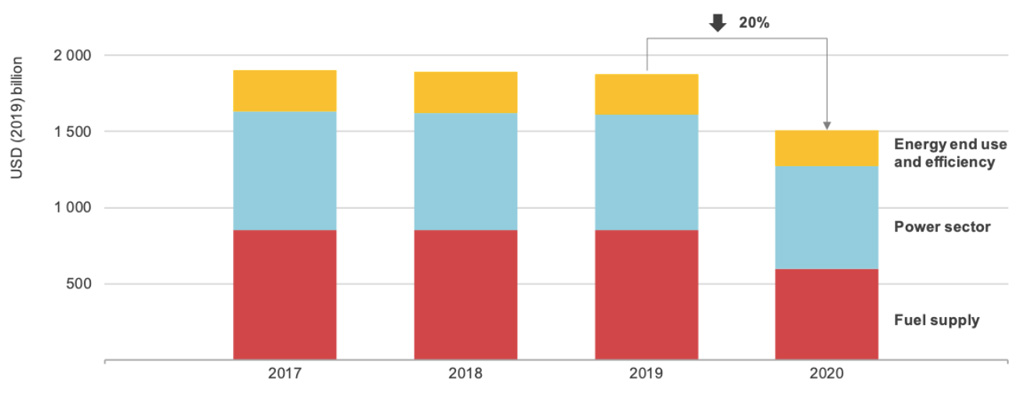
Energy investment is set to fall by a fifth in 2020 due to the coronavirus pandemic. Fuel supply (red) includes all investments associated with the production and provision of fuels to consumers, consisting mainly of oil, gas and coal investments. Power sector (blue) includes spending on power-generation technologies, grids and storage. Energy end use and efficiency (yellow) includes the investment in efficiency improvements across all end-use sectors. Source: IEA

These estimates are based on assumptions about the duration of lockdowns and coronavirus recovery trajectories.

The IEA notes that “almost all” investment activity has been disrupted by these measures, as a result of restrictions to the movement of people, goods and equipment. 

However, the largest impacts are the result of declines in revenues due to falling demand and prices, with the clearest example coming from the oil sector. Analysis of daily data until mid-April suggests countries in full lockdown have seen energy demand drop by a quarter.

As a result, the agency also estimates that these factors, combined with a rise in cases of people not paying their energy bills, will see revenues going to both governments and industry fall by over $1tn this year.

Crisis ‘accelerating’ shift from low-efficiency technologies

Every year energy infrastructure is retired and replaced with new equipment. Typically, the replacement technologies will be cleaner and more efficient, although this is not always the case. 

The coronavirus crisis is expected to have an impact on this rate of turnover and, indeed, it is already contributing to the retirement of some older power plants and facilities, as the chart below illustrates.
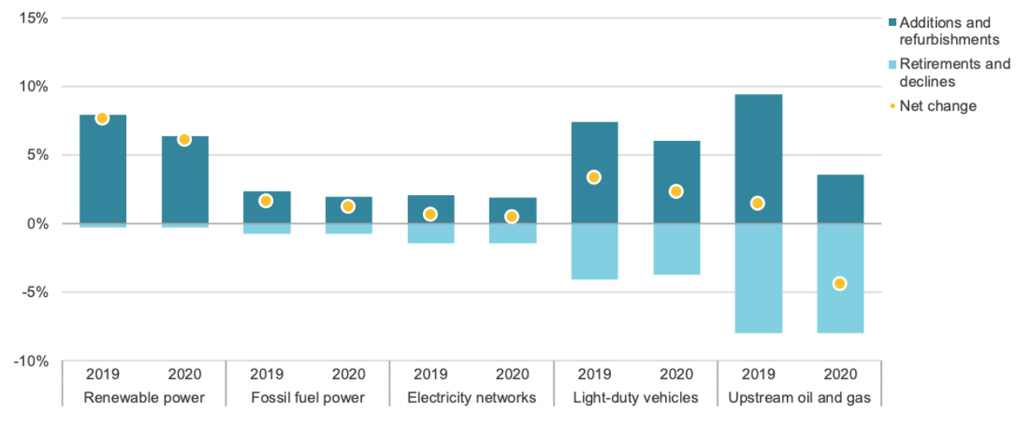
The Covid-19 crisis is hastening the retirement (light blue) of some older plants and facilities, but also impacting consumer spending on new and more efficient technologies (dark blue), with the potential for a net decrease (yellow dot) in upstream oil-and-gas facilities. Source: IEA.

The economic downturn and “surfeit of productive capacity in some areas” as overall demand plummets is already “accelerating” the closure and idling or inefficient technologies, including refineries and some coal-fired power plants.

However, the IEA warns that equally governments might respond to the pandemic by underinvesting in new technologies and remaining reliant on inefficient, older technology. The agency estimates efficiency investment could drop by 10-15% as spending is cut back.

The report warns that policymakers should keep these elements in mind and “combine economic recovery with energy and climate goals”. Dr Fatih Birol, executive director of the IEA, said in a statement that while the pandemic has brought lower emissions it has been “for all the wrong reasons”:

“The response of policymakers – and the extent to which energy and sustainability concerns are integrated into their recovery strategies – will be critical.”

Clean energy spending ‘relatively resilient’

The share of global energy spending going towards clean energy, including renewables as well as nuclear and efficiency improvements, has been flat-lining at around one-third for the past few years.

As the chart below shows, this is likely to change this year as clean energy’s share edges closer to two-fifths of overall spending.
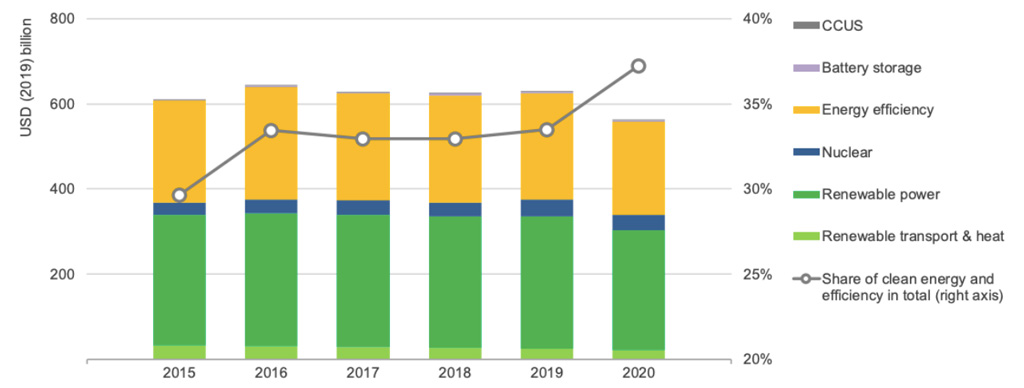
Breakdown of clean energy investment by sector in USD (left x-axis), with the % overall share (right x-axis) of spending indicated by a grey line. Source: IEA.

Clean energy investment is expected to remain “relatively resilient” this year, with spending on renewable projects falling by a comparatively small 10%. 

However, according to the IEA, the main reason for clean energy increasing its share is that fossil fuels are set to take such a “heavy hit”. In absolute terms, spending on these technologies is “far below levels” required to accelerate energy transitions.

The agency notes that investment trends have long been “poorly aligned” with the world’s needs and are still set to fall short of the future it has outlined in its benchmark Sustainable Development Scenario (SDS).

Last year’s edition of the World Energy Investment report concluded that investment in low-carbon energy sources must more than double by 2030 if the world is to meet its Paris Agreement targets.

While the slowdown in clean energy spending is less significant, it still “risks undermining the much-needed transition to more resilient and sustainable energy systems,” according to Birol.

Power sector hit hard

International power investment is set to drop by 10% as a result of the Covid-19 pandemic, according to the agency. 

Virtually every component of the sector is expected to see a decline in investment, with hydro the only exception, as the chart below demonstrates.
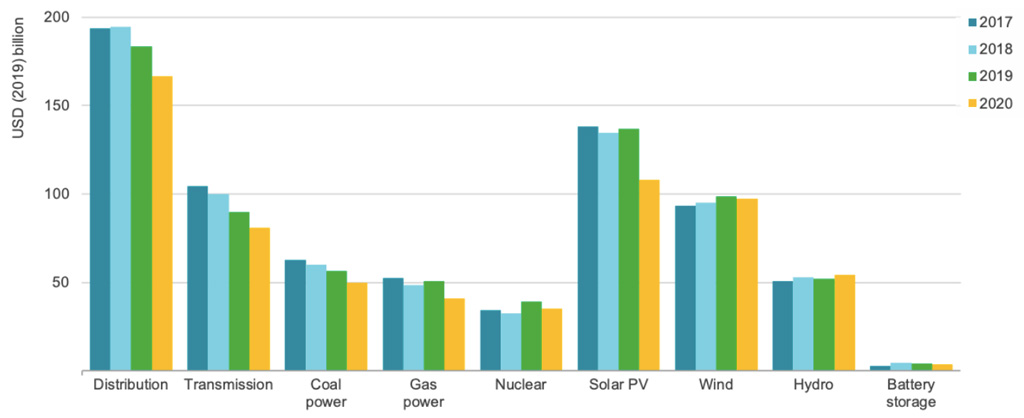
Global investment in the power sector by technology, with figures from the previous three years and estimates for 2020 (yellow). Source: IEA.

Increases in residential electricity demand around the world during lockdown are being “far outweighed” by reductions in commercial and industrial operations, the agency reports. A 9% decline in spending on electricity networks this year is also expected.

The IEA says some parts of power investment are more exposed, specifically fossil fuel-based generation. 

Meanwhile, higher shares of renewables are being dispatched due to low operating costs and priority access to networks. Nevertheless, renewables are still taking a hit, particularly distributed solar photovoltaics (PV) as households and companies cut back on spending.

Technologies with a longer lead time, notably offshore wind and hydropower, are expected to do better despite some delays.

Electricity spending pulls ahead of oil

Oil accounts for most of the decline in revenues expected this year. Furthermore, in a “historic switch” consumer spending on electricity could exceed spending on oil for the first time ever. 

While power-sector revenues are expected to fall by $180bn, oil spending will likely drop by at least $1tn. This can be seen in the chart on the left below. Taken together, investment in oil and gas is expected to fall by almost a third in 2020. 
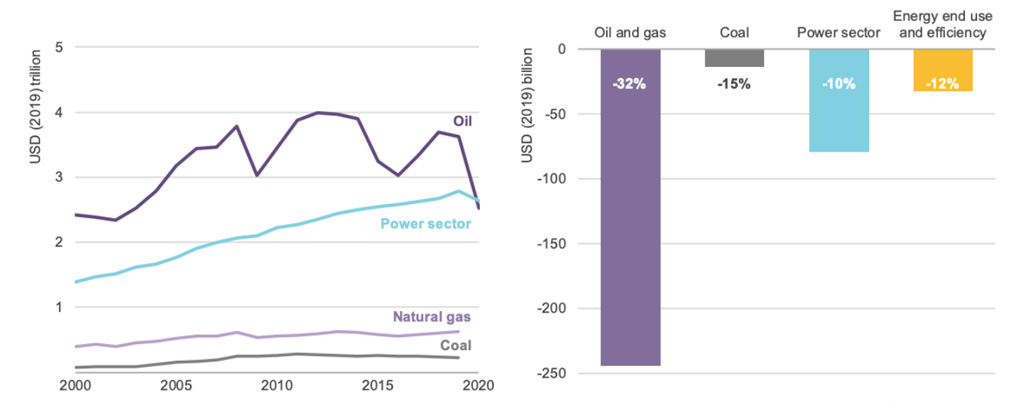
Both global end-use spending by consumers on energy (left) and estimated 2020 investment compared to 2019 show oil is expected to see the biggest decline in investment activity this year. Source: IEA.

The decline in aviation and road transport, which represent nearly 60% of oil demand, are responsible for this disproportionate decline.

Meanwhile, the impact on gas has so far been more moderate, but could fall further due to reduced demand in power and industry settings.

The report also highlights the global shale sector, which was already under pressure, as being particularly vulnerable. 

With investor confidence and access to capital in decline, the IEA predicts shale investment will halve in 2020 and notes the outlook for “highly leveraged shale players in the US” is now “bleak”.

Coal decline given a ‘floor’ by China

Coal is estimated to be the fuel hardest hit by the crisis after oil. Coal demand could drop by 8% this year, investment in coal supply is set to fall by a quarter and spending on new coal-fired plants is set to fall by around 11%.

However, any decline in coal’s fortunes may be curtailed by the recovery of demand for the fossil fuel in China. According to the IEA, investment activity there “may put a floor” under further reductions in coal-power investment this year.

The nation’s focus on coal is illustrated in the chart below, which shows final investment decisions (FIDs) dropping to their lowest levels in a decade, but China providing virtually all of them in the year so far.
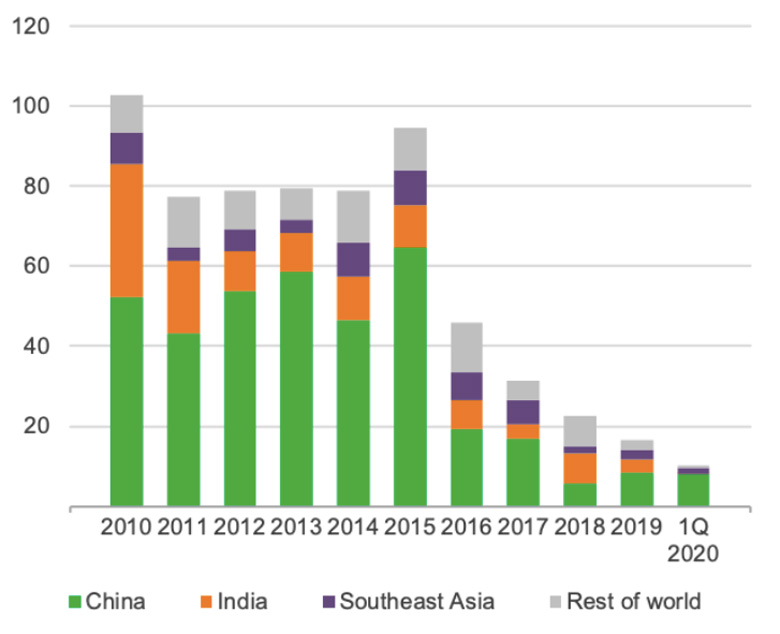
Coal-fired power generation capacity (GW) subject to a final investment decision (FID), with China coloured in green. Source: IEA.

Using data available so far, the IEA notes that approvals for new coal plants in the first quarter of 2020, were “running at twice the rate observed over 2019 as a whole”, primarily in China.

Electric vehicle sales rising as overall market contracts

Last year was a difficult time for the car industry, with total sales growth slowing in all major regions and turning negative in China and the US.

However, this “turbulent” period for the industry is “likely to appear mild” in comparison with 2020, according to the IEA. 

Lockdowns have already severely impacted sales and, across the year, the agency estimates a drop of around 15% – dramatic even compared to the 10% drop that followed the 2008 financial crisis. Negative trends in overall car sales can be seen in the right-hand chart below.
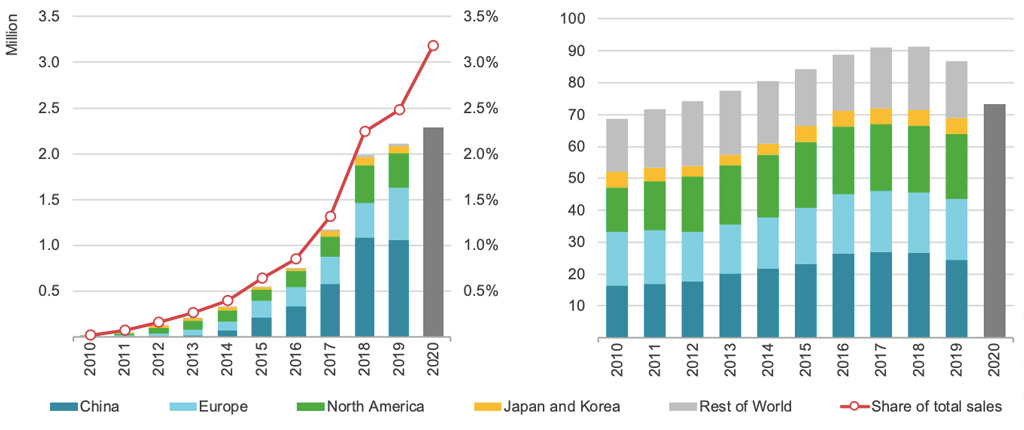
Global sales of electric passenger vehicles – cars, vans and small trucks – and market share, indicated by a red line (left chart). Total light-duty vehicle sales (right). Source: IEA.

However, even though electric vehicle sales followed wider patterns and stalled in 2019 largely due to declining Chinese purchases, their overall market share continued to climb. 

This can be seen in the chart on the left, which shows that electric cars are expected to go against the broader trend in 2020. The IEA estimates that owing to policy support, particularly in Europe, electric vehicle sales will increase this year, as will their share of the market (indicated by the red line).

Battery storage spending fell as prices dropped

Investment in battery storage fell for the first time last year, as the chart below shows. Overall, spending on grid-scale and behind-the-meter batteries fell by 15%, with overall investment just above $4bn.
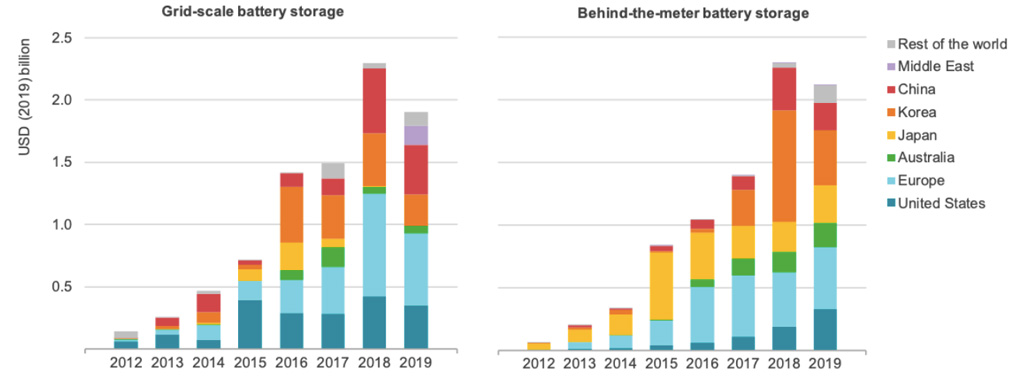
Investment in both grid-scale (left) and behind-the-meter battery storage (right). Source: IEA.

The IEA states this decline took place as costs for battery storage fell rapidly, a trend the agency attributes to maturing supply chains and markets, more efficient production and competition within the sector.

The report mentions fires at energy storage installations in South Korea and regulation uncertainty in China as some of the factors behind the decline in interest last year.

Declining behind-the-meter battery spending also reflects the distributed solar PV market, for which investment slowed last year in a trend expected to continue as consumer spending drops off due to coronavirus.

The agency notes that grid-scale battery investments are also expected to decline this year against the backdrop of a general decrease in power activity. 

However, it says this setback “is likely to be shortlived” due to the technology’s growing importance for system security and flexibility. 

***

IEA: Coronavirus ‘accelerating closure’ of ageing fossil-fuelled power plants

Josh Gabbatiss, Carbon Brief, 27 May 2020

Published under a CC license. Carbon Brief welcomes the reproduction of unadapted material in full for non-commercial use, credited ‘Carbon Brief’ with a link to the article.

coronavirus, climate change, the environment, & the arts: positive steps forward

“To my mind, one does not put oneself in place of the past; one only adds a new link.”

 Cy Twombly, quoted by Gagosian

“an elemental Dionysian force of madness rising, like a ‘fire that rises from the depths of the sea'”

Malcolm Bull, “Fire in the Water,” in Cy Twombly Bacchus Psilax Mainonmenos, exh. cat., New York, 2005, p. 55), quoted in Lot Essay, Cy Twombly (1928-2011), “Untitled” (acrylic on canvas, painted in 2005), Christie’s, Post-War & Contemporary Art Evening Sale, New York, 15 November 2017, Lot 15 B

Cy Twombly (1928-2011), “Untitled” (acrylic on canvas, painted in 2005). “Untitled” sold at the Christie’s Post-War & Contemporary Art Evening Sale of 15 November 2017 in New York realizing a price of US$ 46,437,500

Over ten feet high and sixteen feet in length, “Untitled” is the largest example from a group of giant-scaled paintings that Twombly created beginning in 2003 at age 75.

Twombly makes use of spirals of linear loops, culminating fifty years of regularly invoking scrawls, whirls, and writing/drawing.

In his catalogue essay, “Fire in the Water” that accompanied the first exhibition of Twombly’s Bacchus series in 2005, Malcolm Bull argued that the abiding theme of these paintings was that of an elemental Dionysian force of madness rising, like a “fire that rises from the depths of the sea” (M. Bull, “Fire in the Water,” in Cy Twombly Bacchus Psilax Mainonmenos, exh. cat., New York, 2005, p. 55).’ – Lot Essay

Like Dionysian forces of madness, we are all experiencing the dislocation caused by the current COVID-19 pandemic.  

Individuals, families, supply chains, industries, markets, businesses, nations – all are affected.

This pandemic, however terrible, unexpected, and unprepared for, may in part be an outcome of behaviors that we have, however unwittingly, engaged in over decades.

We are all – individuals, peoples, cultures, animals, plants, functional objects and works of art, buildings, systems of transportation, agriculture, and education, etc. etc. etc. – inextricably embedded in nature. We are part and parcel of and subject to the forces of physics. Part and parcel of and subject to the elements and interactions of chemistry. 

As living, breathing creatures, moreover, and complex systems of systems. we are part and parcel of and subject to the complex forces of biology.  We are calibrated precisely, over long periods of time, to our biosphere.

If and should we take our biosphere for granted, fundamentally alter the composition of our atmosphere, and tamper with our climate, the unexpected can occur. Mayhem may let loose,

And so it has.

Yet, in the arts we are global. We reach across time, across space, across borders, across cultures, across nations. We represent mind and passion, interests and preferences. We come from an abundance of backgrounds and industries. 

We may lead, each in our own place, taking steps to realize our ambitions anew.

Together we will have impact.

While we work in our many spheres of activity, what steps, however simple, might we take to realize our objectives while mitigating risks of future such dislocations?

If we want “to do something to prevent disease emergence, first of all we need to seriously reconsider how we do business with the biosphere.”

Q & A: A Harvard Expert on Environment and Health Discusses Possible Ties Between COVID and Climate,”

“We need to hear what nature is trying to tell us, which is clear: let’s be smarter about how we do business with the biosphere and stop disrupting the climate we depend on.” 

 Conversation on COVID-19 with Dr. Aaron Bernstein, Director of Harvard C-CHANGE

Two recently published articles are insightful. In them, Dr. Aaron Bernstein, MD, MPH, Director of The Center for Climate, Health, and the Global Environment at Harvard’s T.H. Chan School of Public Health (Harvard C-CHANGE) offers guidance.

Please take a few minutes to read them in full:

Neela Banerjee, “Q & A: A Harvard Expert on Environment and Health Discusses Possible Ties Between COVID and Climate,” Inside Climate News, 12 March 2020

A Conversation on COVID-19 with Dr. Aaron Bernstein, Director of Harvard C-CHANGE, ” Harvard C-CHANGE  

Excerpts follow, giving us some idea of what we probably already know but don’t always think about or consider in the decisions we make on a daily basis:

The bottom line here is that if you wanted to prevent the spread of pathogens, the emergence of pathogens, … you wouldn’t transform the climate.”

Q & A: A Harvard Expert on Environment and Health Discusses Possible Ties Between COVID and Climate,”

The separation of health and environmental policy is a dangerous delusion. Our health entirely depends on the climate and the other organisms we share the planet with.”

A Conversation on COVID-19 with Dr. Aaron Bernstein, Director of Harvard C-CHANGE

Simply put, “The likelihood is high that this [a next pandemic] will happen. This has happened through human history but the data we have shows that the pace is accelerating. That’s not terribly surprising. We’re living in highly dense urban places. Air travel is much more prevalent than it used to be. And climate is a part of what is fundamentally reshaping our relationship with the natural world.”

Q & A: A Harvard Expert on Environment and Health Discusses Possible Ties BetweenCOVID and Climate

You look at climate change, we have transformed the nature of the Earth. We have fundamentally changed the composition of the atmosphere, and, as such, we shouldn’t be surprised that that affects our health.”

If you look at the emerging infectious diseases that have moved into people from animals or other sources over the last several decades,the vast majority of those are coming from animals. And the majority of those are coming from wild animals. We have transformed life onEarth. We are having a massive effect on how the relationships between all life on Earth operate and also with ourselves. We shouldn’t be surprised that these emerging diseases pop up.

The principle is that we’re really changing how we relate to other species on Earth and that matters to our risk for infections.”

Q & A: A Harvard Expert on Environment and Health Discusses Possible Ties Between COVID and Climate”

Historically, we have grown as a species in partnership with the plants and animals we live with. So, when we change the rules of the game by drastically changing the climate and life on earth, we have to expect that it will affect our health.

A Conversation on COVID-19 with Dr. Aaron Bernstein, Director of Harvard C-CHANGE

How might we in our private and business capacities be smarter about how we do business with the biosphere and stop disrupting the climate we depend on?

First, think.

All industries, markets, and economies, including the arts, the art market, and the art economy, are interconnected and all are viable only within our shared biosphere.

“Art” is not self-existent. Art as a phenomenon, culture as a phenomenon, works of art, cultures, collections of works of art, collectors, and all parties to art are inextricably embedded in and dependent on nature.

Take time and steps to learn about and understand the biosphere. Take steps to reconsider how we, in every sphere of work and activity, do business with the biosphere.

We have an opportunity to consider ways to optimize connections, culture, art, the business of art, and the biosphere jointly.

Some simple steps that can be taken:

Minimize travel

Whether curator, museum director, staff, or trustee, collector, dealer, gallerist, advisor, interested party – vet travel requirements.

Minimize travel powered by combustion of hydrocarbons.

“We need to drastically decrease our greenhouse gas emissions from fossil fuels like coal, oil and natural gas.”

A Conversation on COVID-19 with Dr. Aaron Bernstein, Director of Harvard C-CHANGE

It goes without saying that travel by foot or by bike is encouraged. Travel by electric-powered cars, buses, and trains – especially insofar as the electricity is generated from renewable, non-hydrocarbon sources – is also encouraged.

Amsterdam-based art dealer Jan Six XI, for instance, bikes to and from work, and across town to consult with experts. (Russell Shorto, “Rembrandt in the Blood: AnObsessive Aristocrat, Rediscovered,” The New York Times Magazine, 27 February 2019)

Work with local partners

We are all somewhere. We do not need to be everywhere.

If you need to do work or close a transaction somewhere else, research, identify, vet, and work with local partners.

Optimize resources and connections made available online

Information, images, and opportunities to meet and discuss face-to-face, even in groups, abound online. As we are now seeing in abundance, education and research can be conducted online. Relationships developed through written and verbal communications optimized online, by mail (even mail that goes through the post office), and by telephone.

As much activity is migrating online, vet also your online service partners and their delivery options.

This website, for instance, is hosted by AISO.net. AISO.net is powered 100% by solar energy generated on site. The company does not make use of carbon credits. Members of staff are knowledgeable, of course, very personable, and extraordinarily helpful. They are great to work with.

Reduce carbon dioxide and greenhouse gas emissions from ongoing operations of physical plants

Galleries,museums, homes, businesses, offices, schools and universities, hotels,hospitals – all house works and collections of art.

Real-life steps can be taken to reduce use of hydrocarbon-based energy sources and achieve net-zero energy.

Expert and experienced stakeholders including architects, engineers, designers, builders, energy consultants, and sources of finance are able and ready to assist.

Information about service providers will follow.

Amsterdam’s Van Gogh Museum can serve as a model. The Van Gogh Museum operates 100% on renewable (wind)energy. (See Van Gogh Museum, sustainability, and accompanying infographic.)

Change habits of mind and behavior

Allow time for foot and bike travel. Schedule meetings and work requirements accordingly. 

Enjoy the great outdoors en route to work, home, meetings, and shopping.

Enjoy your locality

See:

Cy Twombly (1928 – 2011), “Untitled” (acrylic on canvas, painted in 2005), Christie’s, Post-War & Contemporary Art Evening Sale, New York, 15 November 2017, Lot 15 B 

Coronavirus, climate change, and the environment, A Conversation on COVID-19 with Dr. Aaron Bernstein, Director of Harvard C-CHANGE”, Harvard C-Change, 20 March 2020

Aaron Bernstein, MD, MPH, C-Change,Center for Climate, Health, and the Global Environment, Harvard T.H. Chan School of Public Health

Neela Banerjee, “Q&A:A Harvard Expert on Environment and Health Discusses Possible TiesBetween COVID and Climate,” Inside Climate News, 12 March 2020

Russell Shorto, “Rembrandt in the Blood: An Obsessive Aristocrat,Rediscovered,” The New York Times Magazine, 27 February 2019

Art Basel to Offer Online Viewing Rooms

As latent risks emerge, industry, business, and individuals adapt. Opportunities, and benefits, are discovered in and developed from such adaptation. Opportunities and benefits are discovered also in forward-looking mitigation.

Inaugurated in 1970 by Basel gallerists Ernst Beyeler, Trudi Bruckner and Balz Hilt, owned and managed by Switzerland-based MCH Group, art fair giant Art Basel, facing health, travel, and concomitant business risks posed by the emergent Covid-19 virus, cancelled Art Basel Hong Kong 2020.

The Art Basel fairs, offered in Basel, Miami Beach, and Hong Kong, have succeeded as an effective venue for introducing galleries, works of art, and collectors to each other.

The fairs, while offering face-to-face interactions, are, however, premised on travel, often long-distance. The fairs are premised further on the gathering of large numbers of people together in one place at one time.

The travel and costs (staff, booth rentals, insurance, hotels and lodging, shipping of works of art, …) involved with the fair – and the many art fairs that have developed over the years – are expensive for galleries and collectors alike.

The travel, further, can increase risk. Combustion of hydrocarbon-based fuels releases carbon dioxide into the atmosphere. 

Carbon dioxide molecules are precisely calibrated to attract and retain, in our atmosphere, photons of thermal energy that reach the earth from the sun. (See infographic.) Increasing levels of carbon dioxide in our atmosphere leads therefore to greater thermal energy (heat) in the atmosphere.

Acidification of the oceans, that themselvesabsorb about 30% of the carbon dioxide released into the atmosphere, also takes place.

Increased atmospheric heat leads to consequences such as melting of arctic permafrost, melting of glaciers, sea level rise, fires, storms, the release of pathogens and concomitant health risks. (See infographic developed by Zurich-based reinsurance giant Swiss Re.)

 With regard to large numbers of people gathering together in one place at one time, this currently may pose a risk of transmission of the emergent coronavirus (COVID-19).

To reduce such risk, the Swiss Federal Council, on 28 February 2020, issued an ordinance forbidding the holding of public or private events in Switzerland where more than 1,000 people are present at the same time.

MCH Group has, accordingly, not only cancelled Art Basel Hong Kong 2020 but has also postponed further events and trade shows such as the Baselworld Watch and Jewellery Show 2020 (until January-February 2021), the garden exhibition Giardina in Zurich, and Habitat-Jardin in Lausanne.

Fortunately there are means of bringing galleries, works of art, and collectors together that are premised neither on long-distance travel nor on the gathering in one place of multitudes of people.

Art Basel has been developing such a means, an initiative that, as “the art market continues to evolve, exemplifies its longstanding commitment to fostering a healthy art world ecosystem by creating new ways for its galleries to reach collectors from across the globe.”

The initiative is a digital-only platform for Art Basel’s galleries and collectors. The inaugural edition of Art Basel’s Online Viewing Rooms are planned to go live on 20 March 2020.

“Online Viewing Rooms will give visitors the opportunity to browse thousands of artworks presented by Art Basel participating galleries, many of which will be online exclusives. The exhibiting gallery can then be contacted directly for sales inquiries. The Viewing Rooms will run in parallel to the three shows in Basel, Miami Beach, and Hong Kong.”


Art Basel to launch Online Viewing Rooms,” Art Basel

While recognizing “’the essential personal interactions that continue to underlie the  art market,’” Art Basel Global Director Marc Spiegler notes that “’the Online Viewing Rooms will provide galleries with a further possibility for engaging with our global audiences.'”

All the galleries that were accepted for the cancelled 2020 Art Basel Hong Kong have been invited to participate, at no cost, in the launch of the Online Viewing Rooms.

Art Basel is not the first to organization to provide a means for galleries, works of art, and collectors to meet online. New York-based Artsy has been doing so for several years.

The process of selecting works of art, acquiring them, and developing a collection requires intent, effort, patience, and work. Such work is conducted in increments over a long-term.

Relationships of mutual trust and reliance, between collectors, galleries, and dealers, some private, are developed.

Qualifications of all parties are established. Buyers and sellers alike vet each other for acknowledgement and understanding of contract law as well as willingness to agree and adhere to contractual terms.

As works of art are identified for purchase, high-resolution images taken from multiple angles can be shared. Condition reports, provenance, and valuations provided.

The process enables collectors to learn and value not only the aesthetic, historical, and, increasingly, financial qualities of such works of art but also the supply chain logistics.

Supply chain logistics are themselves complex, often crossing cultures, history, collections, sovereign entities such as cities, states, and nations, and laws.

Supply chain logistics and the logistics of collections management evolving to include collaborations not only with art professionals but also with those with in a variety of industries. These industries include science, tech, law, engineering, energy, water, design, architecture, finance, and, insurance.

Insurance especially in a new iteration: in regard to transparent, data-driven identification of risk together with public/private collaborations structured to foster preemptive mitigation of risk.

See:

Art Basel to launch Online Viewing Rooms,” Art Basel

Anny Shaw, “MCH Group postpones Baselworld watch fair as Swiss authorities ban large events over coronavirus fears,” The Art Newspaper, 28 February2020

Christian Jecker, “MCH Group postpones forthcoming events,” MCH Group Media Release, 28 February 2020

Carbon Dioxide Absorbs and Re-Emits Infrared Radiation,” UCAR Center for Science Education

Swiss Re, “Special Feature: It’s existential – climate change and life & health,” 22 May 2019

NOAA, “Ocean Acidification

Acknowledging risk, Sotheby’s revises 2020 Hong Kong Spring Sale

“Monitoring the impact of the Covid-19 virus and the resulting travel restrictions” – in effect acknowledging, and attempting to manage, the health, travel, and business risks that the coronavirus poses – Sotheby’s has revised its 2020 Hong Kong Spring Sale.

The Modern Art Evening Sale, the Contemporary Art Evening Sale, and the Contemporary Art Day Sale will take place in New York on 16 April.

Further 2020 Hong Kong Spring sales have been re-scheduled from April to July. The plan is that they will take place in Hong Kong.

The revised schedule can be found here: “Revised Schedule For Sotheby’s Hong Kong 2020 Spring Auction Series Announced.”

Sotheby’s publishes a message from Kevin Ching, CEO of Sotheby’s Asia:

“We have been closely monitoring the impact of the Covid-19 virus and the resulting travel restrictions.

“After careful consideration and reflection on nearly 50 years of working with our clients in Asia, we have made the strategic decision to continue to hold our major Modern and Contemporary Art auctions in April but relocate them to New York and to postpone the balance of our spring auctions to early July in Hong Kong.

“April in New York represents the best possible venue and timing for our consignors of Modern and Contemporary art. We have scheduled these sales at times that will make it easy for our clients in Asia to participate and our global team stands ready to activate the international market for the great works of art we have assembled.

“Similarly, given the nature of the property and collectors in our other categories, we have decided to postpone those auctions until early July when we can safely hold a traveling exhibition across Asia and present our sale week in Hong Kong.”

Kevin Ching, CEO, Sotheby’s Asia

See:

Revised Schedule for Sotheby’s Hong Kong Spring Auction Series Announced,” Sotheby’s, 24 February 2020

Revised Schedule For Sotheby’s Hong Kong 2020 Spring Auction Series Announced” and “Sale Calendar,” Sotheby’s