art, the built environment, & the Bizot Green Protocol

Works of art. History. Cultural heritage. The market. Galleries. Art fairs. Museums. Private museums. Institutional and private collections. Fiduciary care. Value.

Let’s consider a pressing issue:

How collections are housed, managed, and cared for and the protection of works of art and tangible assets in an age of increasingly erratic weather, increasing sea-level rise, floods, fires, storms, … and pandemics – which in themselves and the response to which can be devastating.

Does one barricade the art behind flood walls and barriers? Insure the works of art? (Insurance is a good idea. Insurance does not, however, mitigate or prevent future damage. Insurance is used to protect the “value” of the art, not the work of art itself. It is used after damage occurs to recover value.)

Can we protect works of art while mitigating possible future damage?

Atmospheric CO2 is a key factor leading towards the storms, floods, and fires that can be so damaging to art and tangible assets. Is it possible to care for our collections while reducing emissions of CO2 into the air?

The Bizot Group of museum directors, or the International Group of Organizers of Large-scale Exhibitions, thinks so.

Max Hollein, now the Director of New York’s Metropolitan Museum of Art, was Chairman of the Bizot Group in 2014. Richard Armstrong, Director of the Solomon R. Gugenheim Museum, and Glen Lowry, Director of the Museum of Modern Art, are members.
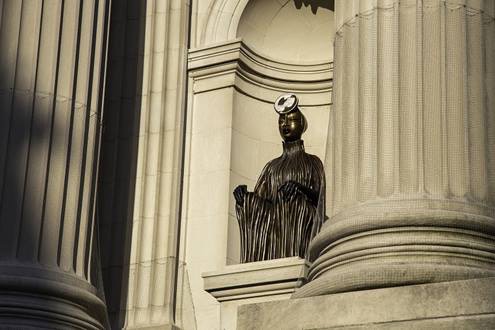

Wangechi Mutu (Kenyan, born Nairobi, 1972), “The Seated II” (bronze, 2019) situated in one of four niches in the facade of New York’s Metropolitan Museum of Art. Courtesy of the the artist, the Metropolitan Museum of Art, and Gladstone Gallery, New York and Brussels.


Wangechi Mutu (Kenyan, born Nairobi, 1972), “The Seated II” (bronze, 2019). Courtesy of the the artist, the Metropolitan Museum of Art, and Gladstone Gallery, New York and Brussels.

Axel Rüger, Director of the Van Gogh Museum in Amsterdam from 2006 until June of 2019 when he left the Van Gogh Museum to take up a new appointment as Chief Executive of London’s Royal Academy of Arts, is a member.

So are many others.

The Bizot Group agreed the Bizot Green Protocol in 2015:

The directors agree that museums can reduce the amount of CO2 emissions they are responsible for while recognizing their duty of care to collections:

1.  Guiding Principles
Museums should review policy and practice, particularly regarding loan requirements, storage and display conditions, and building design and air conditioning systems, with a view to reducing carbon footprints.

Museums need to find ways to reconcile the desirability of long-term preservation of collections with the need to reduce energy use.

Museums should apply whatever methodology or strategies best suit their collections, building and needs, and innovative approaches should be encouraged.

The care of objects is paramount. Subject to this,

environmental standards should become more intelligent and better tailored to specific needs. Blanket conditions should no longer apply. Instead conditions should be determined by the requirements of individual objects or groups of objects and the climate in the part of the world in which the museum is located;

where appropriate, care of collections should be achieved in a way that does not assume air conditioning or other high energy cost solutions. Passive methods, simple technology that is easy to maintain, and lower energy solutions should be considered;

natural and sustainable environmental controls should be explored and exploited fully;

when designing and constructing new buildings or renovating old ones, architects and engineers should be guided significantly to reduce the building’s carbon footprint as a key objective;

the design and build of exhibitions should be managed to mimimise waste and recycle where possible.

2.  Guidelines
For many classes of object containing hygroscopic material (such as canvas paintings, textiles, ethnographic objects or animal glue) a stable relative humidity (RH) is required in the range of 40 – 60% and a stable temperature in the range 16-25°C with fluctuations of no more than ±10% RH per 24 hours within this range. More sensitive objects will require specific and tighter RH control, depending on the materials, condition, and history of the work of art. A conservators evaluation is essential in establishing the appropriate environmental conditions for works of art requested for loan.

Environmental Sustainability – reducing museums’ carbon footprint,”National Museum Directors Council

See:

Environmental sustainability – reducing museums’ carbon footprint,” National Museum Directors Council

Wangechi Mutu: The NewOnes, will free us,” Metropolitan Museum of Art, The Facade Commission, 9 September 2019 – 9 June 2020

Wangechi Mutu, Gladstone Gallery

Axel Rϋger Appointed Chief Executive of London’s Royal Academy of Arts,” Artforum, 13 February 2019

Axel Rüger,” 40 Under 40 Europe 2018, Apollo Magazine, 3 September 2018

Groupe Bizot, Letter of 26 February 2014 to Mr. Mikhail Piotrovsky, Director, State Hermitage Museum, St. Petersburg, Russia

art, real estate, luxury, & global risks

“Humanity has become remarkably adept at understanding how to mitigate conventional risks that can be relatively easily isolated and managed with standard risk-management approaches. But we are much less competent when it comes to dealing with complex risks in the interconnected systems that underpin our world, such as organizations, economies, societies and the environment.

“There are signs of strain in many of these systems: our accelerating pace of change is testing the absorptive capacities of institutions, communities and individuals.

“When risk cascades through a complex system, the danger is not of incremental damage but of “runaway collapse” or an abrupt transition to a new, suboptimal status quo.”

See: “The Global Risks Report 2018, 13th Edition” | World Economic Forum (WEF); Strategic Partners: Marsh & McLennan Companies, Zurich Insurance Company; Academic Advisors: National University of Singapore, Oxford Martin School, University of Oxford, Wharton Risk Management and Decision Processes Center, University of Pennsylvania

#art #artmarket #collectionsmanagement #data #analytics #risk #riskanalysis #riskmanagement #riskmitigation #climaterisk #insurance #insurancerisk #realestate #commercialrealestate #culturalrealestate  #culturalheritage #luxury #resilience #CO2

Southern California collections management: fire rescue & restoration

Fueled by seasonal winds and dry conditions, Southern California’s Thomas Fire has become the largest, in terms of acreage, since 1932 when reliable recording began. State officials are saying that the 2017 fire season has been the most destructive that people in state have seen.

As of the Vanity Fair December 20 publication of Jane Borden’s article “In Southern California, Even the Art Has a Fire Rescue Plan,” the Thomas Fire had destroyed about 800 homes, nearing Santa Barbara, Montecito, and Ojai, collectively home to the Museum of Contemporary Art Santa Barbara, the Santa Barbara Museum of Art, working artists, art collectors, and celebrities.

On the evening of December 4, artists living in Ojai had no time to pack up their work before evacuating. Those with studios in Ventura spent evenings sleeping beside their work.

Works from four collections were moved to purified, closed rooms at the MCASB.

The Santa Barbara Museum of Art, with van and crew ready at short notice, safeguarded works of art, valued at millions of dollars, retrieved from homes in the area.

The Conservation Center of Chicago is described as the “most prepared art-rescue team working in Southern California” during the fire.

As the air quality was rendered “really bad” by the Thomas Fire, teams from The Conservation Center rotated every four or five days. Works of art that were not damaged were stored in a safe location in Los Angeles. Works with minor damages were restored locally. More damaged works of art were shipped to Chicago for full restoration.

An industry leader in rescuing works of art after disasters such as fires or floods, The Conservation Center brings over 30 years of experience caring for individual, private, and public collections.

In addition to restoration and packing and shipping services, The Conservation Center in Chicago specializes in disaster response. The Center’s national clients include corporations, museums, nonprofits, and private collectors, and the response team is trained to triage a variety of situations, most notably flood and fire. This year alone, the 36-person team has responded to hurricane damage in Houston and Miami, and rescued or restored 1,350 works from a Georgia museum damaged by a tornado. Now, the fires. “I’ve been with the company for 29 years, and this is definitely unprecedented, to have these things happening so closely together,“ explains Heather Becker, C.E.O. of The Conservation Center.”

See:

Thomas Fire is Now California’s Largest Wildfire in History” | Doreen McCallister, NPR, 23 December 2017

In Southern California, Even the Art Has a Fire Rescue Plan” | Jane Borden, Vanity Fair, 20 December 2017

The Conservation Center

#art #SouthernCalifornia #ThomasFire #SantaBarbara #Montecito #Ojai #MuseumofContemporaryArtSantaBarbara #MCASB #SantaBarbaraMuseumofArt #SBMA #conservation #rescue #restoration #artcollections #collectionsmanagement #CO2 #luxury #smartluxury #design #architecture #engineering #fireresistance #TheConservationCenter #Chicago #resilience #health #wellness#realestate #culturalrealestate #culturalheritage

energy efficient, living smart, developing a legacy, increasing sales

Maracay Homes, an Arizona homebuilding company and leader in the Arizona real estate industry, “providing homebuyers with smarter choices,” for more than 25 years, reports a correlation between EnergySmart, energy efficiency, and sales.

““We have outperformed our competitors because of the Energy Star and LEED component,” reports Maracay Marketing Manager Elise Goodell. “Realtors and prospects are seeing a lift in value, and they are willing to pay for the LEED certification…'”

The home construction company, headquartered in upscale Scottsdale, Arizona and serving the Phoenix- and Tuscson-area markets, correlates EnergySmart with LivingSmart in its entirety and the quality of life of homeowners together with legacy and better sales.

All homes constructed by Maracay are now Energy Star-certified.

Two years ago Maracay “beta tested” LEED certification on a small scale. Maracay understands LEED (Leadership in Energy and Environmental Design) to provide a more holistic analysis of home energy savings than Energy Star ratings and an educational requirement, on a small scale. The company is now integrating LEED on a large scale.

One essential element in Maracay’s educational campaign is an in-depth, locally produced video that includes interviews with potential (and actual) buyers and a walk-through of an under-construction Maracay home, hosted by D.R. Wastchak (DRW), a local Arizona energy efficiency rating company with a 17-year track record in the field and a list of credits that includes EPA ‘Partner of the Year.’”

See:

Arizona homebuilding company finds success with energy efficiency” | Tina Casey, Inman, 29 December 2017

Maracay Homes

#homes #homeconstruction #buildingtechnology #sales #homesales #realtors #realestate #commercialrealestate #culturalrealestate #energy #energyefficiency #LEED #USGBC #EnergyStar #luxury #smartluxury #CO2 #Arizona #Scottsdale #Phoenix #Tuscon #MaracayHomes #resilience #art #collectionsmanagement#education #health #wellness #family


HouseZero ・retrofitting a 1924-era wood-frame house

Harvard University’s Center for Green Buildings and Cities, in collaboration with international architecture and design firm Snøhetta, is retrofitting a wood frame house built in 1924 in what is now an historic district of Cambridge, Massachusetts. The house now serves as the Center’s headquarters.

The retrofit is intended to fulfill multiple objectives:

A focus on inefficient existing buildings. In the United States, buildings consume around 40% of energy produced annually. This equates to more than $230 billion spent annually by property owners heating, cooling, and powering the nation’s 123.6 million homes. Housing consumes 18-23% of that.

A focus on using current technologies together with better design.

The use of zero energy for heating and cooling. A retrofitted building that produces more energy than it consumes.

100% natural ventilation and daylight autonomy

Zero CO2 emissions, including embodied energy in materials

A positive rather than a negative impact on the surrounding environment. A house conducive to occupant health, encouraging productivity and creativity.

Use of self-generated data that will allow the building to self-adjust. The house will adjust itself seasonally and daily to achieve thermal comfort targets.

The development of ideas and a working model that can be used by homeowners as they seek to renovate existing houses towards significant energy and carbon use improvements without costly or wasteful tear-downs.

The Center for Green Buildings and Cities will not seek any kind of independent certification, such as USGBC LEED, WELL, or Living Building certification. The intent is, rather, to exceed those standards’ criteria.

The renovation, says Ali Malkawi, professor of architectural technology and founding director of the CGBC, is guided not only by the goal of net zero energy consumption with 100% natural light and ventilation but also by the understanding that a green building is “a sustainable building, which means it has the lowest impact on its surrounding environment as possible. It might have a positive effect on its environment—the surrounding as well as the global.” Such a building is, furthermore, “healthy for its occupants” and encourages productivity and creativity.

See:

Harvard Center for Green Buildings and Cities unveils HouseZero project, an ambitious retrofit of its Cambridge headquarters” | Travis Dagenais, Harvard Graduate School of Design, 25 May 2017

Harvard’s ‘HouseZero’” | Alisha Ukani, Harvard Magazine, 3 August 2017

Future Home: HouseZero” | Harvard Center for Green Buildings and Cities”

#architecture #architecturaltechnology #buildingtechnology #technology #design #engineering #netzero #energy #resilience #CO2 #home #luxury #smartluxury #retrofit #homeownership #realestate #commercialrealestate #culturalrealestate #culturalheritage #art #collectionsmanagement #museums #galleries #snøhetta #harvard #harvardcenterforgreenbuildingsandcities #Cambridge #data #health #wellness #family