“Tsuruko Yamazaki endorsed a distinctly non-humanist view of agency by emphasizing the interface between material properties themselves”
・ Joan Kee, Professor, History of Art, University of Michigan, introduction to “Artist’s Portfolio: Tsuruko Yamazaki,” Artforum, February 2013
A founding member of the Japanese Gutai Art Association, Tsuruko Yamazaki (山崎 つる子) was the only woman artist who remained with the group from its beginning in 1954 to its disbanding in 1972.
Tsuruko Yamazaki joined Gutai’s major exhibitions, including the Outdoor Gutai Art Exhibition at Ashiya Park in 1956; the sixth Gutai Art Exhibition held in September 1958 at the Martha Jackson Gallery at 32 East 69th Street, New York (in the same townhouse now occupied by Hauser & Wirth) ; and the international group show “Nul 1965” at the Stedelijk Museum in Amsterdam (see discussion in “Zero: Let Us Explore the Stars,” 4 July – 7 November 2015, Stedelijk Museum, Amsterdam).
Tsuruko Yamazaki, “Red (Shape of Mosquito Net)” (vinyl, wood, metal fixtures, wires, bolts, light bulbs, 1956). Installation view at the “Outdoor Gutai Art Exhibition”, Ashiya Park, along the banks of the Ashiya River, Hyogo, Japan, 1956. Image courtesy of Work” (Red Cube)“, the work was exhibited at the Guggenheim’s “Gutai: Splendid Playground”.
“Tsuruko Yamazaki: Beyond GutaÏ,” the first solo exhibition of Tsuruko Yamazaki’s work outside of Japan, was held in 2010 by Almine Rech, Paris, organized in collaboration with Midori Nishisawa and Olivier Renaud-Clément (13 March – 30 April).
Clear water in Venice. Blue skies over Beijing. Air monitors in the city of Houston recording less ozone than normal. Clearer and crisper Austin skyline. The cleanest air ever recorded in Los Angeles.
“I think contemporary art changes how you look at the world. And that’s huge for everybody who comes into the situation.”
“Art as responsibility, art as a civic engagement, art has to be a force in society, art has to be courageous, unafraid, ecological, ecological. That was Joseph Beuys talking to my art teacher.”
“As a museum, you have a civic responsibility, you have a role in society, you have to be courageous, you have to open up your doors to allow for dialogue.”
“after 10 years of working for and with [MoMA PS1 board chair; president emerita & trustee, MoMA] Agnes Gund, I follow one very important principle in decision-making: ‘It’s not about you, it’s about the difference you can make.
The Museum of Contemporary Art (MOCA), established in 1979, is the only artist-founded museum in Los Angeles. As of late 2018 its endowment amounted to more than $134 million.
Klaus Biesenbach is MOCA’s sixth director, beginning work with the museum on 23 October 2018. He “’loves fundraising’” and sees his role at MOCA “as strictly administrative, focused on fundraising and growing the museum’s attendance, programming, endowment and board.”
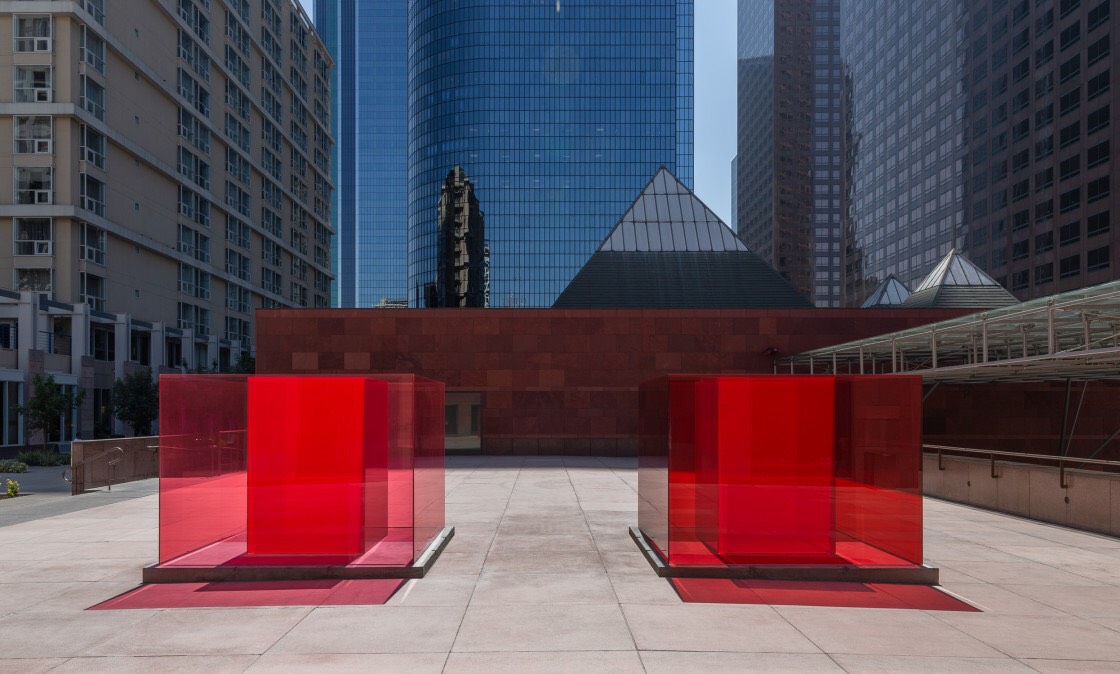
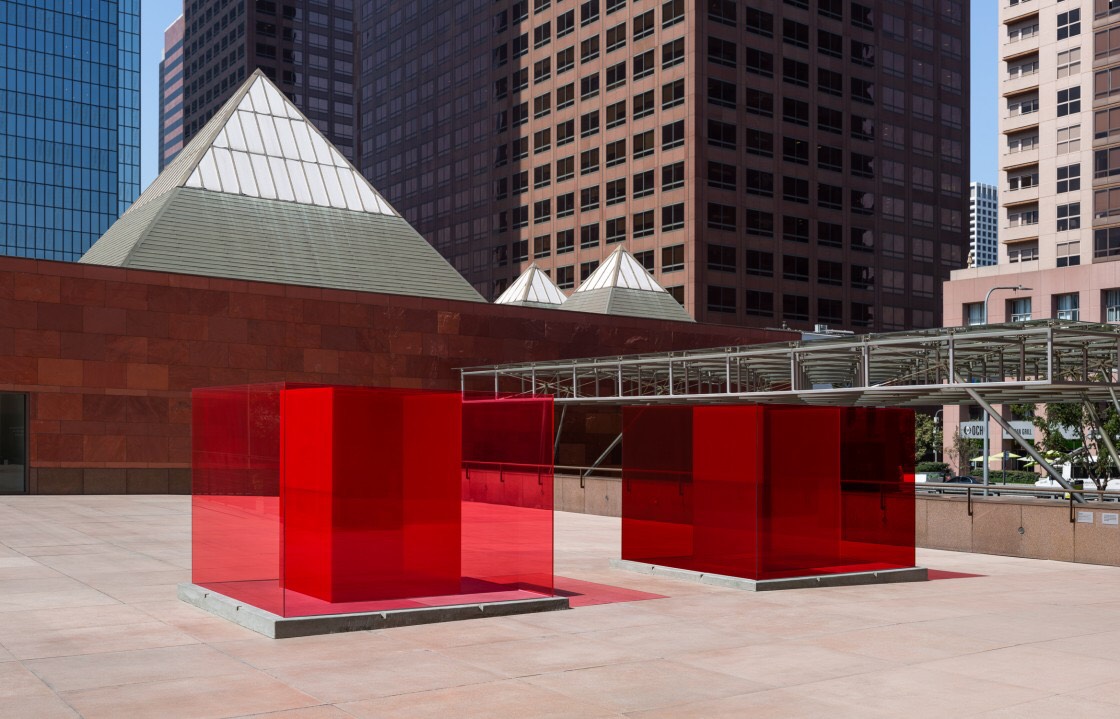
Larry Bell, “Bill and Coo at MOCA’s nest” (site-specific installation, laminated glass, 2019), in the collection of the Museum of Contemporary Art, Los Angeles. Accession number: 2019-19. Purchase with funds provided by Carol and David Appel.
Larry Bell, “Bill and Coo at MOCA’s Nest” (site specific installation, laminated glass, two parts, 2019), in the collection of the Museum of Contemporary Art, Los Angeles. Accession number: 2019-19. Purchase with funds provided by Carol and David Appel. Installation view, MOCA Grand Avenue. Image courtesy of The Museum of Contemporary Art. Photo by Zak Kelley.
Prior to moving to Los Angeles to take up the directorship of MOCA, Klaus Biesenbach lived for 23 years in Manhattan. In 1995 he moved to New York from Berlin where, in 1991, as an intern for the East German government, he established Berlin’s Kunst-Werke Institute for Contemporary Art in a vacant former margarine factory.
Biesenbach worked initially with what was then called the P.S.1 Contemporary Art Center in New York. The P.S. 1 Contemporary Art Center was established in 1971 by Alanna Heiss as the Institute for Art and Urban Resources Inc., an organization devoted to organizing exhibitions in underutilized and abandoned spaces across New YorkCity.
The P.S.1 Contemporary Art Center became an affiliate of TheMuseum of Modern Art in 2000.
Biesenbach joined MoMA in 2004 with a concurrent role at MoMA PS1. He became director of MoMA PS1 in 2010, serving also as chief curator-at-large at MoMA.
Just weeks into his job at MOCA, Mr. Biesenbach described his view of the mission of museums: “’to be a resident among residents,’” “meant not only to display art but to support artists and greater civic life.”
“’“As
a museum, you have a civic responsibility, you have a role in
society, you have to be courageous, you have to open up your doors to
allow for dialogue.’”
“’After 10 years of working for and with [MoMA PS1 board chair] Agnes Gund, I follow one very important principle in decision-making: ‘It’s not about you, it’s about the difference you can make.’”’”
He
continues, a primary goal is now “’alignment. To develop a vision
for the museum and then align the board and the staff and all the
other constituencies. And vision doesn’t necessarily mean huge
buildings or blockbusters. It could also be a much more modest
vision: simply functioning.
“’I think contemporary art changes how you look at the world. And that’s huge for everybody who comes into the situation.’”
Growing up near Cologne, Germany, Mr. Biesenbach’s love for art began when he was in primary school. Joseph Beuys spoke through his art teacher, who had studied with him.
“Art
as responsibility, art as a civic engagement, art has to be a force
in society, art has to be courageous, unafraid, ecological,
ecological. That was Joseph Beuys talking to my art teacher. We were
like 8 or 9 years old!”
Full circle to today’s Los Angeles, and to today’s Houston, Beijing, Venice, and so many other cities.
Clear
water in Venice. Blue skies over Beijing. Air monitors in the city of
Houston recording less ozone than normal. Clearer and crisper Austin
skyline. The cleanest air ever recorded, in March 2020, in Los
Angeles.
Home not only to MOCA but also to The Broad (across the street from MOCA and founded by philanthropists Eli and Edythe Broad; Eli Broad was founding chairman of MOCA in 1979), the Hammer Museum (affiliated with UCLA), and the Los Angeles County Museum of Art amongst others, Los Angeles has seen a lifting of its “notorious L.A. Smog” due “to the fact that most Angelenos are driving less.”
“The
notorious L.A. smog starts as a cloud of traffic emissions that’s
spewed into the air during the morning rush hour. This layer of air
pollution is then held in place by a combination of the Southland’s
topography and its prevailing weather patterns, and baked for hours
in SoCal’s warm ultraviolet rays, an effect that air-quality
experts liken to a pot of soup heating on a stove.
“There’s no question that the drastic improvement in air quality—a combined measure of the particle pollution, carbon monoxide, sulfur dioxide, nitrogen dioxide, and ozone we breathe into our lungs—is due to the fact that most Angelenos are driving less and staying inside more.”
Better quality of air is observed also in Houston, home to numerous excellent museums including the Museum of Fine Arts, Houston (MFAH).
“The
primary reason, experts say, is fewer vehicles on the road, which
means fewer emissions from the petroleum-based fuels on which so much
of the Texas economy relies.” …
“In
Houston, where the huge volumes of commuters and sprawl of industrial
facilities often result in a lingering smog, emissions of nitrogen
oxides, which combine with other pollutants in the atmosphere to form
ozone, are already down 15 percent this month compared to last year.”
“The reduction in pollutants such as nitrogen dioxide and microscopic particulate matter, not to mention the carbon dioxide that is warming the planet, offers a temporary window on what the world might look like as governments worldwide move to cut greenhouse gas emissions to net-zero by mid-century.”
“A question we should be asking is, how do we maintain the better air quality without the economic consequences of shutter in place orders?’” Michael Webber, energy resources professor at theUniversity of Texas, Austin.
The economic consequences of “shutter in place orders” are dire.
In response to the outbreak of the coronavirus, MOCA, for instance, has laid off all 97 part-time employees. Almost all 69 full-time employees are taking a full or partial furlough or a significant salary reduction.
In correspondence with Deborah Vankin of the Los Angeles Times, Mr. Biesenbach writes, “the coronavirus crisis is changing lives in unprecedented ways and that he couldn’t say ‘how long this slow-burning catastrophe will grow and when it will end.”
“’Given
these uncertainties, we are taking significant measures to make sure
MOCA’s unique legacy and collection, built through the creative hard
work and contributions of so many will continue to be preserved and
accessible for generations to come.”
More
vulnerable than some other Los Angeles museums, MOCA does not enjoy
the financial privilege of a wealthy benefactor behind it, as does
the Broad (Eli Broad). Nor is the museum partially funded by a
university, as is the Hammer Museum. Nor is it so directly connected
to a government entity as is the Los Angeles County Museum of Art.
“’MOCA,’” rather, Biesenbach observes, “’is supported independently, mostly by individuals, and we have to navigate this crisis in our own way.’”
So
how might we maintain the better air quality without the economic
consequences of shutter in place orders?
A hint at forward direction might come from Cody A. Hill, Vice President, Energy Storage at LS Power.”
LS Power is “a development, investment, and operating company focused on power generation, electric transmission and energy infrastructure. We partner with communities across North America to create lower-cost, cleaner energy solutions.”
Mr. Hill has an MS in Electrical and ComputerEngineering from the University of Texas at Austin and is now based in the San Francisco Bay Area.
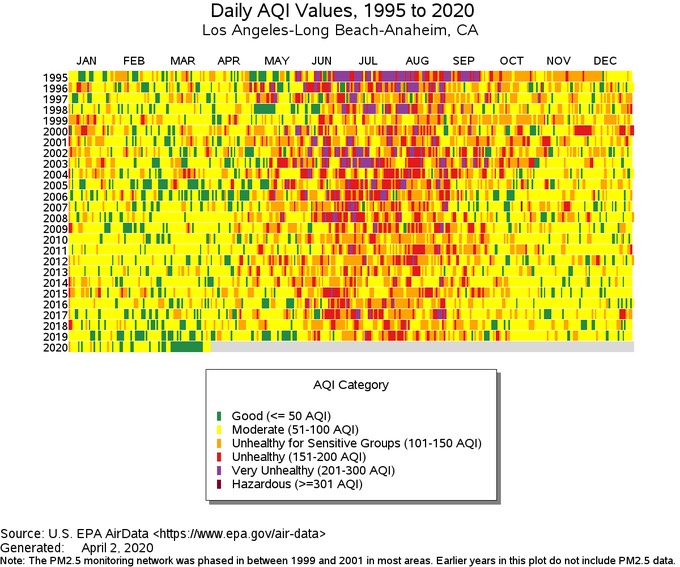
Sharing an “astounding chart from the EPA,” Mr. Hill (Twitter: @cody_a_hill) notes, in a tweet of 2 April 2020, that “Los Angeles had the cleanest air ever recorded there in March 2020.”
EPA, generated 2 April 2020, shared by Cody A. Hill, @cody_a_hill, via Twitter, 2 April 2020
Cody Hill continues in the same tweet, “This is mostly from reduced driving with the same vehicle fleet. It could be the new normal and ~13 million people living there would be healthier if we electrify transportation.”
Mark Bradford’s “Constitution IV” (mixed media on canvas, 2013) sold, from the collection of Fredric Brandt, plastic surgeon to the stars, for £3,778,500 at the Phillips London Contemporary Art Evening Sale of 14 October 2015. This sale set an auction record, since exceeded, for the artist.
Mark Bradford, born in Los Angeles, California in 1961, continues to live and work in Los Angeles. He has been exclusively represented by Hauser & Wirth since 2015.
Christopher Bedford, director of the Baltimore Museum of Art, considers Mark Bradford to be “the most important living abstract painter”.
The catalogue prepared by Phillips observes that “Mark Bradford’s vast tactile works characterized by their décollaged surfaces, evoke a sense of transience and instability. In compositions such as ‘Constitution IV’ however, these ideas transcend material objects and infiltrate less physical subjects consequently, indicating the fragility of seemingly solid notions.”
The essay continues, “Using printed text through his collage and décollage technique the canvas becomes a surface offering insights into further meanings and depths … Thus, the viewer is drawn into Bradford’s works in order to try and draw meaning from the myriad of letters flickering in and out of focus.”