IEA: Coronavirus ‘accelerating closure’ of ageing fossil-fuelled power plants

IEA: Coronavirus ‘accelerating closure’ of ageing fossil-fuelled power plants

Josh Gabbatiss, Carbon Brief, 27 May 2020

***

This year will see the largest ever drop globally in both investment and consumer spending on energy as the coronavirus pandemic hits every major sector, according to the International Energy Agency (IEA).

The crisis is accelerating the shutdown of older fossil-fuelled power plants and refineries, with the agency saying it could provide an opportunity to push the global energy sector onto a “more resilient, secure and sustainable path”.

In the latest edition of the World Energy Investment report, which Carbon Brief has covered in previous years, the IEA has gone beyond its usual remit of reviewing annual trends. 

Its analysis looks ahead to the coming year and estimates the impact of this year’s economic turmoil on energy investment, which was expected to grow by around 2% prior to Covid-19. It is now expected to drop by 20%, or almost $400bn.

Meanwhile, as demand and prices collapse, consumer spending on oil is expected to drop by more than $1tn, prompting a “historic switch” as spending on electricity exceeds oil for the first time.

Here, Carbon Brief has picked out some key charts to illustrate the economic repercussions of the pandemic across the energy sector.

Energy investment will drop by a fifth

The “baseline expectation” for 2020 is a global recession resulting from widespread lockdowns, according to the IEA. Last month, the agency estimated this will also lead to CO2 emissions dropping by 8% this year in the largest decline ever recorded.

Based on the latest investment data and project information, announcements from companies and governments, interviews with industry figures and its own analysis, the IEA concludes such a recession will see energy investment drop by a fifth. This can be seen in the chart below.
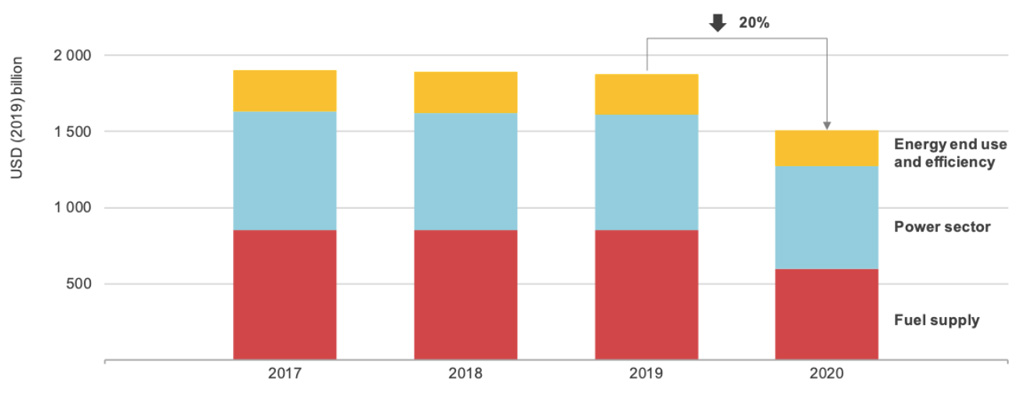
Energy investment is set to fall by a fifth in 2020 due to the coronavirus pandemic. Fuel supply (red) includes all investments associated with the production and provision of fuels to consumers, consisting mainly of oil, gas and coal investments. Power sector (blue) includes spending on power-generation technologies, grids and storage. Energy end use and efficiency (yellow) includes the investment in efficiency improvements across all end-use sectors. Source: IEA

These estimates are based on assumptions about the duration of lockdowns and coronavirus recovery trajectories.

The IEA notes that “almost all” investment activity has been disrupted by these measures, as a result of restrictions to the movement of people, goods and equipment. 

However, the largest impacts are the result of declines in revenues due to falling demand and prices, with the clearest example coming from the oil sector. Analysis of daily data until mid-April suggests countries in full lockdown have seen energy demand drop by a quarter.

As a result, the agency also estimates that these factors, combined with a rise in cases of people not paying their energy bills, will see revenues going to both governments and industry fall by over $1tn this year.

Crisis ‘accelerating’ shift from low-efficiency technologies

Every year energy infrastructure is retired and replaced with new equipment. Typically, the replacement technologies will be cleaner and more efficient, although this is not always the case. 

The coronavirus crisis is expected to have an impact on this rate of turnover and, indeed, it is already contributing to the retirement of some older power plants and facilities, as the chart below illustrates.
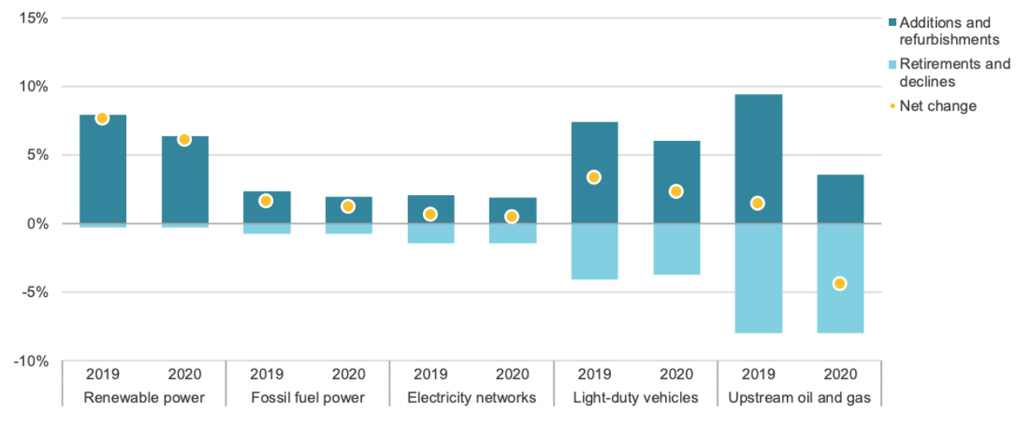
The Covid-19 crisis is hastening the retirement (light blue) of some older plants and facilities, but also impacting consumer spending on new and more efficient technologies (dark blue), with the potential for a net decrease (yellow dot) in upstream oil-and-gas facilities. Source: IEA.

The economic downturn and “surfeit of productive capacity in some areas” as overall demand plummets is already “accelerating” the closure and idling or inefficient technologies, including refineries and some coal-fired power plants.

However, the IEA warns that equally governments might respond to the pandemic by underinvesting in new technologies and remaining reliant on inefficient, older technology. The agency estimates efficiency investment could drop by 10-15% as spending is cut back.

The report warns that policymakers should keep these elements in mind and “combine economic recovery with energy and climate goals”. Dr Fatih Birol, executive director of the IEA, said in a statement that while the pandemic has brought lower emissions it has been “for all the wrong reasons”:

“The response of policymakers – and the extent to which energy and sustainability concerns are integrated into their recovery strategies – will be critical.”

Clean energy spending ‘relatively resilient’

The share of global energy spending going towards clean energy, including renewables as well as nuclear and efficiency improvements, has been flat-lining at around one-third for the past few years.

As the chart below shows, this is likely to change this year as clean energy’s share edges closer to two-fifths of overall spending.
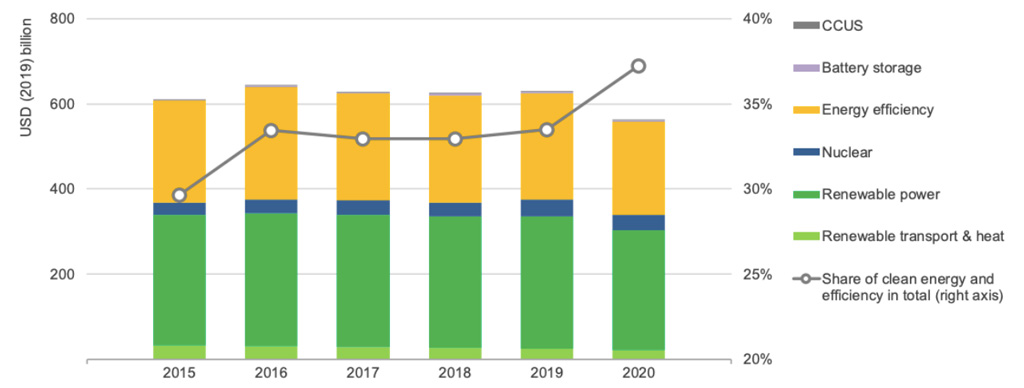
Breakdown of clean energy investment by sector in USD (left x-axis), with the % overall share (right x-axis) of spending indicated by a grey line. Source: IEA.

Clean energy investment is expected to remain “relatively resilient” this year, with spending on renewable projects falling by a comparatively small 10%. 

However, according to the IEA, the main reason for clean energy increasing its share is that fossil fuels are set to take such a “heavy hit”. In absolute terms, spending on these technologies is “far below levels” required to accelerate energy transitions.

The agency notes that investment trends have long been “poorly aligned” with the world’s needs and are still set to fall short of the future it has outlined in its benchmark Sustainable Development Scenario (SDS).

Last year’s edition of the World Energy Investment report concluded that investment in low-carbon energy sources must more than double by 2030 if the world is to meet its Paris Agreement targets.

While the slowdown in clean energy spending is less significant, it still “risks undermining the much-needed transition to more resilient and sustainable energy systems,” according to Birol.

Power sector hit hard

International power investment is set to drop by 10% as a result of the Covid-19 pandemic, according to the agency. 

Virtually every component of the sector is expected to see a decline in investment, with hydro the only exception, as the chart below demonstrates.
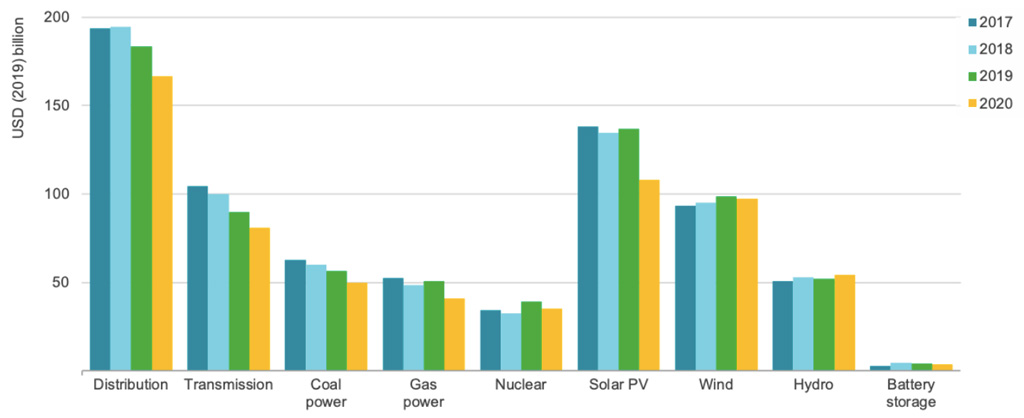
Global investment in the power sector by technology, with figures from the previous three years and estimates for 2020 (yellow). Source: IEA.

Increases in residential electricity demand around the world during lockdown are being “far outweighed” by reductions in commercial and industrial operations, the agency reports. A 9% decline in spending on electricity networks this year is also expected.

The IEA says some parts of power investment are more exposed, specifically fossil fuel-based generation. 

Meanwhile, higher shares of renewables are being dispatched due to low operating costs and priority access to networks. Nevertheless, renewables are still taking a hit, particularly distributed solar photovoltaics (PV) as households and companies cut back on spending.

Technologies with a longer lead time, notably offshore wind and hydropower, are expected to do better despite some delays.

Electricity spending pulls ahead of oil

Oil accounts for most of the decline in revenues expected this year. Furthermore, in a “historic switch” consumer spending on electricity could exceed spending on oil for the first time ever. 

While power-sector revenues are expected to fall by $180bn, oil spending will likely drop by at least $1tn. This can be seen in the chart on the left below. Taken together, investment in oil and gas is expected to fall by almost a third in 2020. 
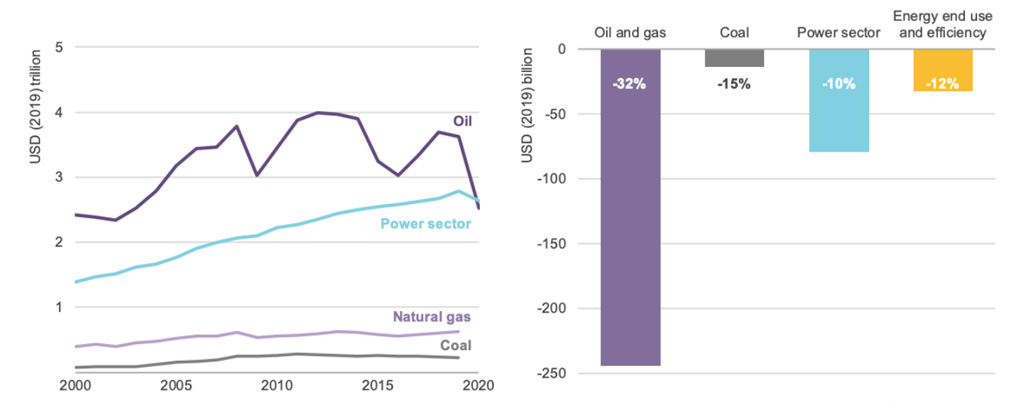
Both global end-use spending by consumers on energy (left) and estimated 2020 investment compared to 2019 show oil is expected to see the biggest decline in investment activity this year. Source: IEA.

The decline in aviation and road transport, which represent nearly 60% of oil demand, are responsible for this disproportionate decline.

Meanwhile, the impact on gas has so far been more moderate, but could fall further due to reduced demand in power and industry settings.

The report also highlights the global shale sector, which was already under pressure, as being particularly vulnerable. 

With investor confidence and access to capital in decline, the IEA predicts shale investment will halve in 2020 and notes the outlook for “highly leveraged shale players in the US” is now “bleak”.

Coal decline given a ‘floor’ by China

Coal is estimated to be the fuel hardest hit by the crisis after oil. Coal demand could drop by 8% this year, investment in coal supply is set to fall by a quarter and spending on new coal-fired plants is set to fall by around 11%.

However, any decline in coal’s fortunes may be curtailed by the recovery of demand for the fossil fuel in China. According to the IEA, investment activity there “may put a floor” under further reductions in coal-power investment this year.

The nation’s focus on coal is illustrated in the chart below, which shows final investment decisions (FIDs) dropping to their lowest levels in a decade, but China providing virtually all of them in the year so far.
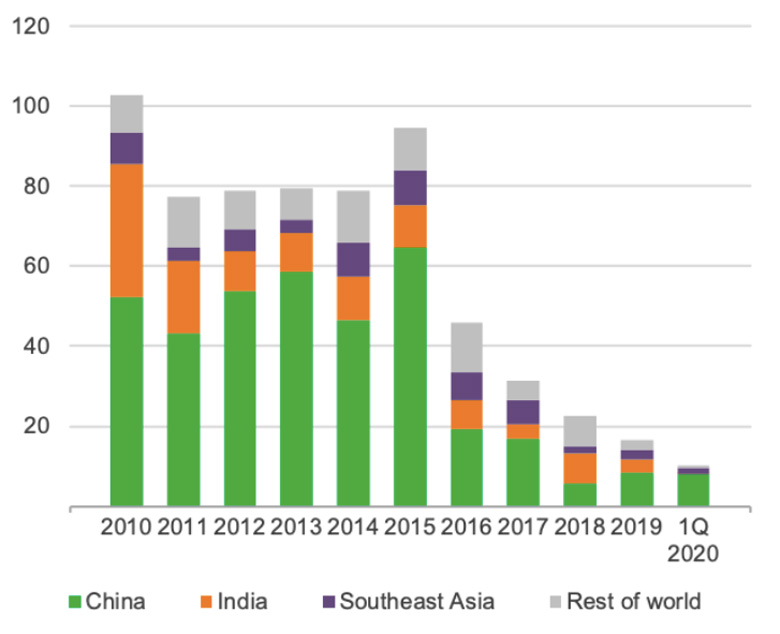
Coal-fired power generation capacity (GW) subject to a final investment decision (FID), with China coloured in green. Source: IEA.

Using data available so far, the IEA notes that approvals for new coal plants in the first quarter of 2020, were “running at twice the rate observed over 2019 as a whole”, primarily in China.

Electric vehicle sales rising as overall market contracts

Last year was a difficult time for the car industry, with total sales growth slowing in all major regions and turning negative in China and the US.

However, this “turbulent” period for the industry is “likely to appear mild” in comparison with 2020, according to the IEA. 

Lockdowns have already severely impacted sales and, across the year, the agency estimates a drop of around 15% – dramatic even compared to the 10% drop that followed the 2008 financial crisis. Negative trends in overall car sales can be seen in the right-hand chart below.
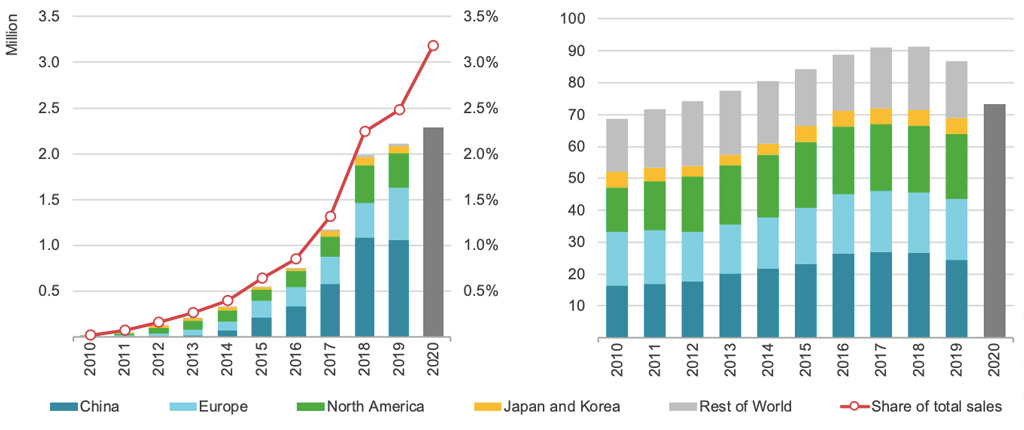
Global sales of electric passenger vehicles – cars, vans and small trucks – and market share, indicated by a red line (left chart). Total light-duty vehicle sales (right). Source: IEA.

However, even though electric vehicle sales followed wider patterns and stalled in 2019 largely due to declining Chinese purchases, their overall market share continued to climb. 

This can be seen in the chart on the left, which shows that electric cars are expected to go against the broader trend in 2020. The IEA estimates that owing to policy support, particularly in Europe, electric vehicle sales will increase this year, as will their share of the market (indicated by the red line).

Battery storage spending fell as prices dropped

Investment in battery storage fell for the first time last year, as the chart below shows. Overall, spending on grid-scale and behind-the-meter batteries fell by 15%, with overall investment just above $4bn.
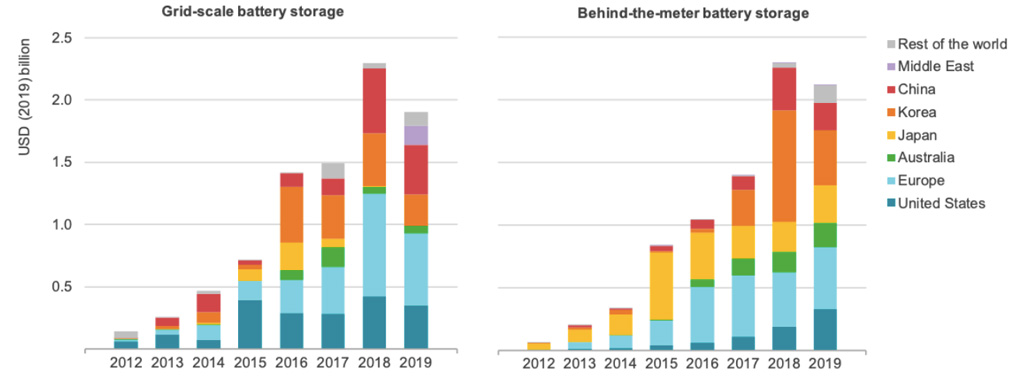
Investment in both grid-scale (left) and behind-the-meter battery storage (right). Source: IEA.

The IEA states this decline took place as costs for battery storage fell rapidly, a trend the agency attributes to maturing supply chains and markets, more efficient production and competition within the sector.

The report mentions fires at energy storage installations in South Korea and regulation uncertainty in China as some of the factors behind the decline in interest last year.

Declining behind-the-meter battery spending also reflects the distributed solar PV market, for which investment slowed last year in a trend expected to continue as consumer spending drops off due to coronavirus.

The agency notes that grid-scale battery investments are also expected to decline this year against the backdrop of a general decrease in power activity. 

However, it says this setback “is likely to be shortlived” due to the technology’s growing importance for system security and flexibility. 

***

IEA: Coronavirus ‘accelerating closure’ of ageing fossil-fuelled power plants

Josh Gabbatiss, Carbon Brief, 27 May 2020

Published under a CC license. Carbon Brief welcomes the reproduction of unadapted material in full for non-commercial use, credited ‘Carbon Brief’ with a link to the article.
IEA: Coronavirus impact on CO2 emissions six times larger than 2008 financial crisis

IEA: Corona virus impact on CO2 emissions six times larger than 2008 financial crisis

Written by Josh Gabbatiss. Published on Carbon Brief, 30 April 2020.

The world’s CO2 emissions are expected to fall by 8% this year as the coronavirus pandemic shuts down much of the global economy, according to the International Energy Agency (IEA).

Such a drop would be the largest ever recorded in terms of tonnes of CO2, some six times greater than the impact of the 2008 financial crisis.

The agency’s new Global Energy Review is based on extensive data from the year so far and is intended to provide close to a real-time estimate of energy usage and emissions.

Its projections for the whole of 2020 are based on a series of assumptions including that the lockdowns, curfews and closure of schools and businesses currently in place are gradually eased over the coming months.

However, as the pandemic spreads and its devastating impacts continue to unfold, the agency makes clear that there are still “major uncertainties” about how it will play out.

The IEA’s central figure of 8% is even higher than previous estimates, including analysis conducted by Carbon Brief and published earlier this month, which was based on a less comprehensive dataset and less recent data.

An 8% cut is roughly equivalent to the annual emissions reductions needed to limit warming to less than 1.5C above pre-industrial temperatures. However, the stretch target laid out in the Paris Agreement would require similar reductions every year this decade.

The agency is clear that the expected decline in emissions due to a pandemic is “absolutely nothing to cheer”. Moreover, it emphasises the importance of prioritising clean energy in economic recovery plans in order to avoid a sharp rebound in emissions.

Unprecedented shock

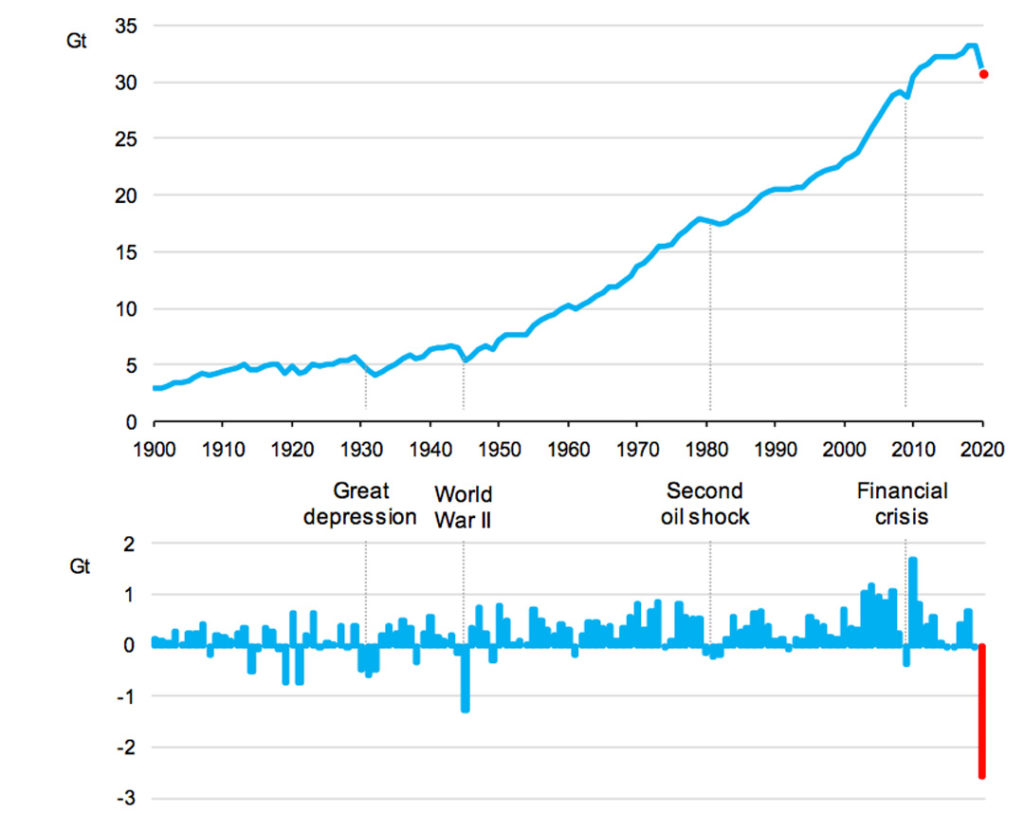
Describing the pandemic as a “a macroeconomic shock that is unprecedented in peacetime”, the IEA draws comparisons with the impact that wars and other recent crises have had on the global energy system. Some of these events can be seen in the figure below.

The report compares the covid-19 pandemic with the last financial crisis, when growth in China and India “was able to largely offset reductions elsewhere”. This time around, both nations are also feeling the effects of the disease and such an offset is unlikely.

Global energy-related emissions (top) and annual change (bottom) in GtCO2, with projected 2020 levels highlighted in red. Other major events are indicated to a give a sense of scale. Source: IEA Global Energy Review.

As it spreads to virtually every nation on the planet, the impact of coronavirus is being felt in all walks of life, but different sectors are being affected in very different ways.

Energy use for residential gas heating or electricity use for server farms and digital equipment may even show a significant increase in the coming months, the IEA says, whereas other sectors such as aviation have collapsed.

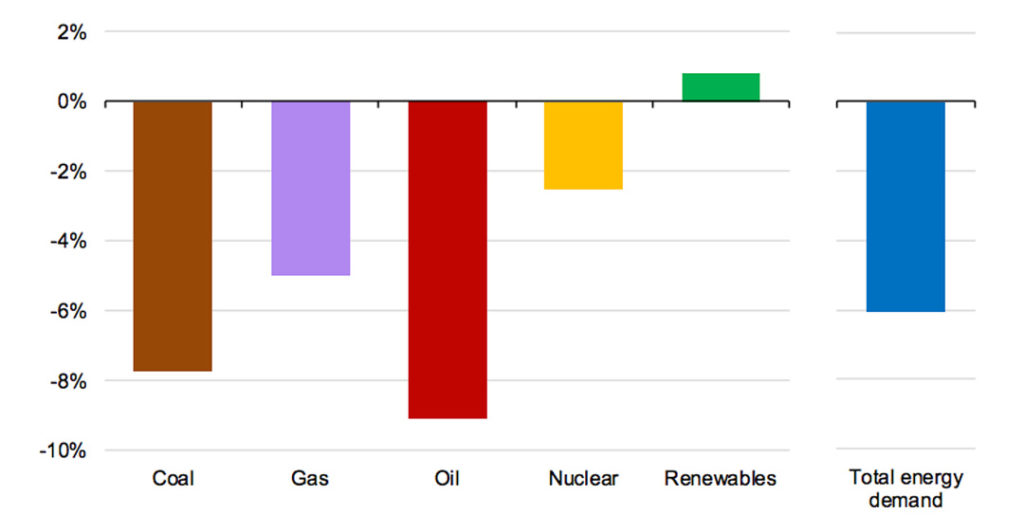
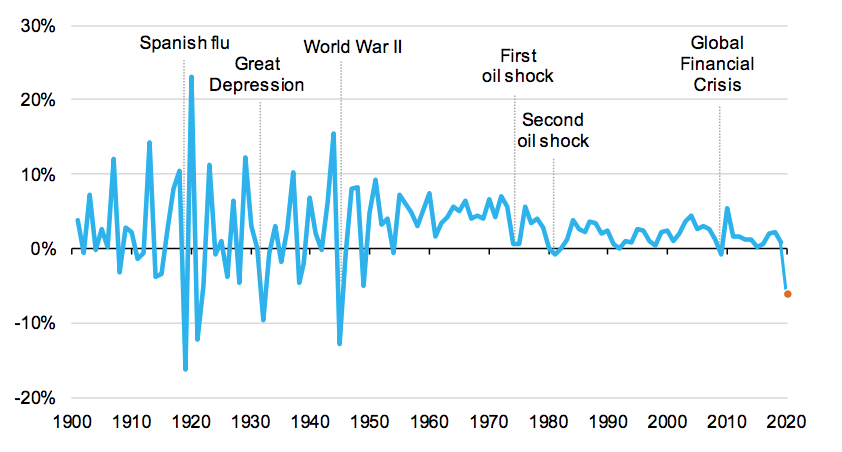
Global energy demand was 3.8% lower in the first quarter of 2020 than last year, the IEA says, and it expects the annual total to drop by 6% year-on-year in 2020. 

Such a decline has not been seen for decades, as the chart below shows, and will effectively wipe out five years of demand growth.

Annual rate of change in primary energy demand, %, since 1900, with key events impacting demand highlighted. Source: IEA Global Energy Review.

CO2 emissions are expected to fall to 30.6bn tonnes of CO2 (GtCO2) this year, an 8% drop from last year, with declining coal use the most significant factor.

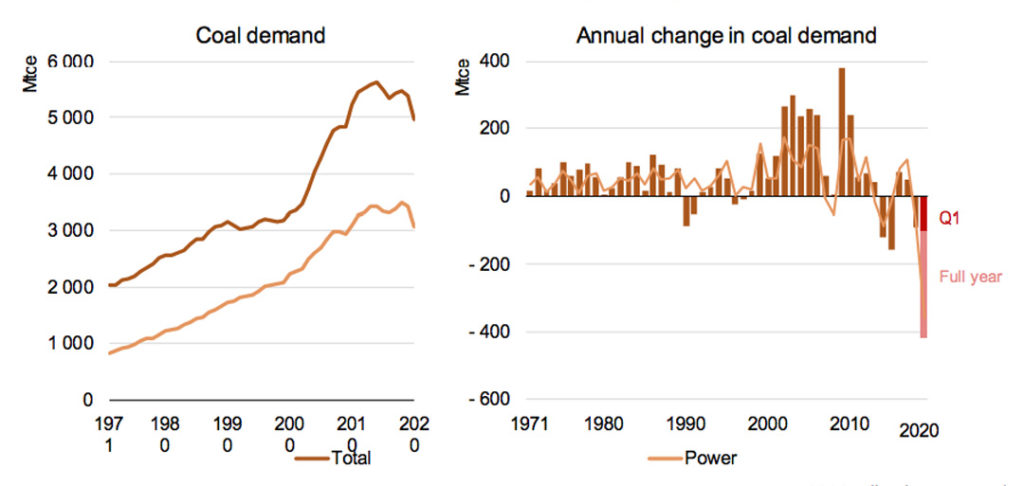
The drop in coal combustion is being driven mainly by the power sector, the IEA says, together with competition from cheap natural gas and industrial slowdown. Coal demand is expected to fall 8%, but as China’s industrial sector starts up again, it is expected to go some way to offsetting larger declines.

Demand (left) and annual change in demand (right) for the total quantity of coal used globally (dark) and coal in the power sector alone (light), measured in million tonnes of coal equivalent (Mtce). The change in demand for the first quarter of 2020 (Q1) is shown in red while the projection for the full year is shown in pink. Source: IEA Global Energy Review

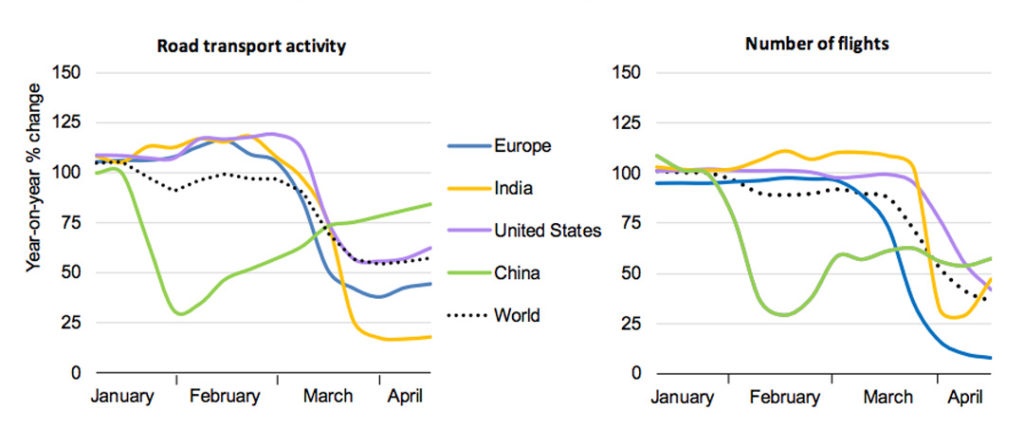
Due to the global lockdown’s impact on transport, illustrated in the charts below, demand for oil has fallen at an “unprecedented scale” in the first four months of the year.

Change in road transport activity and flight numbers as a % in 2020 so far compared to the previous year, for selected countries (solid lines) and the whole world (dashed line). Source: IEA Global Energy Review

This is particularly true for fuels used in passenger transport, namely petrol and kerosene. Meanwhile demand for diesel, a substantial portion of which is used to power vehicles that transport goods, is expected to remain stronger. Overall, oil demand is expected to drop by 9% across the year after a 29% drop in the month of April.

As a side-effect of declining transport activity, car sales are expected to decline. In March, EU sales were 55% lower than 2019 levels, and if this trend plays out in nations with fuel economy standards in place, improvements in energy efficiency will be slower, the IEA notes.

Gas demand is expected to fall less than oil or coal as it is less vulnerable to changes in transportation demand, although the IEA says it could still fall by 5%. Gas will be particularly susceptible if countries in the Middle East and North Africa enter long lockdowns, the agency says, due to their reliance on the fuel for power.

In general, nuclear power is expected to fare better than fossil fuels, with lockdowns expected to reduce global output by 3% due to falling demand and disrupted construction. Already, delays have been announced to projects in China and Finland, and more are expected in the UK, US and France.

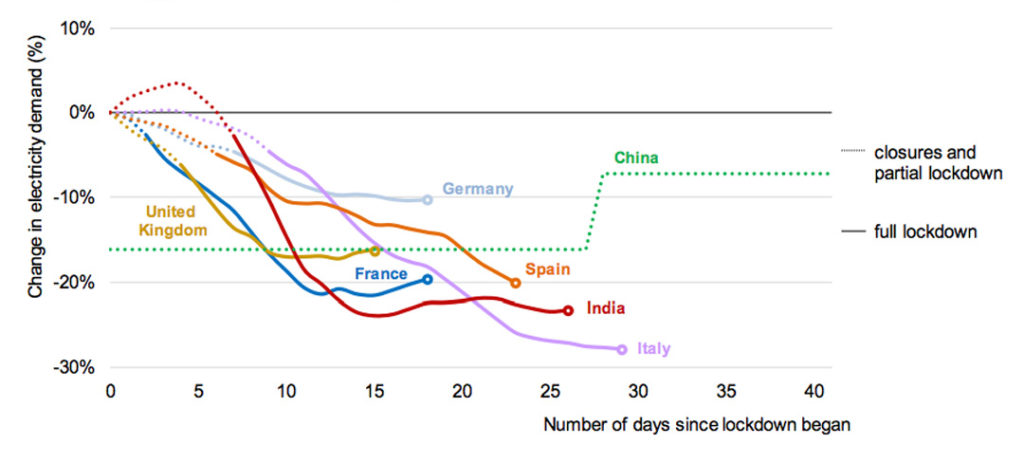
As the figure below shows, lockdowns in recent months have pushed down electricity demand significantly, with the strongest impacts found in nations with service-based economies and the strictest lockdowns, such as Italy.

Weather-corrected change in electricity demand, %, in selected countries implementing full (solid lines) or partial lockdowns (dashed lines), by number of days since their lockdowns began. Source: IEA Global Energy Review

It is worth noting that as pointed out in Carbon Brief’s recent analysis, it is difficult to assign effects specifically to coronavirus as many other factors will influence energy demand and emissions over the course of the year.

As an example, the IEA points to “milder than average” weather throughout most of the northern hemisphere in the first quarter of the year, which played a part in pushing down energy demand due to less gas being used for heating.

Renewables ascend

As fossil fuel use sank in the first few months of 2020, renewables remained stable, as in general they are given priority access to electricity grids and are not required to adjust their output based on demand. 

Combined with rising capacity as new wind and solar facilities are built, this means that renewable electricity generation rose by almost 3% in the first quarter of the year.

As a result, renewables achieved record-high hourly shares in Belgium, Italy, Germany, Hungary and parts of the US. Analysis just published by Carbon Brief shows a similar trend, with wind and solar reaching a record-high share of generation across Europe over the past 30 days.

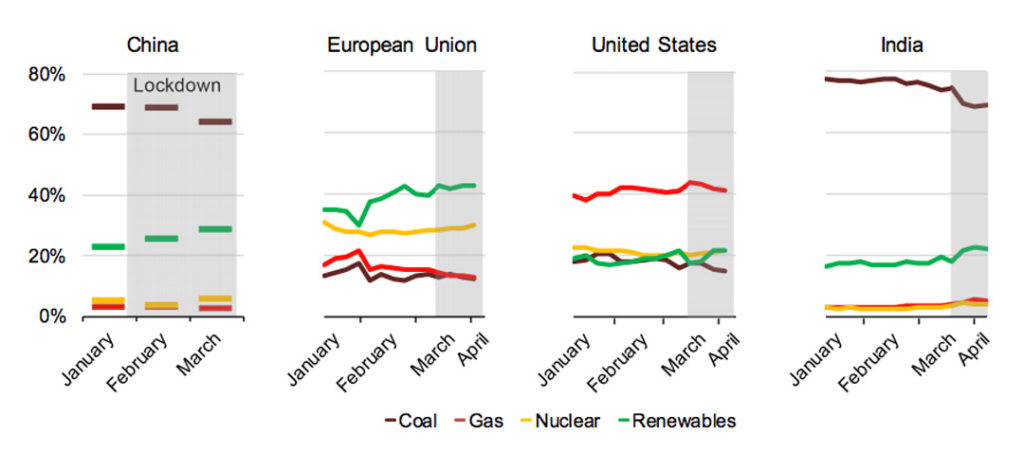
These records reflect a rising renewable share of the electricity mix of countries around the world – where demand has declined during lockdowns – as shown in the chart, below.

Changes in the electricity mixes of key emitters in 2020 so far, with the implementation of lockdown strategies indicated by grey shading. Source: IEAGlobal Energy Review

In fact, renewables are also the only energy sources expected to grow this year “regardless of the length of lockdown or strength of recovery”, the report states. This can be seen in the figure below.

Projected % change in primary energy demand by fuel type in 2020 compared to the previous year, with renewables (green) showing the only positive change. Source: IEA Global Energy Review

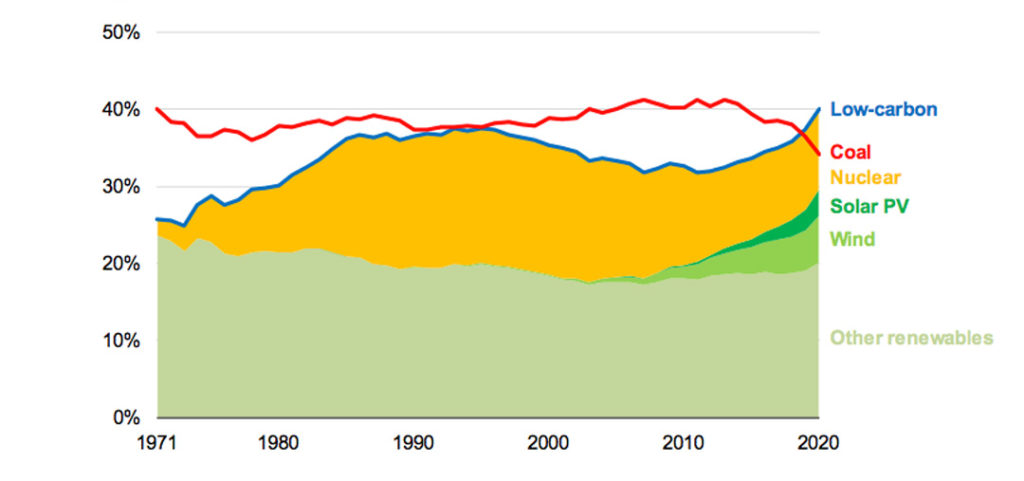
The chart below shows how a pandemic recovery, in which restrictions are gradually loosened over the course of the year, is expected to push low-carbon electricity sources to 40% of power generation in 2020, extending the slight lead on coal achieved last year. This would be the highest level on record, albeit due in part to a 5% dip in total electricity demand.

Global generation % shares from coal (red line) and low-carbon sources (shaded area), including nuclear (yellow) and all renewables (different shades of green). Source: IEA Global Energy Review

New projects coming online this year are expected to increase wind and solar’s share of global electricity generation up to 9%, twice as high as levels seen just five years ago.

The IEA estimates total renewable energy use, including for heat and transport, will rise by about 1% in 2020, and there will still be an increase even if economic recovery is slow. 

However, despite being more resilient than other industries, the renewable sector has still faced challenges. The end of 2020 marks an important deadline for new wind projects in the US and China to receive tax credits and subsidies, but progress on these projects is now highly uncertain.

In a recent blog post, IEA analyst Heymi Bahar writes that what was meant to be “an outstanding year for renewables” has been hindered by supply chain and labour disruptions linked to the pandemic.

Wind turbine manufacture has been hit particularly hard due to a very global supply chain compared with solar panels, which are largely manufactured in China.

Methods and discrepancies

When Carbon Brief attempted to calculate a figure for total CO2 emissions decline this year due to coronavirus, it reached a slightly more modest figure of  5.5%, compared to the IEA’s 8%.

This analysis was based on five key datasets that cover roughly three-quarters of the world’s annual CO2 emissions, with the expectation that the elements not covered would have added to the final total.

The IEA has access to a much larger array of detailed information, and its analysis was based on data available up until mid-April including country submissions to the IEA, other statistical releases from national administrations and estimates by the agency itself when official data was missing.

Published on Carbon Brief, 30 April 2020, under a CC license. Unadapted material may be reproduced in full for non-commercial use, credited ‘Carbon Brief’ with a link to the article.