
inflection point? · oil major tears up the industry’s financial playbook

In August 2014 Simon Evans of Carbon Brief, reporting on a white paper, “Fossil fuel divestment: a $5 trillion challenge,” published days earlier by Bloomberg New Energy Finance, noted that “‘fossil fuels are investor favourites for a reason’….fossil fuel investments have a history of strong performance.

BNEF looked at seven alternative trillion-dollar sectors and found that only shares in real estate firms have paid higher dividends in recent years than fossil fuel firms.”

(Simon Evans, “Why fossil fuel divestment won’t be easy,” Carbon Brief, 27 August 2014)

Fast forward to today. Due to the impact of the Covid-19 pandemic, global energy demand in the first quarter of 2020 was 3.8% lower than in the same quarter of 2019. The IEA expects global energy demand for 2020 to decline by 6% year-on-year, a decline not seen for decades.
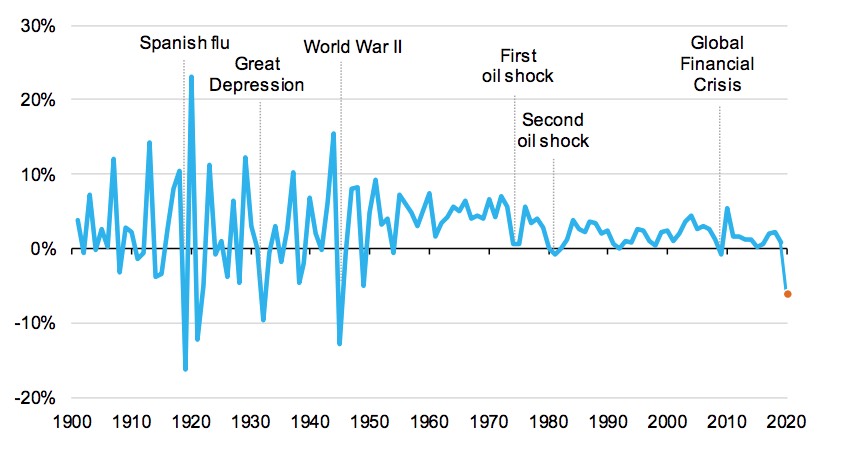
Annual rate of change in primary energy demand, %, since 1900, with key events impacting demand highlighted. Source: Josh Gabbatiss, “IEA: Coronavirus impact on CO2 emissions six times larger than 2008 financial crisis,” Carbon Brief, 30 April 2020; IEA Global Energy Review

The fossil fuel sector, consistently a source of large dividends over the years, is suddenly under market stress and scrutiny from investors.

While “most analysts expected the world’s largest Western super majors … to defend their dividend at almost any cost given how important the payouts are to North American investors” (Kevin Crowley, Exxon Freezes Dividend for First Time in 13 years Amid Crash, Bloomberg, 29 April 2020), Royal Dutch Shell, Europe’s largest oil company, shocked the investing world.

Shell both reduced its dividend, the first time it has done so since World War II, for Q1 2020 and, observing that it would be neither “wise” nor “prudent” nor “responsible” to do so, announced it will not follow industry practice of borrowing against its balance sheet to finance the dividend payment.

The Board of Royal Dutch Shell plc (“RDS” or the “Company”) today announced an interim dividend in respect of the first quarter of 2020 of US$ 0.16 per A ordinary share (“A Share”) and B ordinary share (“B Share”), reduced from the US$ 0.47 dividend for the same quarter last year.

The pace and scale of the societal impact of COVID 19 and the resulting deterioration in the macroeconomic and commodity price outlook is unprecedented. The duration of these impacts remains unclear with the expectation that the weaker conditions will likely extend beyond 2020.

“In response, Shell has taken decisive actions to reduce our spending and position our businesses to compete in the current lower commodity price environment and uncertain demand outlook.

“The Board of Royal Dutch Shell has taken the decision to reset its dividend to provide financial resilience and further flexibility to manage the uncertainty. Shell is taking the steps necessary to ensure that we are well-positioned for the eventual economic recovery.

(“Royal Dutch Shell plc first quarter 2020 interim dividend,” 30 April 2020)

Not only did the dividend reduction, coupled with CEO Ben van Beurden’s further announcement that Shell would not take on debt to fund its dividend payment, shock investors, it also “tore up the industry’s playbook.”

When the boss of Royal Dutch Shell Plc slashed his dividend on Thursday, he didn’t just shock investors,” Laura Hurst of Bloomberg commented, “he tore up the industry’s financial playbook.

For decades Big Oil has used the strength of a large balance sheet to borrow money when the going gets tough and keeps investors sweet until the next upward cycle.

As the coronavirus pandemic potentially causes lasting damage to energy demand, Europe’s largest oil company asked whether this strategy is sustainable.

“’I would say no,’ said Shell Chief Executive Officer Ben van Beurden. ‘It’s also not wise and prudent, nor even responsible, to pay out a dividend if you know for sure you have to borrow for it.‘”

(Laura Hurst, “Shell’s Dividend Cut Shows This Time is Different for Big Oil,” Bloomberg, 30 April 2020)

Norwegian multinational energy company Equinor (OSE:EQNR,NYSE:EQNR; formerly Statoil) announced on 23 April a cash dividend of US$ 0.09 per share for the first quarter 2020, a reduction of 67% compared to the dividend proposed for the fourth quarter 2019.  

On 28 April, BP announced an interim dividend of 10.50 cents per ordinary share for the first quarter of 2020.

Gaurav Sharma, Senior Contributor at Forbes, observing that whilst first quarter profits at BP have decreased by 67% on lack of oil demand and the crude oil price crash, the company “sprung a surprise for the market by maintaining the company’s 10.5 U.S. cents per share dividend payment, hiked by 2.4% as recently as February.”

The move,” Mr. Sharma noted, “will come as a relief to beleaguered U.K. income funds that have seen over $18.6 billion in payouts cancelled or suspended over the last six weeks.

Collectively, HSBC, GSK, Royal Dutch Shell, British American Tobacco and BP accounted for 40% of FTSE 100 dividend payouts in 2019. With BP promising to payout, HSBC holding back following regulatory pressure, GSK, BAT and Shell, which hasn’t failed to pay a dividend since the Second World War II, appear to be in the bag.”

(Gaurav Sharma, “Profits Slump 67% At BP But Oil Major Maintains Dividend Despite Coronavirus Downturn,” Forbes, 28 April 2020)

On 29 April, Exxon Mobil Corp., based in Irving, Texas and the largest oil company in the Western Hemisphere, announced that for the second quarter 2020 it will pay a dividend of 87 cents per share. This is the same amount that was paid per share for the first quarter of 2020.

For the first time in 13 years, ExxonMobil “froze” its second quarter dividend to the amount paid in the first quarter.

Kevin Crowley of Bloomberg notes “Before now, Exxon had an uninterrupted streak of April increases going back to 2007.”

Most analysts expected the world’s largest Western super majors, including Exxon, to defend their dividend at almost any cost given how important the payouts are to North American investors. Before today, Exxon was the third-largest dividend payer in the S&P 500 Index behind Microsoft Corp. and AT&T Inc., according to data compiled by Bloomberg.”

The freeze may not derail Exxon’s multi decade streak of annual increases,” Mr. Crowley continues. “Even if the company maintains quarterly payouts at the current level for the rest of 2020, the annual outlay will be $3.48 a share, or 1.5% above 2019.

“’It’s definitely a sign of the times and to be expected given the price environment,’ said Jennifer Rowland, an analyst at Edward D. Jones &Co. The payout is “secure” because the company has capacity to take on debt to fund it, she said. On an annualized basis, the dividend will cost Exxon almost $15 billion this year.”

(Kevin Crowley, Exxon Freezes Dividend for First Time in 13 years Amid Crash, Bloomberg, 29 April 2020)

See:

Josh Gabbatiss, “IEA: Coronavirus impact on CO2 emissions six times larger than 2008 financial crisis,” Carbon Brief, 30 April 2020

First Quarter 2020 Interim Dividend,” Royal Dutch Shell Plc, 30 April 2020

Laura Hurst, “Shell’s Dividend Cut Shows This Time is Different for Big Oil, ” Bloomberg, 30 April 2020

Dividend Information, ExxonMobil dividends per common share,” Exxon Mobil, 29 April 2020

Kevin Crowley, “Exxon Freezes Dividend for First Time in 13 years Amid Crash,” Bloomberg, 29 April 2020

BPp.l.c. Group results, First quarter 2020“, 28 April 2020

Gaurav Sharma, “Profits Slump 67% At BP But Oil Major Maintains DividendDespite Coronavirus Downturn,” Forbes, 28 April 2020

Equinor reducing quarterly cash dividend for first quarter 2020 by 67%,” Equinor, 23 April 2020

Mikael Holter, “Norway Oil Giant Slashes Dividend to Weather Oil-Market Crash,” Bloomberg, 23 April 2020

Financial Times, “Shell dividend cut puts Big Oil investment case in focus” 

Simon Evans, “Why fossil fuel divestment won’t be easy,” Carbon Brief, 27 August 2014

Nathaniel Bullard, “Fossil fuel divestment: a $5 trillion challenge,” White Paper, Bloomberg New Energy Finance, 25 August 2014

Gutai masterpiece ・ Sadamasa Motonaga’s “Work 145” of 1964

Art Basel opens in Switzerland next week.

London-based Alexandre Carel, former Christie’s Paris wunderkind, Stanford MBA, summer intern in real estate at New York-based, global investment firm KKR (Kohlberg Kravis & Roberts; KKR manages multiple alternative asset classes, including private equity, energy, infrastructure, real estate, credit and, through its strategic partners, hedge funds),

and Paris-based gallery Natalie Seroussi are collaborating to curate a booth

exploring post-war Asian and European abstraction.

Carel and Seroussi’s catalogue “Lands of Abstraction,” prepared for their Art Basel joint exhibition, explores abstract movements that arose almost simultaneously in Asia, Europe, and the United States – all of which “matured in parallel to one another.”

Among the many masterpieces on view will be Sadamasa Motonaga’s almost nine-foot “Work 145” of 1964. Asking price: $5 million.

Sadamasa Motonaga (元永 定正, 1922-2011) was a founding member of Japan’s Gutai Art Association (1954-1972).

His “Work 145” of 1964, last shown in New York at the Guggenheim Museum during the 2013 exhibition “Gutai: Splendid Playground,” reflects Gutai’s deep connection to nature, the process of art making, and life-affirming rationale

Carel and Seroussi write:

“Literally translated as ‘concreteness,’ Gutai’s intention was to impart life to matter and reach pure creativity.

“To artists such as Sadamasa Motonaga …, this goal could only be attained by way of a deep connection between the artist’s hand and his spirit.”

See:

  1. Massive Motonaga Stars at Carel & Seroussi Booth at Art Basel,” Marion Maneker, Art Market Monitor, 5 June 2018;
  2. 2) “Lands of Abstraction,” Natalie Seroussi Galerie, Paris & Alexandre Carel, London, Art Basel Highlights, June 2018


#art #arthistory #artmarket #artbasel #gutai #guggenheim #guggenheimmuseum #postwarabstraction #abstraction #japan #natalieseroussi #alexandrecarel #stanford #stanforduniversity #mba #collection #portfolio #collectionsdevelopment #environmentalcollectionsmanagement #co2 #nature #basel #newyork #london #paris #zurich #milan #dubai #hongkong #tokyo #seoul #asia #europe #tech #luxury #design #realestatedevelopment #entrepreneur #investments #investor #privateequity #energy #infrastructure #realestate #credit #hedgefunds

global investment in renewable energy & energy-smart technologies

Annual figures from Bloomberg New Energy Finance (BNEF) show that global investment in renewable energy and energy-smart technologies reached $333.5 billion last year, up 3% from a revised $324.6 billion in 2016, and only 7% short of the record figure of $360.3 billion, reached in 2015.

Chinese investment in all the clean energy technologies was $132.6 billion, up 24% setting a new record. The next biggest investing country was the U.S., at $56.9 billion, up 1% on 2016.

Solar led the way, as mentioned above, attracting $160.8 billion – equivalent to 48% of the global total for all of clean energy investment.

Wind was the second-biggest sector for investment in 2017, at $107.2 billion. Down 12% on 2016 levels.

The third-biggest sector was energy-smart technologies, where asset finance of smart meters and battery storage, and equity-raising by specialist companies in smart grid, efficiency, storage and electric vehicles, reached $48.8 billion in 2017, up 7% on the previous year and the highest ever.

See:

Runaway 53GW Solar Boom in China Pushed Global Clean Energy Investment Ahead in 2017” | Bloomberg New Energy Finance, 16 January 2018

#cleanenergy #renewableenergy #energy #finance #solar #wind #energy-smarttech #tech #investments #luxury #smartluxury  #realestate #commercialrealestate #resilience #CO2


energy-efficient buildings & significant ROI

The return on investment in energy-efficient building features is significant and results accrue to corporate bottom lines.

According to the Morgan Stanley Research report, “Building Energy Efficiency,” the ROI in energy-efficient features can lower the cost of ownership by 50% for commercial buildings.

Green buildings” can yield significant savings at every scale of construction, operations and maintenance. Rising global demand for such buildings is fueling growth of a high-tech, industrial-strength sector focused on delivering state-of-the-art building materials, equipment and energy management.

Observes Europe-based Sustainability Analyst Faty Dembele,

With residential, commercial and public buildings accounting for more than an estimated 30% of the world’s energy consumption, this is an area of growing interest for consumers, building owners, tenants and regulators.”

See:

Green Buildings Power Savings & Return” | Morgan Stanley Research, 20 June 2017

#realestate #commercialrealestate #CRE #residentialrealestate #ROI #finance #investments #greenbuildings #resilience #energy #luxury #smartluxury #urbansmart #art #MorganStanley

bricks, mortar, health, wellness, & sustainable amenities → enhanced value + premium pricing

AMLI Residential, a company founded in 1980, owned by PRIME Property Fund, a core commingled institutional fund, and focused on the development, acquisition, and management of luxury apartment communities in the United States, has recently completed the first AMLI Sustainable Living Index. Residents of AMLI apartment properties were asked after their views of sustainability and green living. The survey was conducted in August of this year at properties in Atlanta, Austin, Chicago, Dallas, Denver, Houston, Seattle, Southern California and Southeast Florida.

There were 2,812 respondents. 12 percent of the respondents were younger than age 25, 47 percent were ages 25-34, 16 percent were ages 35-44, and 25 percent were 45 or older.

A majority of residents are willing to pay slightly more to live in a “green” residence

The survey indicates that a majority of residents are willing to pay slightly more to live in a “green” residence.

64% of respondents are willing to pay more for sustainable housing

84% of respondents say living in sustainable homes is important to them

85% of respondents believe living in sustainable homes is beneficial to their health.

The following features are most valued by respondents:

a smoke-free community – 94% of respondents

energy- and water-efficient features – 93% of respondents

access to public transit/ strong walk and bike scores  – 85% of respondents

77% of respondents report that AMLI’s green living features have saved them money in utility costs.

Resilience

AMLI Vice President of Sustainability Erin Hatcher discusses the resilience factor. Buildings can be made more resilient to environmental, market, and regulatory risks through the incorporation of a holistic features. “Utility price increases, unpredictable power outages and other unforeseen events just don’t affect them as much as their less environmentally-friendly counterparts.”

Sustainability is good business when done right & done smart

Ms. Hatcher reports:

Sustainability is good business when done right and done smart. In multifamily residential, a developer should consider a sustainably holistic approach that includes value adds for the resident, our buildings, and the immediate communities where they reside. Operating costs, and ultimately residents’ utility bills, can be reduced through LEED-targeted construction, as well as efficient HVAC, lighting, and water systems. These […] enhance both the resident experience and asset values. Efficient systems can go far to decrease the wear-and-tear (i.e., maintenance costs) on the property’s equipment and the overall power and water grids, too.

Green buildings are also more resilient to environmental factors. Utility price increases, unpredictable power outages and other unforeseen events just don’t affect them as much as their less environmentally-friendly counterparts. Similarly, avoiding potentially harmful building materials promotes the longevity of our buildings and the health of residents who live in them. More frequent fresh air exchanges and non-smoking policies at sustainable communities add to the health benefits. Keeping residents safe and comfortable in their home is always top priority, but that need not conflict with our sustainable mission, nor erode the bottom line.

Sustainability on the community level is often overlooked, yet is a by-product of any eco-conscious development. Adding green space and rainwater management features such as rain gardens or ponds have great civic potential at a low cost. These efforts provide scenic, natural amenities for building residents and the community at-large, while reducing the loads on shared, often aged community infrastructure, especially storm-water drainage.”

Twenty-eight AMLI properties (more than one-third of the company’s portfolio) are LEED (Leadership in Energy and Environmental Design) certified and 15 AMLI communities are ENERGY STAR certified.

AMLI received two awards this month from the U.S. Green Building Council (USGBC):

the Outstanding Multi-Family Developer LEED Homes award for its outstanding leadership and innovation in the residential green building marketplace, and

the LEED Power Builder award, which recognizes developers that certify at least 90 percent of their units built in the past year.

AMLI currently owns and manages 59 apartment communities including more than 19,900 apartment homes and has approximately 4,600 additional apartment homes under development at 14 new properties.


See:

Residents Will Pay More for Sustainable Spaces, Says Survey” | Jennifer Hermes, Environmental Leader, 20 September 2017

New Survey: 84 Percent of Residents Say Living in a Green Home is Important to Them; 85 Percent Believe Living in a Green Home Benefits Their Health” | Business Wire, a Berkshire Hathaway Company, 18 September 2017

Leaders Unveil Their Secrets: Business Case for Environmental Stewardship” | Jennifer Hermes, Environmental Leader, 18 July 2017

Bricks, Mortar, and Carbon | How Sustainable Buildings Drive Real Estate Value” | Morgan Stanley Institute for Sustainable Investing, March 2016

#realestate #commercialrealestate #investments #finance #ROI #bottomline #sustainability #resilience #health #wellness #value #enhancedvalue #luxury #smartluxury #AMLI #USGBC #LEED #EnergyStar #BerkshireHathaway

art storage & protection @ $1+ billion globally

The global art market generated sales of about $65 billion in 2016 according to the TEFAF Art Market Report 2017.

The growing, global network of facilities to store art now generates revenues of over $1 billion a year. Many of these spaces serve multiple objectives – including security, environmental protections, and trade: Sto

  • security
    • video surveillance
    • retinal scanning
  • space | collectors have too much to keep at home
  • protection
    • climate-controlled environments
    • fire-resistant walls
    • air-filtration
    • flood control
    • LEED and BREEAM building certifications
  • investment purchases
  • tax benefits
  • tax-suspended transport to and from galleries | as long as works of art return to storage no duty is payable, even if ownership of the art has changed
  • “1031 exchange” friendly
  • gallery inventory between shows and art fairs
  • storage of art taken by banks as collateral against loans
  • viewing rooms that can be rented on a more permanent basis | in-house, private sales and transfers of ownership
  • passport free access (freeports within airport perimeters)

Simon Hornby, the president of Crozier Fine Arts, estimates that 80% or even more of all the world’s art is in storage at any one time.

The art storage business has doubled in size in eight years and continues to grow.

“Until about ten years ago, Modern and contemporary art collectors were mainly made up of art enthusiasts and amateurs, they had a real passion, spending their money on what they liked; they collected in order to simply enjoy the work in their home environment. Today you have to work with an increasing number of art funds or speculators buying art for investment. Art buying has become accessible to a much larger audience than before and is considered an asset. The result of this is that more work sleeps in warehouses rather than hanging in collectors’ homes.”

Stephane Custot, Waddington Custot Gallery, London

“In the last year, I only physically saw one piece of art that I negotiated. Everything else was bought and sold via jpegs and remained in storage. It was all for investment.”

New York dealer and appraiser

In order to protect the assets, moreover, built environment investment is attempting to keep up with the evolution of demand, including security and environmental protections.

A state-of-the-art storage facility with “foreign trade zone” (FTZ) status (a freeport), ARCIS Fine Art & Collection Care, is under construction on Manhattan’s West 146th Street. Developed by Cayre Equities, the project has taken two years and over $40 million. Executive Director Tom Sapienza and Tom Lay, both formerly with Crozier Fine Arts, were recruited by art collector, real estate developer, and Crozier founder Ken Cayre to manage the project.

The five-story, 110,000 square foot is scheduled to open next month (July 2017).  ARCIS is Latin for “fortress”. The facility is designed and engineered to provide and enhance both environmental and security protections.

With the objective of constructing a museum-quality, sustainable, state-of-the-art secure building, Sapienza and Lay took crash courses in thermal dynamics and consulted with the professional services branch of the Van Gogh Museum in Amsterdam. Works of art will be scanned as they move through the building. State-of-the-art air filters are installed; air will change three to six times an hour.  LEED and BREEAM certifications are to be achieved for the building.

See:

TEFAF’s 2017 Art Market Report” | Marion Maneker, Art Market Monitor, 6 March 2017

TEFAF Art Market Report 2017” | Prof. Dr. Rachel A.J. Pownall, TEFAF Chair in Art Markets, The European Fine Art Foundation, March 2017

Where does all the art go after a fair?” | Georgina Adam, The Art Newspaper, 16 June 2017

Picasso Finds Possible Digs in Harlem $2.5 Billion Art Port” | Katya Kazakina, Bloomberg, 2 March 2017

Will New York Get Its Own Freeport for Art? ARCIS Plans a Tax Haven in Harlem” | Eileen Kinsella, Artnet, 2 March 2017

One of the World’s Greatest Art Collections Hides Behind This Fence” | Graham Bowley & Doreen Carvajal, The New York Times, 28 May 2016

About Foreign-Trade Zones and Contact Info” | U.S. Customs and Border Protection, U.S. Department of Homeland Security

#realestate #resilience #smartluxury #art #LEED #BREEAM #finance #investments #artcollections #artmarket #VanGoghMuseum #museums


climate change as opportunity・developing economic value through investments in resilience

From a Dutch mind-set, climate change is neither a hypothetical , nor a drag on the economy, nor an ideology. For the people of the Netherlands climate change is an opportunity – to let water in, where possible, to live with water rather than struggle to defeat it – with added economic value developed through investing in resilience.

People in the Netherlands believe that the places with the most people and the most to lose economically should get the most protection.

To the Dutch, what’s truly incomprehensible is New York after Hurricane Sandy, where too little has been done to prepare for the next disaster.

The idea that a global economic hub like Lower Manhattan flooded during Hurricane Sandy, costing the public billions of dollars, yet still has so few protections, dumbfounds climate experts in the Netherlands.

See:

The Dutch Have Solutions to Rising Seas. The World is Watching” | Michael Kimmelman, The New York Times, 15 June 2017

#climatechange #realestate #resilience #Rotterdam #investments #economicvalue

Apple issues second green bond, a $1 billion bond to finance renewable energy & closed-loop supply chain

Yesterday Apple issued its second “green bond”, a $1 billion bond dedicated to financing renewable energy, energy efficiency at Apple facilities and throughout its supply change, to close its supply chain loop, and procure safer materials for its products. 

The bond offering includes a specific focus on helping Apple meet a goal of

  • developing a closed-loop supply chain and
  • using only renewable resources or recycled material in the manufacture of its products.

The bond is to mature in 2027 and will yield 95 to 100 basis points more than Treasuries. Bank of America Corp., Goldman Sachs Group Inc. and JPMorgan Chase & Co. arranged the sale.

Investors are seeking lower-carbon investments. Demand for green bonds is growing significantly.

According to the Climate Bonds Initiative, in 2016 $81 billion of green bonds were issued. This is double the number of green bonds that were issued in 2015.

See:

Apple Issues a Second Green Bond to Finance Clean Energy” | Alex Webb, Bloomberg, 13 June 2017

Apple issues $1 billion green bond after Trump’s Paris climate exit” | by Valerie Volcovici, Reuters, 13 June 2017

Climate Bonds Initiative | “Climate Bonds Initiative is an international, investor-focused not-for-profit. We’re the only organisation working solely on mobilising the $100 trillion bond market for climate change solutions.”

#Apple #finance #greenbond #GoldmanSachs #BankofAmerica #JPMorganChase #renewableenergy #cleanenergy #investments #bondmarket #climatechange #climatechangesolutions