art, philanthropy, energy: in transition

· renewable energy sources are set to account for nearly 21 percent of the electricity the United States uses for the first time this year, up from about 18 percent last year and 10 percent in 2010

· renewable energy provides 18% of total U.S. power generation, up from 10% in 2010

· corporate PPA’s for renewal energy accelerated from 0.1 GW in 2010 to33.6 GW by year-end 2019, with a record breaking 13.6 GW in 2019 alone.

· the carbon intensity of the power sector continues to decline. From 2010 to 2019, power sector emissions fell nearly 25%

· total U.S. greenhouse gas (GHG) emissions have fallen 4.1% over thepast decade, and now sit at roughly 12% below 2005 levels

2020 Sustainable Energy in America Factbook”, produced for the Business Council for Sustainable Energy by BloombergNEF

Art, philanthropy, energy. The relationships between them have history. As the way we generate energy evolves, the relationships between art, philanthropy, and energy will, in all likelihood, evolve as well.
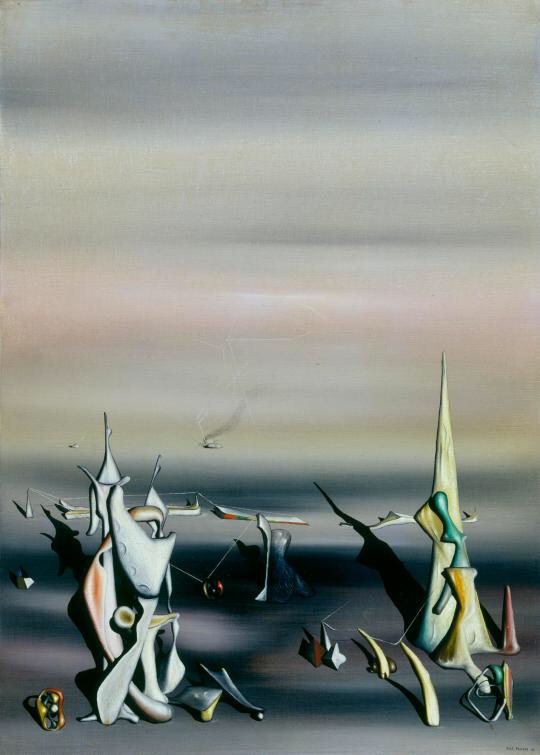
Yves Tanguy (French, 1900-1955), “What” (oil on canvas, 1940), in the collection of the Museum of Fine Arts, Houston. The Joseph and Sylvia Slifka Collection. Object Number: 2004.146

“Houston,” observed Gary Tinterow, Director of the Museum of Fine Arts, Houston, in 2019, “is a cultural capital largely thanks to the discovery of oil.” (Houston Chronicle)

Yet, the energy economy is shifting in Texas. Renewable energy constitutes an ever increasing percentage of energy produced and used in Texas. 

Texas, a competitive rather than regulated energy market, is first in the United States in wind power capacity and near to having the second-most capacity for solar PV after California.

Solar energy has a significant (“marvelous”) cost advantage over gas-fired power plants: the marginal cost of solar is zero. Texas is on course to build a quarter of the record new industrial-scale solar capacity being installed across the United States in 2020.

As the energy economy evolves, how will the philanthropy that supports so many museums and cultural institutions evolve?

Let’s begin our quest for understanding by taking a look at relationships between art, philanthropy, and energy. We’ll start by looking to Texas.

The U.S. state of Texas consumes the most electricity in the United States. Demand for energy in Texas has grown over five percent over the past five years even as it has declined nationwide (EIA as reported in the FT).

Adding solar power through the incentives of a competitive electricity market, Texas is near to having the second-most capacity for solar PV after California. Texas, further, now ranks first in the United States in wind power capacity.

Texas is home to the Museum of Fine Arts, Houston (MFAH). The MFAH is one of the largest museums in the United States. As of late 2011 it had the third-largest museum endowment.

The permanent collection of the MFAH consists of nearly 70,000 works from throughout the world, from antiquity to the present day (MFAH) .

Gary Tinterow, Director of the MFAH, grew up in Houston. He worked at New York’s Metropolitan Museum of Art for 28 years, serving from 2008 until his departure for Houston as chairman of the department of 19th-century, modern and contemporary art. Mr. Tinterow’s appointment as Director of the MFAH was finalized by the museum’s board of trustees in late November 2011. He started his new position in early 2012.

Richard D. Kinder, co-founder (February 1997) and now Executive Chairman of Kinder Morgan, Inc., one of North America’s largest energy infrastructure companies, serves as Life Trustee of the museum and Chairman of the Board of Trustees. Mr. Kinder served as chairman of the museum’s search committee that identified Mr. Tinterow as a candidate for the directorship of the museum.

The business of Kinder Morgan is involved primarily with oil, gas, and petroleum products. Kinder Morgan “owns an interest in or operates 83,000 miles of pipelines and 147 terminals. The company’s pipelines transport primarily natural gas, refined petroleum products, CO2 and crude oil and its terminals store, transfer and handle such products as gasoline, ethanol, coal, petroleum coke and steel.” (Kinder Morgan)

Mr. Kinder commended Mr. Tinterow: “Gary’s passion for the job and his encyclopedic knowledge were what convinced us. He has so many good ideas, and there is so much potential to make this one of the outstanding museums of the world.” (NYTimes)

For his part, Mr. Tinterow explained, “As sorry as I will be to leave the Met after 28 years, I think I’ve landed the best job in the world. It’s a matchless combination: a committed board, a passionate audience, a fine collection and an institution with the third-largest endowment in the country.” (NYTimes)

Mr. Tinterow observed that the endowment of the Museum of Fine Arts, Houston stood at $1 billion in December 2011 after the J. Paul Getty Trust in Los Angeles, which oversees the J. Paul Getty Museum (endowment: $4.8 billion) and the Metropolitan Museum of Art, New York (endowment: $2.6 billion).

Asked in June 2019 after the relationship of the museum to energy companies and oil, Mr. Tinterow replied that he has “enormous respect for the energy industry.”

“Houston,” he continued, “is a cultural capital largely thanks to the discovery of oil.” (Houston Chronicle)

Indeed.

As of June 30, 2018, the Kinder Foundation had donated more than $50,000,000 to the Campaign for the Museum of Fine Arts, Houston (“The Museum of Fine Arts, Houston, Annual Report 2017 – 2018,”p. 17). This followed $50+ million reported by the museum as donated by the Foundation to the capital campaign as of the years ending June 30, 2017, June 30, 2016, and June 30, 2015.

The Nancy and Rich Kinder Building, dedicated to art after 1900 from the MFAH collections, is scheduled to open in November 2020. Consisting of two floors and more than 100,000 square feet of exhibition space,the building will increase overall MFAH exhibition space by nearly 75%. (MFAH)

While the MFAH has benefited, and continues to benefit, from the business of oil, the mix of Texas energy is changing.

First in the United States in wind power capacity and near to having the second-most capacity for solar PV after California, Texas will build a quarter of the record new industrial-scale solar capacity being installed across the US in 2020 (EIA, FT).

The cost of solar has plummeted, with the average industrial-scale PV project just $0.80 per installed watt last year compared to $3.53/Win 2010, according to the “2020 Sustainable Energy in America Factbook”, produced for the Business Council for Sustainable Energy by BloombergNEF, that looks at the U.S. energy transition over the decade 2010 – 2020.

Solar has a significant cost advantage over gas-fired power plants. The marginal cost of solar is zero. “The key thing is they have a magnificent cost advantage over gas-fired power plants,” observes Edward Hirs, energy fellow at the University of Houston. “The marginal cost of solar is zero.” (FT)

Investors in renewable energy, with time horizons of more than a decade, moreover, like the stable returns of projects backed by long-term contracts. (FT)

Corporations are taking advantage of falling costs to sign long-term solar power purchase agreements. Of the record 13,600MW of clean energy deals that companies completed in the US in 2019, 5,500MW of deals were generated in Texas. The majority of the deals closed were based on solar energy according to the “2020 Sustainable Energy in America Factbook”.

Google, for instance, is committing to buy power from Texas solar plants.

Neha Palmer, Google’s director of operations and head of energy strategy, observes that “[Texas] is a large, deregulated market. Users of electricity have a choice in who they buy electricity from and the type of energy that they buy. I think that’s been another driver of the large uptake of renewables in the state.”

The solar energy travels from the Permian Basin in west Texas, where much of the investment in solar energy is taking place, to cities such as Dallas and Houston aided by special transmission lines. The state of Texas authorized the lines 15 years ago. Designed to handle wind power, they are now enabling the flow of solar also.

Largely disconnected from the interstate transmission networks to the east and west of Texas, the grid is exempted from federal oversight. It is operated by the non-profit body Ercot (Electric Reliability Council of Texas.

“The Ercot power market is designed to be the ultimate competitive market,” Mr Archer says. Chris Archer, head of Americas at Macquarie’s Green Investment Group, a solar and wind developer with projects in Texas.

“Generators are only paid for the energy that they sell, not for having capacity at the ready. Wholesale prices that average about $40 per megawatt-hour are allowed to climb as high as $9,000 per MWh when demand surges on the hottest afternoons, a potential windfall for generators. Solar farms’ output crests when the sun is highest, enabling them to participate in these sales.” (FT)

As renewables grow as a percentage of the energy mix in Texas, and elsewhere, we will follow the evolution of the relationship between art, philanthropy, and energy.

See:

Ivan Penn, “Oil Companies Are Collapsing, but Wind and Solar Energy Keep Growing,” The New York Times, 7 April 2020, updated 8 April 2020

Gregory Meyer, “Texas: how the home of US oil and gas fell in love with solar power,” Financial Times, 7 April 2020

2020, Sustainable Energy in America Factbook, Understanding the U.S. EnergyTransition,” the2020 edition of the Sustainable Energy in America Factbook – produced for the Business Council for Sustainable Energy by BloombergNEF

The Museum of Fine Arts, Houston, Annual Report 2017 – 2018

Richard D. Kinder, Kinder Morgan

Erin Douglas, “Museum of Fine Arts Houston director putting final brushstrokes on $450 million expansion,” Houston Chronicle, 7 June 2019

Carol Vogel, “Met Veteran Named Director of Houston Art Museum,” TheNew York Times, 1 December 2011

Stephanie Cash, “Gary Tinterow leaves the Met for Houston,” artnews.com, 1December 2011

Business Council for Sustainable Energy

BloombergNEF (Bloomberg New Energy Finance)

Hans Hofman ・pictorial space & the hidden inherent laws of the picture surface.

Across time, space, and generations, the magic and spirit of Hans Hofmann, teacher to many, continues.

A composition of warm and vivid hues, geometric blocks of color, a surface that is rich in both visual and textural details, highlighting the materiality and thickness of the paint and the flatness of the canvas.

“Into Outer Space,” Hans Hofmann (oil on panel, 1957), at the Chrysler Museum of Art, Norfolk, VA (Gift of Walter P. Chrysler, Jr., 1971)

Action painter? Abstract expressionist?

“While critic Robert Coates first used the term Abstract Expressionism in his review of Hofmann’s 1946 solo exhibition at the Mortimer Brandt Gallery in New York, histories of postwar American art, have always focused on the youth, vitality, and uniquely American experiences of the generation of artists who matured in the 1940s.”

Lowery Stokes Sims, former Curator of 20th Century Art at The Metropolitan Museum of Art and organizer of the exhibition of 1999, “Hans Hofmann at the Metropolitan Museum of Art“.

Hofmann does not fit the narrative of such postwar histories. Born in 1880, Hofmann immigrated to the US from Germany in 1932 when in his fifties, developing a new style and creating a whole new body of work in his seventies and eighties.

During the course of his life Hofmann was a contemporary of and acquainted with Picasso, Braque, Matisse, and the Delaunays (both husband and wife). He had a lifelong interest in nature, science, music, poetry, and science. He crossed more significant barriers, national and aesthetic, than almost any other twentieth-century painter.

He was never a follower, nor an expressionist, fauvist, a cubist, or a surrealist.

I am often asked how I approach my work,” Hofmann wrote in 1962 on the importance of the act of painting.

“Let me confess: I hold my mind and my work free from any association foreign to the act of painting. I am thoroughly inspired and agitated by the actions themselves which the development of painting continuously requires….This seems simple but it is actually the fruit of long research”

H. Hofmann, “Hans Hofmann on Art,” in Art Journal, Vol. 22, Spring 1963, p. 18; quoted in Lot Essay, Hans Hofmann, “Auxerre,” Lot 36B, Christie’s, Post-War and Contemporary Art Evening Sale, New York, 13 May 2015

William Chapin Seitz, the first scholar to receive a PhD from Princeton University in the field of modern art (it took him more than a year to convince the Princeton art history graduate committee that the work of living artists was a topic worthy of graduate study) and formerly Associate Curator of Painting and Sculpture Exhibitions at New York’s Museum of Modern Art, organized the 1963 MoMA exhibition, “Hans Hofmann”.

Dr. Seitz observes,

“When one looks back at the years after 1945, when the “New American Painting” was taking form, it is apparent that one of its aesthetic determinants was the desire felt by many artists to incorporate in their work tendencies of style and feeling previously thought to be contradictory. Both the temper of Hofmann’s mind and his supranational development led him in this direction.”

It has been said that Hofmann is an “automatic” painter; he has also been called an “action painter” because of his direct enactment of emotional content. Yet his automatism has never been mere psychic catharsis, his activity is never purely physical, and his fury, like his delicate lyricism, is that of nature as well as himself. And even in the most passionate of his works the adjustment of formal relationships can be as precise as in the compositions of Mondrian or Malevich.”

Hofmann admired Mondrian for the purity of his abstract structure. He admired Kandinsky — whom he once called an “anti-plastic” painter — for his automatism and fluid color.

The architectural basis of his own painting derives from a study of Cezanne, and from cubism, yet (at least in his representational paintings).

By synthesizing such diverse materials, Hofmann developed his own metier: the unhampered autonomy of lines and planes; the elevation of color to a primary means; the maintenance of clear “intervals” between color planes; the preservation of physical gestures in pigment. He cast aside the dross of systematic perspective, tonal modeling, literature, and illusionism.”

Hans Hofmann with selected writings by the artist,” William Chapin Seitz, The Museum of Modern Art, 1963

Believing in the innate integrity of the pictorial space, Hofmann theorized the “push and pull” within a painting, describing how he used balance and contrast between colors and forms to create pictorial dynamism. Rejecting the traditional practice of creating depth through graduations of tone, Hofmann created space without denying the flatness of the picture’s surface.

Hofmann wrote in a late essay,

“Pictorial space is an aesthetically created space and is as such as real as nature. Its reality is based on the reality of the hidden inherent laws of the picture surface.”

H. Hoffman, quoted in S. Hunter, Hans Hofmann, New York, 1963, p. 44.

See:

Hans Hofmann with selected writings by the artist,” William Chapin Seitz, The Museum of Modern Art, 1963.

Hans Hofmann,” September 11 – December 1, 1963, The Museum of Modern Art

William C. Seitz: Defending the Modern,” The Museum of Modern Art

Hans Hofmann at the Metropolitan Museum of Art,” April 13 – October 17, 1999,

Hans Hofmann at the Metropolitan Museum of Art,” exhibition catalogue, Lowery Stokes Sims, 1999.

“Post-War and Contemporary Art Evening Sale,” Lot 36B, Hans Hofmann’s “Auxerre,” Christie’s, New York, 13 May 2015, Lot Essay

“Post-War and Contemporary Art Evening Sale,” Lot 20B, Hans Hofmann’s “Lava,” Christie’s, New York, 15 November 2017, Lot Essay

#art #artmarket #arthistory #history #hanshofmann #science #physics #pictorialspace #modernart #postwarart #contemporaryart #picasso #braque #delaunay #matisse #mondrian #malevich #jacksonpollock #actionpainting #abstractexpressionism #met #metropolitanmuseumofart #moma #museumofmodernart #christie’s #germany #newyork #sanfrancisco #london #berlin #oslo #vienna #milan #dubai #hongkong #seoul #tokyo #architecture #design #luxury #urban #urbanliving #realestatedevelopment

art restitution, “conflicting realities,” & Clemens Toussaint

Marc Spiegler, now Global Director of Art Basel, wrote “an extensive profile” of art historian and art restitution specialist Clemens Toussaint in 2003. Spiegler’s article about Toussaint, The Devil and the Art Detective, appeared in Art + Auction in July of 2003. Spiegler considers this article to be among his “best ever.”

Art restitution is, in Mr. Spiegler’s words, “a minefield of ethical dilemmas and conflicting ‘realities.'” Toussaint’s work is sensitive, with passion, compelling argument, and, oftentimes, a wish for discretion on all sides. He is known to do detailed, thorough, impeccable research and has assisted clients recover paintings from collections and museums globally.

Prerequisites for restitution of works of art include a “united family front” (all known heirs need to be in agreement) and a detailed knowledge of a work’s provenance (exactly when, how, and where a work has changed hands and which country’s laws apply to each transaction).

Mr. Spiegler writes,

An extensive profile of Clemens Toussaint, who at the time ranked among the most controversial men in the European art world. In part because he’s a tempestuous maverick in a milieu of complicit discretion. But also because art restitution is a minefield of ethical dilemmas and conflicting “realities.” Roaming from 1930s Germany to present-day Monte Carlo, this article ranks among my best ever.”

See:

MarcSpiegler.com

The Devil and the Art Detective” | Marc Spiegler, Art and Auction, July 2003

For more about Clemens Toussaint and his work, see:

Europe Celebrates Kazimir Malevich, a Pioneer in Abstract Art” | Kevin Holden Platt, The New York Times, 25 May 2016

How Did a Stolen Malevich End Up at Sotheby’s” | Noelle Bodick, Blouin Artinfo, 4 November 2015

Göring, Rembrandt and the Little Black Book” | Alan Riding, The New York Times, 26 March 2006

A Monet Off the Met’s Wall Has a Controversial History” | Brooks Barnes, The Wall Street Journal, 3 May 2002

Met to Sell Monet” | Martin Bailey for The Art Newspaper, Forbes, 1 May 2002

#art #ClemensToussaint #restitution #artrestitution #collections #MarcSpiegler #ArtBasel #KazimirMalevich #MetropolitanMuseumofArt #Sotheby’s

New York’s Metropolitan Museum of Art changes leadership structure

New York’s Metropolitan Museum of Art announced yesterday that Daniel H. Weiss, who has served as president and chief operating officer of the Met since 2015,  will now serve as president and chief executive.

This appointment, decided by the Board of Trustees, represents an organizational shift for the museum.  In prior years the director has served as chief executive.

As both president and chief executive, Dr. Weiss will lead the administrative operation of the museum and will have the “worry about day-to-day matters like security, restaurants and maintenance.”

The next director will oversee the museum’s “core mission functions” –  curatorial focus, acquisitions, exhibitions, publishing program, conservation efforts, and library – and will report to Dr. Weiss, the chief executive.

Both chief executive and director will serve on the Board of Trustees. They will establish the museum’s priorities together.

See:

In an organizational shift, Met president Daniel Weiss takes over as chief executive” | Pac Pobric, The Art Newspaper, 13 June 2017

Met Museum Changes Leadership Structure” | Robin Pogrebin, The New York Times, 13 June 2017

#MetropolitanMuseumofArt #theMet #art #museums #DanielHWeiss #collections #NewYork #realestate