art, philanthropy, energy: in transition (los angeles)

Clear water in Venice. Blue skies over Beijing. Air monitors in the city of Houston recording less ozone than normal. Clearer and crisper Austin skyline. The cleanest air ever recorded in Los Angeles.

“I think contemporary art changes how you look at the world. And that’s huge for everybody who comes into the situation.”

“Art as responsibility, art as a civic engagement, art has to be a force in society, art has to be courageous, unafraid, ecological, ecological. That was Joseph Beuys talking to my art teacher.”

“As a museum, you have a civic responsibility, you have a role in society, you have to be courageous, you have to open up your doors to allow for dialogue.”

“after 10 years of working for and with [MoMA PS1 board chair; president emerita & trustee, MoMA] Agnes Gund, I follow one very important principle in decision-making: ‘It’s not about you, it’s about the difference you can make.

・Klaus Biesenbach, Director, Museum of Contemporary Art (MOCA), Los Angeles (Deborah Vankin, “New MOCA director Klaus Biesenbach embarks on a’civic-minded’ mission to steady the museum,” Los Angeles Times, 8 November 2018)

The Museum of Contemporary Art (MOCA), established in 1979, is the only artist-founded museum in Los Angeles. As of late 2018 its endowment amounted to more than $134 million.

Klaus Biesenbach is MOCA’s sixth director, beginning work with the museum on 23 October 2018. He “’loves fundraising’” and sees his role at MOCA “as strictly administrative, focused on fundraising and growing the museum’s attendance, programming, endowment and board.”
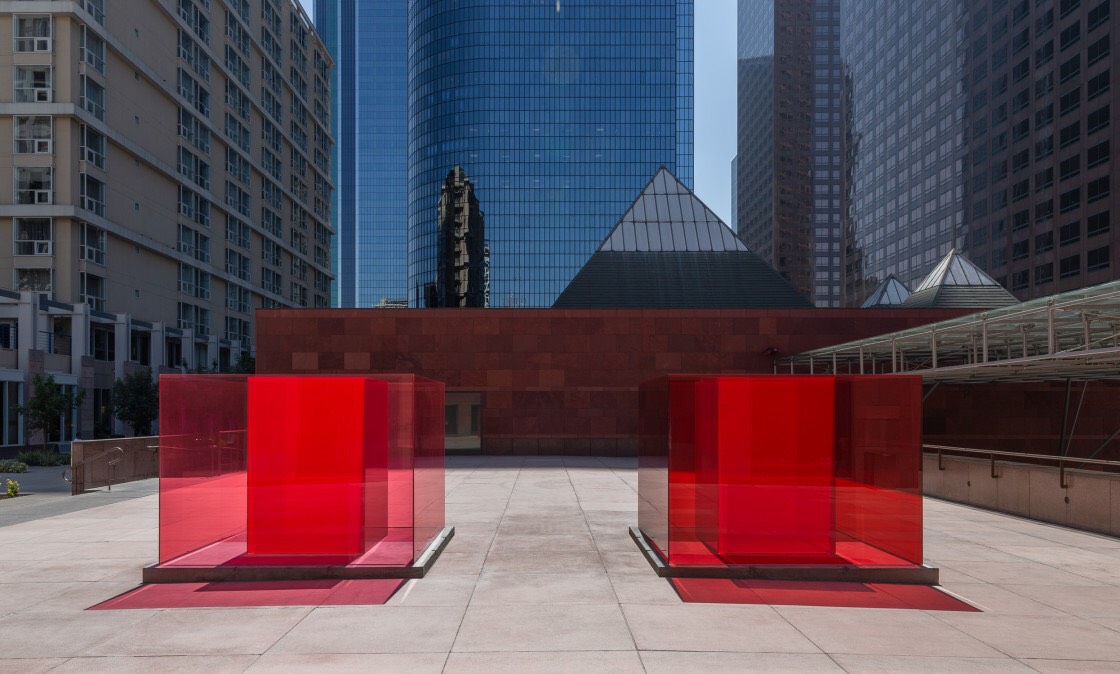
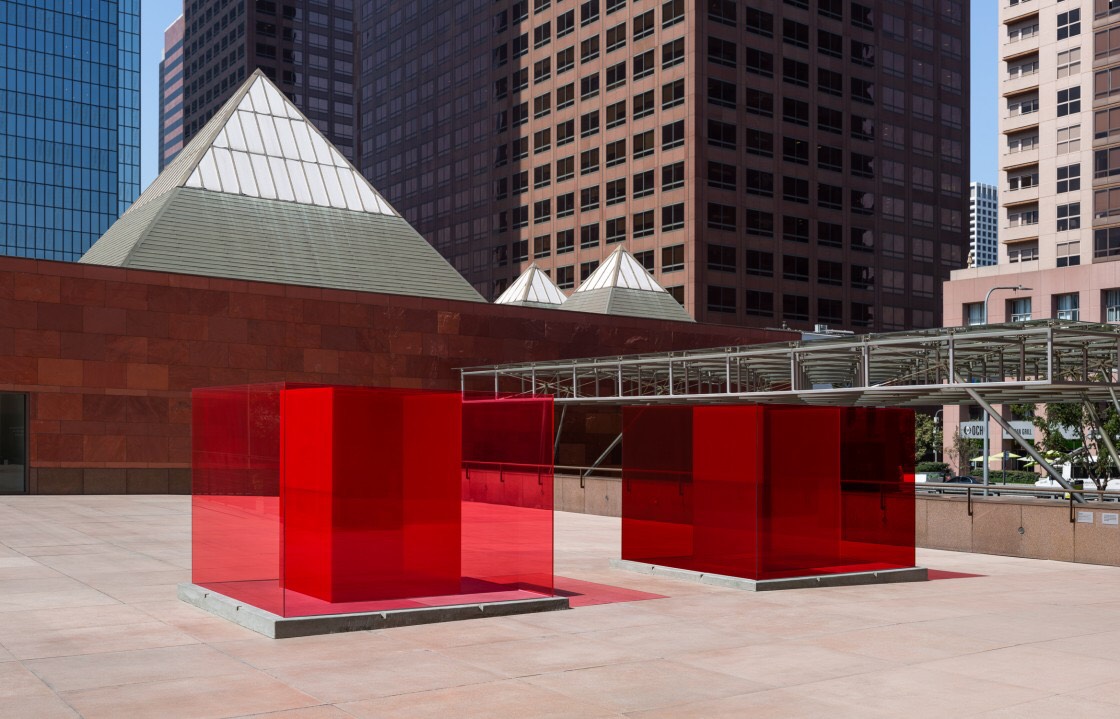
Larry Bell, “Bill and Coo at MOCA’s nest” (site-specific installation, laminated glass, 2019), in the collection of the Museum of Contemporary Art, Los Angeles. Accession number: 2019-19. Purchase with funds provided by Carol and David Appel.
Larry Bell, “Bill and Coo at MOCA’s Nest” (site specific installation, laminated glass, two parts, 2019), in the collection of the Museum of Contemporary Art, Los Angeles. Accession number: 2019-19. Purchase with funds provided by Carol and David Appel. Installation view, MOCA Grand Avenue. Image courtesy of The Museum of Contemporary Art. Photo by Zak Kelley.

Prior to moving to Los Angeles to take up the directorship of MOCA, Klaus Biesenbach lived for 23 years in Manhattan. In 1995 he moved to New York from Berlin where, in 1991, as an intern for the East German government, he established Berlin’s Kunst-Werke Institute for Contemporary Art in a vacant former margarine factory.

Biesenbach worked initially with what was then called the P.S.1 Contemporary Art Center in New York. The P.S. 1 Contemporary Art Center was established in 1971 by Alanna Heiss as the Institute for Art and Urban Resources Inc., an organization devoted to organizing exhibitions in underutilized and abandoned spaces across New YorkCity.

The P.S.1 Contemporary Art Center became an affiliate of TheMuseum of Modern Art in 2000.

Biesenbach joined MoMA in 2004 with a concurrent role at MoMA PS1. He became director of MoMA PS1 in 2010, serving also as chief curator-at-large at MoMA.

Just weeks into his job at MOCA, Mr. Biesenbach described his view of the mission of museums: “’to be a resident among residents,’” “meant not only to display art but to support artists and greater civic life.”

“’“As a museum, you have a civic responsibility, you have a role in society, you have to be courageous, you have to open up your doors to allow for dialogue.’”

“’After 10 years of working for and with [MoMA PS1 board chair] Agnes Gund, I follow one very important principle in decision-making: ‘It’s not about you, it’s about the difference you can make.’”’”

He continues, a primary goal is now “’alignment. To develop a vision for the museum and then align the board and the staff and all the other constituencies. And vision doesn’t necessarily mean huge buildings or blockbusters. It could also be a much more modest vision: simply functioning.

“’I think contemporary art changes how you look at the world. And that’s huge for everybody who comes into the situation.’”

Growing up near Cologne, Germany, Mr. Biesenbach’s love for art began when he was in primary school. Joseph Beuys spoke through his art teacher, who had studied with him.

“Art as responsibility, art as a civic engagement, art has to be a force in society, art has to be courageous, unafraid, ecological, ecological. That was Joseph Beuys talking to my art teacher. We were like 8 or 9 years old!”

Full circle to today’s Los Angeles, and to today’s Houston, Beijing, Venice, and so many other cities.

Clear water in Venice. Blue skies over Beijing. Air monitors in the city of Houston recording less ozone than normal. Clearer and crisper Austin skyline. The cleanest air ever recorded, in March 2020, in Los Angeles.

Home not only to MOCA but also to The Broad (across the street from MOCA and founded by philanthropists Eli and Edythe Broad; Eli Broad was founding chairman of MOCA in 1979), the Hammer Museum (affiliated with UCLA), and the Los Angeles County Museum of Art amongst others, Los Angeles has seen a lifting of its “notorious L.A. Smog” due “to the fact that most Angelenos are driving less.”

“The notorious L.A. smog starts as a cloud of traffic emissions that’s spewed into the air during the morning rush hour. This layer of air pollution is then held in place by a combination of the Southland’s topography and its prevailing weather patterns, and baked for hours in SoCal’s warm ultraviolet rays, an effect that air-quality experts liken to a pot of soup heating on a stove.

“There’s no question that the drastic improvement in air quality‪—a combined measure of the particle pollution, carbon monoxide, sulfur dioxide, nitrogen dioxide, and ozone we breathe into our lungs—is due to the fact that most Angelenos are driving less and staying inside more.”

・Jason McGahan, “As Many Stay Home, L.A.’s Air Quality Is Better Than It’s Been in Decades,” Los Angeles Magazine, 6 April 2020

Better quality of air is observed also in Houston, home to numerous excellent museums including the Museum of Fine Arts, Houston (MFAH).

“The primary reason, experts say, is fewer vehicles on the road, which means fewer emissions from the petroleum-based fuels on which so much of the Texas economy relies.” …

“In Houston, where the huge volumes of commuters and sprawl of industrial facilities often result in a lingering smog, emissions of nitrogen oxides, which combine with other pollutants in the atmosphere to form ozone, are already down 15 percent this month compared to last year.”

“The reduction in pollutants such as nitrogen dioxide and microscopic particulate matter, not to mention the carbon dioxide that is warming the planet, offers a temporary window on what the world might look like as governments worldwide move to cut greenhouse gas emissions to net-zero by mid-century.”

・James Osborne, “As pollution abates and skies clear, coronavirus shutdown gives glimpse of life with less fossil fuel,” Houston Chronicle, 27 March 2020, updated 1 April 2020

“A question we should be asking is, how do we maintain the better air quality without the economic consequences of shutter in place orders?’” Michael Webber, energy resources professor at theUniversity of Texas, Austin.

・James Osborne, “As pollution abates and skies clear, coronavirus shutdown gives glimpse of life with less fossil fuel,” Houston Chronicle, 27 March 2020, updated 1 April 2020

The economic consequences of “shutter in place orders” are dire.

In response to the outbreak of the coronavirus, MOCA, for instance, has laid off all 97 part-time employees. Almost all 69 full-time employees are taking a full or partial furlough or a significant salary reduction.

In correspondence with Deborah Vankin of the Los Angeles Times, Mr. Biesenbach writes, “the coronavirus crisis is changing lives in unprecedented ways and that he couldn’t say ‘how long this slow-burning catastrophe will grow and when it will end.”

“’Given these uncertainties, we are taking significant measures to make sure MOCA’s unique legacy and collection, built through the creative hard work and contributions of so many will continue to be preserved and accessible for generations to come.”

More vulnerable than some other Los Angeles museums, MOCA does not enjoy the financial privilege of a wealthy benefactor behind it, as does the Broad (Eli Broad). Nor is the museum partially funded by a university, as is the Hammer Museum. Nor is it so directly connected to a government entity as is the Los Angeles County Museum of Art.

“’MOCA,’” rather, Biesenbach observes, “’is supported independently, mostly by individuals, and we have to navigate this crisis in our own way.’”

・Deborah Vankin, “Hit by ‘slow-burning catastrophe,’ MOCA forced to furlough or cut pay for most staff,” Los Angeles Times, 1 April 2020

So how might we maintain the better air quality without the economic consequences of shutter in place orders?

A hint at forward direction might come from Cody A. Hill, Vice President, Energy Storage at LS Power.

LS Power is “a development, investment, and operating company focused on power generation, electric transmission and energy infrastructure. We partner with communities across North America to create lower-cost, cleaner energy solutions.”

Mr. Hill has an MS in Electrical and ComputerEngineering from the University of Texas at Austin and is now based in the San Francisco Bay Area.

Sharing an “astounding chart from the EPA,” Mr. Hill (Twitter: @cody_a_hill) notes, in a tweet of 2 April 2020, that “Los Angeles had the cleanest air ever recorded there in March 2020.”
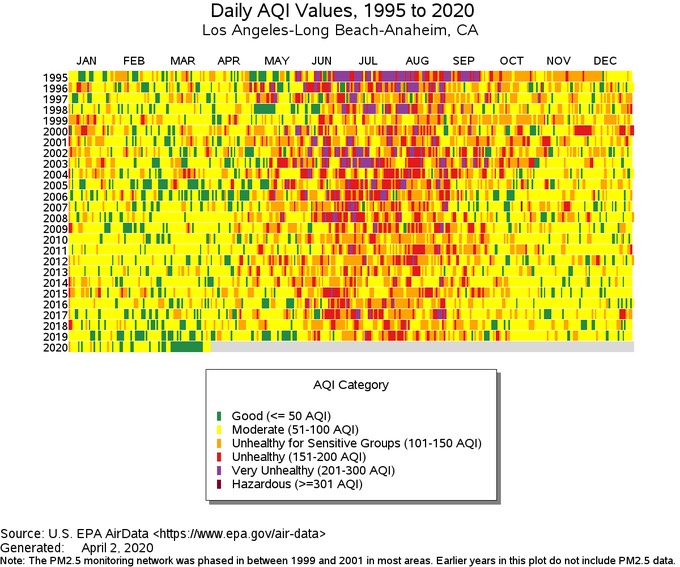
EPA, generated 2 April 2020, shared by Cody A. Hill, @cody_a_hill, via Twitter, 2 April 2020

Cody Hill continues in the same tweet, “This is mostly from reduced driving with the same vehicle fleet. It could be the new normal and ~13 million people living there would be healthier if we electrify transportation.”

See:

MoMA PS1 history

Museum of Contemporary Art (MOCA)

Eli and Edythe Broad Foundation | MOCA

The Broad | About

Jason McGahan, “As Many Stay Home, L.A.’s Air Quality Is Better Than It’s Been in Decades,” Los Angeles Magazine, 6 April 2020

Cody A. Hill (@cody_a_hill), tweet of 2 April 2020

James Osborne, “As pollution abates and skies clear, coronavirus shutdown gives glimpse of life with less fossil fuel,” Houston Chronicle, 27 March 2020, updated 1 April 2020

Deborah Vankin, “Hit by ‘slow-burning catastrophe,’ MOCA forced to furloughor cut pay for most staff,” Los Angeles Times, 1 April 2020

Larry Bell, Bill and Coo at MOCA’s Nest (2019),” MOCA

Larry Bell, “Bill and Coo at MOCA’s Nest” (site-specific installation, laminated glass, 2019)

Larry Bell, represented by Hauser & Wirth, New York and Los Angeles, and Anthony Meier Fine Arts, San Francisco

Deborah Vankin, “New MOCA director Klaus Biesenbach embarks on a’civic-minded’ mission to steady the museum,” Los Angeles Times, 8 November 2018

Trio of gallery greats commence sales of works from the Donald B. Marron Family Collection

Good contemporary art reflects the society, and great contemporary art anticipates.

Donald B. Marron (quoted by Pace Gallery, “Acquavella Galleries, Gagosian and Pace to Handle Sale of Donald B. MarronFamily Collection”)

Kelly Crow of the Wall Street Journal has reported that two works by Pablo Picasso, “Femme au beret et la collerette” (Woman with Beret and Collar,” 1937) and “Seated Woman (Jacqueline)” (1962) have been sold from the Donald B. Marron Family Collection to collector Stephen Wynn. It is reported that Mr. Wynn paid approximately $105 million for the two paintings.

Sales of works from the family collection are being conducted by a collaboration of gallery greats – Pace Gallery, Gagosian, and Acquavella Galleries. Bill Acquavella (son of Acquavella Galleries founder Nicholas Acquavella), Larry Gagosian (founder of Gagosian), and Arne Glimcher (founder of Pace Gallery) each worked with Mr. Marron in the development of the collection.

The collaboration, “the first of its kind, signals a new way for families to handle the sales of their collections” (Gagosian).

Under the terms of the collaboration, the galleries are charged to work jointly and privately to place and sell the works in the market. They are charged, further, neither to disclose publicly what is or is not available for sale nor to disclose an estimate for the collection.

The collaboration appears to have been the brainchild of Marc Glimcher, son of Arne Glimcher and president of Pace Gallery.

Eileen Kinsella of Artnet News, reporting that the plan came together quickly, quotes Mr. Glimcher:

“’I heard that [the Marron family] were considering going to auction and I just picked up the phone and called Larry [Gagosian] and said, ‘We should really present an alternative to the family. It’s tragic for this collection to go to auction,’” Glimcher recalled.

“After reaching out to Bill Acquavella, who also had a longstanding relationship with Marron, “’we all came and presented an idea to the family of how we would do it” around a month ago.’”

The Acquavella family – sister, brothers, and father – came on board. Eleanor Acquavella, Bill Acquavella’s daughter, reports that they“’ liked the idea of competing with the auctions on a great estate.’” They acknowledged, however, that “it would be hard to pull off.'” The galleries would be required to “’compete financially,'” and otherwise, to win to the business.

Indeed. Financial guarantees for the collection, in the amount of $300 million, had been offered by auction houses Christie’s, Sotheby’s, and Phillips.

Especially in the face of those guarantees, “’“the key,’” observed Gagosian’s COO Andrew Fabricant, “’was to meet the fiduciary requirements of an estate, which is complicated.

“‘We had to convince the family and the lawyers. The challenge was to be in line and competitive and still have some daylight for running with an exhibition and sales.”

A joint New York exhibition of May and June, is being organized by the three galleries. Including works from the family collection together with loans from institutions,  the exhibition “will chronicle Marron’s collecting activities, including his early acquisitions in the 1960s and 1970s, his museum stewardship, and his pioneering work reinventing how corporations build art collections around a singular vision.”

See:

Kelly Crow, “Steve Wynn Pays $105 Million for Pair of Picassos,” The Wall Street Journal, 24 February 2020

Eileen Kinsella, “The $450 Million Marron Collection Is the Art Market’s Ultimate Prize. Now, Three of the World’s Top Rival Galleries Are Joining Forces to Sell It,” Artnet, 19 February 2020

Acquavella Galleries, Gagosian, and Pace to Handle Sale of Donald B. MarronFamily Collection,” Gagosian

Acquavella Galleries, Gagosian and Pace to Handle Sale of Donald B. Marron Family Collection,” Pace Gallery

Hans Hofman ・pictorial space & the hidden inherent laws of the picture surface.

Across time, space, and generations, the magic and spirit of Hans Hofmann, teacher to many, continues.

A composition of warm and vivid hues, geometric blocks of color, a surface that is rich in both visual and textural details, highlighting the materiality and thickness of the paint and the flatness of the canvas.

“Into Outer Space,” Hans Hofmann (oil on panel, 1957), at the Chrysler Museum of Art, Norfolk, VA (Gift of Walter P. Chrysler, Jr., 1971)

Action painter? Abstract expressionist?

“While critic Robert Coates first used the term Abstract Expressionism in his review of Hofmann’s 1946 solo exhibition at the Mortimer Brandt Gallery in New York, histories of postwar American art, have always focused on the youth, vitality, and uniquely American experiences of the generation of artists who matured in the 1940s.”

Lowery Stokes Sims, former Curator of 20th Century Art at The Metropolitan Museum of Art and organizer of the exhibition of 1999, “Hans Hofmann at the Metropolitan Museum of Art“.

Hofmann does not fit the narrative of such postwar histories. Born in 1880, Hofmann immigrated to the US from Germany in 1932 when in his fifties, developing a new style and creating a whole new body of work in his seventies and eighties.

During the course of his life Hofmann was a contemporary of and acquainted with Picasso, Braque, Matisse, and the Delaunays (both husband and wife). He had a lifelong interest in nature, science, music, poetry, and science. He crossed more significant barriers, national and aesthetic, than almost any other twentieth-century painter.

He was never a follower, nor an expressionist, fauvist, a cubist, or a surrealist.

I am often asked how I approach my work,” Hofmann wrote in 1962 on the importance of the act of painting.

“Let me confess: I hold my mind and my work free from any association foreign to the act of painting. I am thoroughly inspired and agitated by the actions themselves which the development of painting continuously requires….This seems simple but it is actually the fruit of long research”

H. Hofmann, “Hans Hofmann on Art,” in Art Journal, Vol. 22, Spring 1963, p. 18; quoted in Lot Essay, Hans Hofmann, “Auxerre,” Lot 36B, Christie’s, Post-War and Contemporary Art Evening Sale, New York, 13 May 2015

William Chapin Seitz, the first scholar to receive a PhD from Princeton University in the field of modern art (it took him more than a year to convince the Princeton art history graduate committee that the work of living artists was a topic worthy of graduate study) and formerly Associate Curator of Painting and Sculpture Exhibitions at New York’s Museum of Modern Art, organized the 1963 MoMA exhibition, “Hans Hofmann”.

Dr. Seitz observes,

“When one looks back at the years after 1945, when the “New American Painting” was taking form, it is apparent that one of its aesthetic determinants was the desire felt by many artists to incorporate in their work tendencies of style and feeling previously thought to be contradictory. Both the temper of Hofmann’s mind and his supranational development led him in this direction.”

It has been said that Hofmann is an “automatic” painter; he has also been called an “action painter” because of his direct enactment of emotional content. Yet his automatism has never been mere psychic catharsis, his activity is never purely physical, and his fury, like his delicate lyricism, is that of nature as well as himself. And even in the most passionate of his works the adjustment of formal relationships can be as precise as in the compositions of Mondrian or Malevich.”

Hofmann admired Mondrian for the purity of his abstract structure. He admired Kandinsky — whom he once called an “anti-plastic” painter — for his automatism and fluid color.

The architectural basis of his own painting derives from a study of Cezanne, and from cubism, yet (at least in his representational paintings).

By synthesizing such diverse materials, Hofmann developed his own metier: the unhampered autonomy of lines and planes; the elevation of color to a primary means; the maintenance of clear “intervals” between color planes; the preservation of physical gestures in pigment. He cast aside the dross of systematic perspective, tonal modeling, literature, and illusionism.”

Hans Hofmann with selected writings by the artist,” William Chapin Seitz, The Museum of Modern Art, 1963

Believing in the innate integrity of the pictorial space, Hofmann theorized the “push and pull” within a painting, describing how he used balance and contrast between colors and forms to create pictorial dynamism. Rejecting the traditional practice of creating depth through graduations of tone, Hofmann created space without denying the flatness of the picture’s surface.

Hofmann wrote in a late essay,

“Pictorial space is an aesthetically created space and is as such as real as nature. Its reality is based on the reality of the hidden inherent laws of the picture surface.”

H. Hoffman, quoted in S. Hunter, Hans Hofmann, New York, 1963, p. 44.

See:

Hans Hofmann with selected writings by the artist,” William Chapin Seitz, The Museum of Modern Art, 1963.

Hans Hofmann,” September 11 – December 1, 1963, The Museum of Modern Art

William C. Seitz: Defending the Modern,” The Museum of Modern Art

Hans Hofmann at the Metropolitan Museum of Art,” April 13 – October 17, 1999,

Hans Hofmann at the Metropolitan Museum of Art,” exhibition catalogue, Lowery Stokes Sims, 1999.

“Post-War and Contemporary Art Evening Sale,” Lot 36B, Hans Hofmann’s “Auxerre,” Christie’s, New York, 13 May 2015, Lot Essay

“Post-War and Contemporary Art Evening Sale,” Lot 20B, Hans Hofmann’s “Lava,” Christie’s, New York, 15 November 2017, Lot Essay

#art #artmarket #arthistory #history #hanshofmann #science #physics #pictorialspace #modernart #postwarart #contemporaryart #picasso #braque #delaunay #matisse #mondrian #malevich #jacksonpollock #actionpainting #abstractexpressionism #met #metropolitanmuseumofart #moma #museumofmodernart #christie’s #germany #newyork #sanfrancisco #london #berlin #oslo #vienna #milan #dubai #hongkong #seoul #tokyo #architecture #design #luxury #urban #urbanliving #realestatedevelopment