Trio of gallery greats commence sales of works from the Donald B. Marron Family Collection

Good contemporary art reflects the society, and great contemporary art anticipates.

Donald B. Marron (quoted by Pace Gallery, “Acquavella Galleries, Gagosian and Pace to Handle Sale of Donald B. MarronFamily Collection”)

Kelly Crow of the Wall Street Journal has reported that two works by Pablo Picasso, “Femme au beret et la collerette” (Woman with Beret and Collar,” 1937) and “Seated Woman (Jacqueline)” (1962) have been sold from the Donald B. Marron Family Collection to collector Stephen Wynn. It is reported that Mr. Wynn paid approximately $105 million for the two paintings.

Sales of works from the family collection are being conducted by a collaboration of gallery greats – Pace Gallery, Gagosian, and Acquavella Galleries. Bill Acquavella (son of Acquavella Galleries founder Nicholas Acquavella), Larry Gagosian (founder of Gagosian), and Arne Glimcher (founder of Pace Gallery) each worked with Mr. Marron in the development of the collection.

The collaboration, “the first of its kind, signals a new way for families to handle the sales of their collections” (Gagosian).

Under the terms of the collaboration, the galleries are charged to work jointly and privately to place and sell the works in the market. They are charged, further, neither to disclose publicly what is or is not available for sale nor to disclose an estimate for the collection.

The collaboration appears to have been the brainchild of Marc Glimcher, son of Arne Glimcher and president of Pace Gallery.

Eileen Kinsella of Artnet News, reporting that the plan came together quickly, quotes Mr. Glimcher:

“’I heard that [the Marron family] were considering going to auction and I just picked up the phone and called Larry [Gagosian] and said, ‘We should really present an alternative to the family. It’s tragic for this collection to go to auction,’” Glimcher recalled.

“After reaching out to Bill Acquavella, who also had a longstanding relationship with Marron, “’we all came and presented an idea to the family of how we would do it” around a month ago.’”

The Acquavella family – sister, brothers, and father – came on board. Eleanor Acquavella, Bill Acquavella’s daughter, reports that they“’ liked the idea of competing with the auctions on a great estate.’” They acknowledged, however, that “it would be hard to pull off.'” The galleries would be required to “’compete financially,'” and otherwise, to win to the business.

Indeed. Financial guarantees for the collection, in the amount of $300 million, had been offered by auction houses Christie’s, Sotheby’s, and Phillips.

Especially in the face of those guarantees, “’“the key,’” observed Gagosian’s COO Andrew Fabricant, “’was to meet the fiduciary requirements of an estate, which is complicated.

“‘We had to convince the family and the lawyers. The challenge was to be in line and competitive and still have some daylight for running with an exhibition and sales.”

A joint New York exhibition of May and June, is being organized by the three galleries. Including works from the family collection together with loans from institutions,  the exhibition “will chronicle Marron’s collecting activities, including his early acquisitions in the 1960s and 1970s, his museum stewardship, and his pioneering work reinventing how corporations build art collections around a singular vision.”

See:

Kelly Crow, “Steve Wynn Pays $105 Million for Pair of Picassos,” The Wall Street Journal, 24 February 2020

Eileen Kinsella, “The $450 Million Marron Collection Is the Art Market’s Ultimate Prize. Now, Three of the World’s Top Rival Galleries Are Joining Forces to Sell It,” Artnet, 19 February 2020

Acquavella Galleries, Gagosian, and Pace to Handle Sale of Donald B. MarronFamily Collection,” Gagosian

Acquavella Galleries, Gagosian and Pace to Handle Sale of Donald B. Marron Family Collection,” Pace Gallery
Acknowledging risk, Sotheby’s revises 2020 Hong Kong Spring Sale

“Monitoring the impact of the Covid-19 virus and the resulting travel restrictions” – in effect acknowledging, and attempting to manage, the health, travel, and business risks that the coronavirus poses – Sotheby’s has revised its 2020 Hong Kong Spring Sale.

The Modern Art Evening Sale, the Contemporary Art Evening Sale, and the Contemporary Art Day Sale will take place in New York on 16 April.

Further 2020 Hong Kong Spring sales have been re-scheduled from April to July. The plan is that they will take place in Hong Kong.

The revised schedule can be found here: “Revised Schedule For Sotheby’s Hong Kong 2020 Spring Auction Series Announced.”

Sotheby’s publishes a message from Kevin Ching, CEO of Sotheby’s Asia:

“We have been closely monitoring the impact of the Covid-19 virus and the resulting travel restrictions.

“After careful consideration and reflection on nearly 50 years of working with our clients in Asia, we have made the strategic decision to continue to hold our major Modern and Contemporary Art auctions in April but relocate them to New York and to postpone the balance of our spring auctions to early July in Hong Kong.

“April in New York represents the best possible venue and timing for our consignors of Modern and Contemporary art. We have scheduled these sales at times that will make it easy for our clients in Asia to participate and our global team stands ready to activate the international market for the great works of art we have assembled.

“Similarly, given the nature of the property and collectors in our other categories, we have decided to postpone those auctions until early July when we can safely hold a traveling exhibition across Asia and present our sale week in Hong Kong.”

Kevin Ching, CEO, Sotheby’s Asia

See:

Revised Schedule for Sotheby’s Hong Kong Spring Auction Series Announced,” Sotheby’s, 24 February 2020

Revised Schedule For Sotheby’s Hong Kong 2020 Spring Auction Series Announced” and “Sale Calendar,” Sotheby’s

“Suprematist Composition” (Kazimir Malevich, 1916) to be sold in May

Loïc Gouzer, Christie’s Co-Chairman of Post-War and Contemporary Art, has announced that he will be selling the painting “Suprematist Composition” (Kazimir Malevich, oil on canvas, 1916) in May. Estimate: $70 million.

“Suprematist Composition” was last sold at Sotheby’s on 3 November 2008 by the heirs of the artist (after being in the collection of the Stedelijk Museum Amsterdam for several decades). Art dealer David Nahmad purchased the painting for US $60,002,500.

Mr. Gouzer is confident of the art historic, and current market, value of this work. “‘A work like this one should be the corner stone of every major collection or museum and if the market was indexed to the art historical importance of works, then this should be a billion $ painting (although we as specialists have to sadly take into account the laws of gravity and the estimate will be in the region of $70m).'”

Sixth sense matters. “’I relate it a lot to my spearfishing—you don’t know why, but you know that if you dive now the big fish is going to come. When you’re at the surface, you don’t see anything, but you just have this instinct that it is going to happen. In art, it is the same thing—this instinct sometimes that I know a painting is going to move.’”

Company matters too. “’If you start putting works around another work, they give each other meaning. Each of the works are in dialogue, and they help each other.'”


See:

Loïc Gouzer’s $70m Malevich for May,” Marion Maneker, Art Market Monitor, 10 April 2018

The Daredevil of the Auction World,” Rebecca Mead, The New Yorker, 4 July 2016

Sotheby’s “Impressionist & Modern Art Evening Sale,” Lot No. 6, Kazimir Malevich, “Suprematist Composition,” 3 November 2008, New York


#art #artmarket #kazimirmalevich #christie’s #loïcgouzer #russia #suprematism #suprematistcomposition #modernism #abstraction #geneva #switzerland #vienna #austria #brittany #france #sothebys #davidnahmad #luxury #beijing #shanghai #hongkong #taipei #seoul #jakarta #singapore

art restitution, “conflicting realities,” & Clemens Toussaint

Marc Spiegler, now Global Director of Art Basel, wrote “an extensive profile” of art historian and art restitution specialist Clemens Toussaint in 2003. Spiegler’s article about Toussaint, The Devil and the Art Detective, appeared in Art + Auction in July of 2003. Spiegler considers this article to be among his “best ever.”

Art restitution is, in Mr. Spiegler’s words, “a minefield of ethical dilemmas and conflicting ‘realities.'” Toussaint’s work is sensitive, with passion, compelling argument, and, oftentimes, a wish for discretion on all sides. He is known to do detailed, thorough, impeccable research and has assisted clients recover paintings from collections and museums globally.

Prerequisites for restitution of works of art include a “united family front” (all known heirs need to be in agreement) and a detailed knowledge of a work’s provenance (exactly when, how, and where a work has changed hands and which country’s laws apply to each transaction).

Mr. Spiegler writes,

An extensive profile of Clemens Toussaint, who at the time ranked among the most controversial men in the European art world. In part because he’s a tempestuous maverick in a milieu of complicit discretion. But also because art restitution is a minefield of ethical dilemmas and conflicting “realities.” Roaming from 1930s Germany to present-day Monte Carlo, this article ranks among my best ever.”

See:

MarcSpiegler.com

The Devil and the Art Detective” | Marc Spiegler, Art and Auction, July 2003

For more about Clemens Toussaint and his work, see:

Europe Celebrates Kazimir Malevich, a Pioneer in Abstract Art” | Kevin Holden Platt, The New York Times, 25 May 2016

How Did a Stolen Malevich End Up at Sotheby’s” | Noelle Bodick, Blouin Artinfo, 4 November 2015

Göring, Rembrandt and the Little Black Book” | Alan Riding, The New York Times, 26 March 2006

A Monet Off the Met’s Wall Has a Controversial History” | Brooks Barnes, The Wall Street Journal, 3 May 2002

Met to Sell Monet” | Martin Bailey for The Art Newspaper, Forbes, 1 May 2002

#art #ClemensToussaint #restitution #artrestitution #collections #MarcSpiegler #ArtBasel #KazimirMalevich #MetropolitanMuseumofArt #Sotheby’s

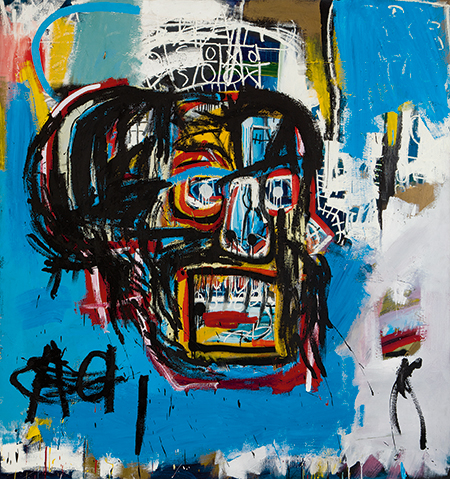
Jean-Michel Basquiat’s “Untitled” (1982)

Consigned by Lise Spiegel Wilks, the daughter of Jerry Spiegel, a real estate developer of Kings Point, N.Y., and his wife Emily, who as collectors of works by emerging artists bought the work in 1984 for $19,000, Jean-Michel Basquiat’s “Untitled” (1982, acrylic, spray paint and oil stick on canvas) was offered at auction by Sotheby’s on May 18, 2017 with a guaranteed price of at least $60 million.

The painting was purchased for $110,487, 500 (hammer price with buyer’s premium) by Yusaku Maezawa.

Yusaku Maezawa, 41, is the founder of Contemporary Art Foundation and of of Japan’s large online fashion mall, Zozotown.

Passionate about the works of Jean-Michel Basquiat, Mr. Maezawa acquired “Untitled” for a museum that he is planning for his hometown of Chiba, Japan.

“But before then I wish to loan this piece — which has been unseen by the public for more than 30 years — to institutions and exhibitions around the world, I hope it brings as much joy to others as it does to me, and that this masterpiece by the 21-year-old Basquiat inspires our future generations.”

Yusaku Maezawa

See:

Untitled” | Jean-Michel Basquiat, 1982, acrylic, spray paint and oil stick on canvas

A Basquiat Sells for “Mind-Blowing” $110.5 Million at Auction” | Robin Pogrebin & Scott Reyburn, The New York Times, 18 May 2017

How Basquiat Became the $60 Million Man” | Robin Pogrebin & Scott Reyburn, The New York Times, 17 May 2017

Sibling Rivalry Erupts Into $160 Million Art Auction Showdown” | Katya Kazakina, Bloomberg, 10 May 2017

Monumental Basquiat Leads Contemporary Art Evening Sale” | Sotheby’s, 18 April 2017

#JeanMichelBasquiat #Basquiet #artmarket #YusakuMaezawa #JerryandEmilySpiegel #LiseSpiegelWilks #Sotheby’s #GabrielaPalmieri #AlexRotter


Lévy Gorvy’s Brett Gorvy speaks

Lévy Gorvy, the gallery

What we do see ourselves as is a boutique, a haute-couture gallery that ultimately adapts itself and takes advantage of market changes and opportunities but is very sustained and has growth over a longer period of time.

It’s incredibly important to Dominique and myself that we are an individual company. We’ve committed ourselves financially to this project with the understanding that we can work with any business partner where it will be mutually beneficial, with no conflict of interest.

It will also be about painting, because what we really responded to in Dan’s studio is that he’s returning to his roots in a way that’s very much to our own tastes, where it’s less about the conceptual pieces and more about just really beautiful painting.

The only way these kinds of shows can be feasible is if you have a financial commitment and also a focus, which is how this kind of gallery works. Here I mean less from a purely curatorial aspect, and more curatorial in that it’s highly focused on our client base from a business point of view, and on the art-collecting sphere we feel very close to.

Auction background

Working at an auction house is a phenomenal training, obviously—you have access to great art, you have access to an amazing group of collectors who become your friends, and you learn how to work as a team, which is incredibly important within this environment. But you also learn ultimately how to understand the valuation of works of art and price them.

because of our strong auction background, we have very close ties with now all three auction houses. That gives us an understanding of how markets work and how values work, because we can dissect the results of the auctions at all three houses and know exactly what happened.

Art fairs

If you look at how an art fair can ultimately change, communication will be a large part of it. … So now they’re going to have to get to the fair in the first half hour, because that’s when these things happen. … The key is to get someone as committed as they would be to an auction picture, to the point where the only thing they need to do is see it physically, which is obviously a crucial part.

Asia

I’ve done a lot of work in Asia over the years, and we want to continue our position there. We believe very firmly in the strength of the market there, not just in China but all over Asia, and, having worked there, you know all of the nuances, and who are the people to deal with.

So, from our point of view, Hong Kong is where we’ll have the best access to the top collectors who we can ultimately develop. One of the most exciting aspects about Asia is that the learning curve of Asian collectors is phenomenal. I’ve never come across that speed of understanding markets and artists and desiring to learn more and read more.

And in Hong Kong too—we really need an office in Hong Kong in order to function, because a lot of clients want to have a base outside of mainland China, either because they want to have their assets outside of the mainland or because they prefer that way of buying. It’s like with a lot of West Coast collectors in America—they prefer to come to New York to buy, even if it’s from a dealer who has a gallery out on the West Coast. People buy more when they’re traveling.

See:

Former Christie’s Rainmaker Brett Gorvy on How He’s Creating a New Power Center in the Gallery World” | Andrew Goldstein, Artnet, 12 June 2017

#art #artmarket #LévyGorvy #DominiqueLévy #BrettGorvy #collectors #collections #Asia #HongKong #Christie’s #Sotheby’s