Works of art. History. Cultural heritage. The market. Galleries. Art fairs. Museums. Private museums. Institutional and private collections. Fiduciary care. Value.
Let’s consider a pressing issue:
How collections are housed, managed, and cared for and the protection of works of art and tangible assets in an age of increasingly erratic weather, increasing sea-level rise, floods, fires, storms, … and pandemics – which in themselves and the response to which can be devastating.
Does one barricade the art behind flood walls and barriers? Insure the works of art? (Insurance is a good idea. Insurance does not, however, mitigate or prevent future damage. Insurance is used to protect the “value” of the art, not the work of art itself. It is used after damage occurs to recover value.)
Can we protect works of art while mitigating possible future damage?
Atmospheric CO2 is a key factor leading towards the storms, floods, and fires that can be so damaging to art and tangible assets. Is it possible to care for our collections while reducing emissions of CO2 into the air?
The Bizot Group of museum directors, or the International Group of Organizers of Large-scale Exhibitions, thinks so.
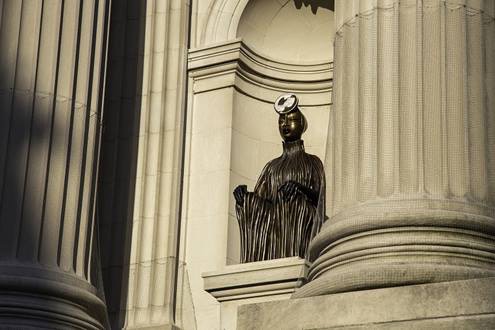
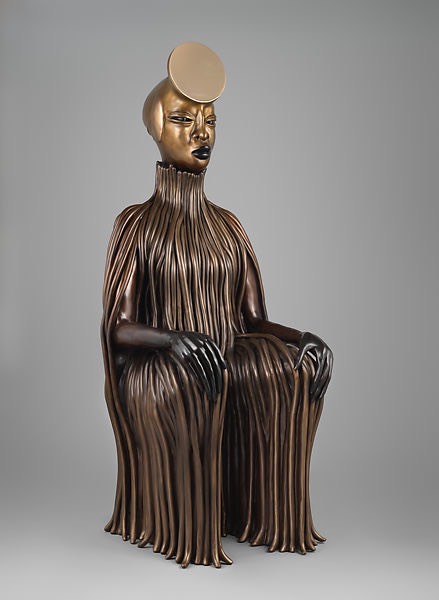
Wangechi Mutu (Kenyan, born Nairobi, 1972), “The Seated II” (bronze, 2019) situated in one of four niches in the facade of New York’s Metropolitan Museum of Art. Courtesy of the the artist, the Metropolitan Museum of Art, and Gladstone Gallery, New York and Brussels.
Axel Rüger, Director of the Van Gogh Museum in Amsterdam from 2006 until June of 2019 when he left the Van Gogh Museum to take up a new appointment as Chief Executive of London’s Royal Academy of Arts, is a member.
The directors agree that museums can reduce the amount of CO2 emissions they are responsible for while recognizing their duty of care to collections:
1. Guiding Principles Museums should review policy and practice, particularly regarding loan requirements, storage and display conditions, and building design and air conditioning systems, with a view to reducing carbon footprints.
Museums need to find ways to reconcile the desirability of long-term preservation of collections with the need to reduce energy use.
Museums should apply whatever methodology or strategies best suit their collections, building and needs, and innovative approaches should be encouraged.
The care of objects is paramount. Subject to this,
environmental standards should become more intelligent and better tailored to specific needs. Blanket conditions should no longer apply. Instead conditions should be determined by the requirements of individual objects or groups of objects and the climate in the part of the world in which the museum is located;
where appropriate, care of collections should be achieved in a way that does not assume air conditioning or other high energy cost solutions. Passive methods, simple technology that is easy to maintain, and lower energy solutions should be considered;
natural and sustainable environmental controls should be explored and exploited fully;
when designing and constructing new buildings or renovating old ones, architects and engineers should be guided significantly to reduce the building’s carbon footprint as a key objective;
the design and build of exhibitions should be managed to mimimise waste and recycle where possible.
2. Guidelines For many classes of object containing hygroscopic material (such as canvas paintings, textiles, ethnographic objects or animal glue) a stable relative humidity (RH) is required in the range of 40 – 60% and a stable temperature in the range 16-25°C with fluctuations of no more than ±10% RH per 24 hours within this range. More sensitive objects will require specific and tighter RH control, depending on the materials, condition, and history of the work of art. A conservators evaluation is essential in establishing the appropriate environmental conditions for works of art requested for loan.
“for that’s the real way to learn to understand art better and better.
“Painters understand nature and love it,
“and teach us to see“
Vincent van Gogh, letter to his brother Theo, London, 1874
Vincent van Gogh (1853 – 1890), “The Pink Orchard” (Arles, beginning of April 1888, oil on canvas) Credits: Van Gogh Museum, Amsterdam (Vincent van Gogh Foundation
“The season of orchards in blossom is so short,
“and you know these subjects are among the ones that cheer everyone up.”
Vincent van Gogh, letter to his brother Theo, Arles, on or about 5 April 1888
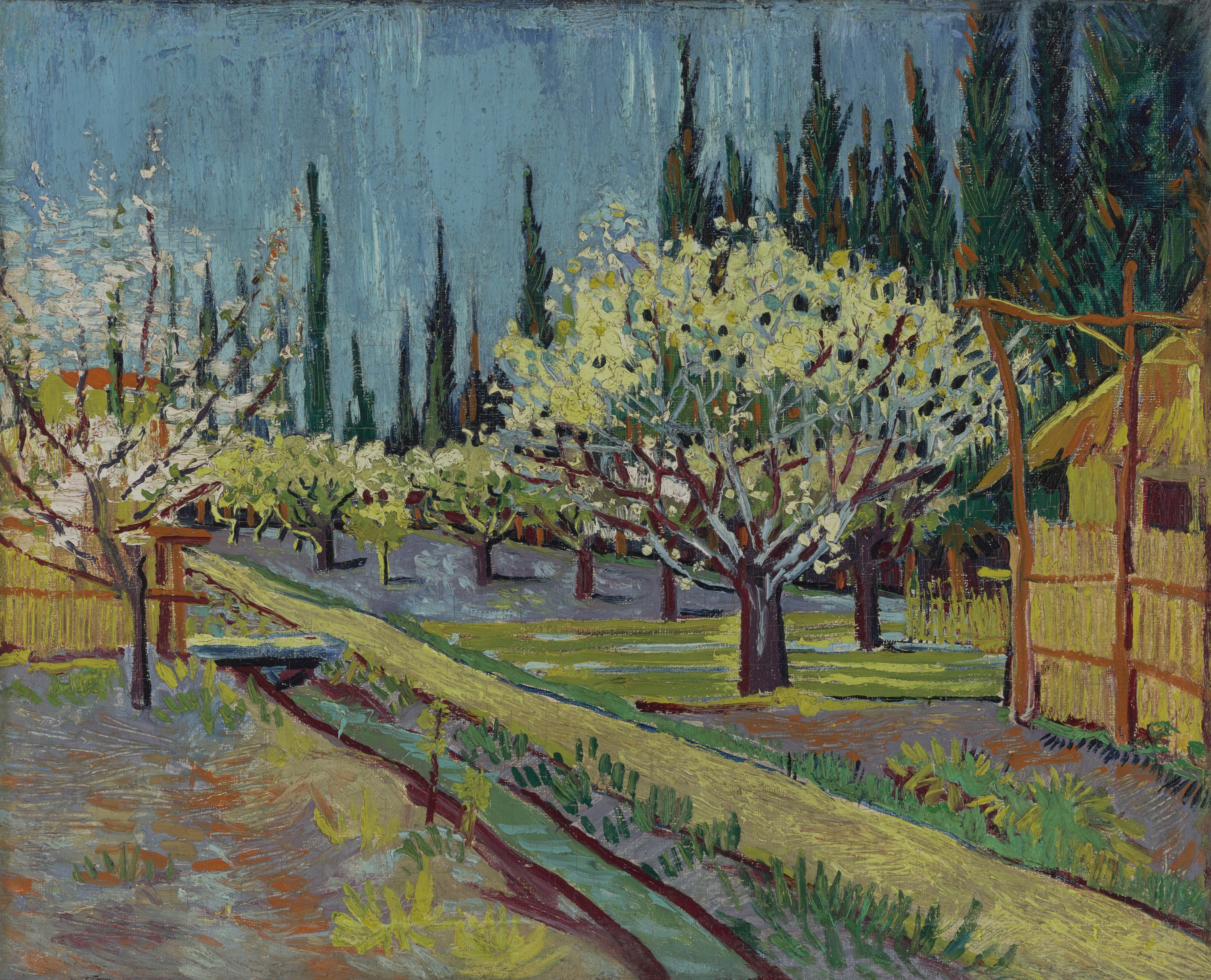
Vincent van Gogh (1853 – 1890), “Orchard Bordered by Cypresses,” (Arles, 1888, oil on canvas) Credit: Yale University Art Gallery, Promised Gift of William L. Bernhard, B.A.1954, and Catherine G. Cahill
“an elemental Dionysian force of madness rising, like a ‘fire that rises from the depths of the sea'”
Malcolm Bull, “Fire in the Water,” in Cy Twombly Bacchus Psilax Mainonmenos, exh. cat., New York, 2005, p. 55), quoted in Lot Essay, Cy Twombly (1928-2011), “Untitled” (acrylic on canvas, painted in 2005), Christie’s, Post-War & Contemporary Art Evening Sale, New York, 15 November 2017, Lot 15 B
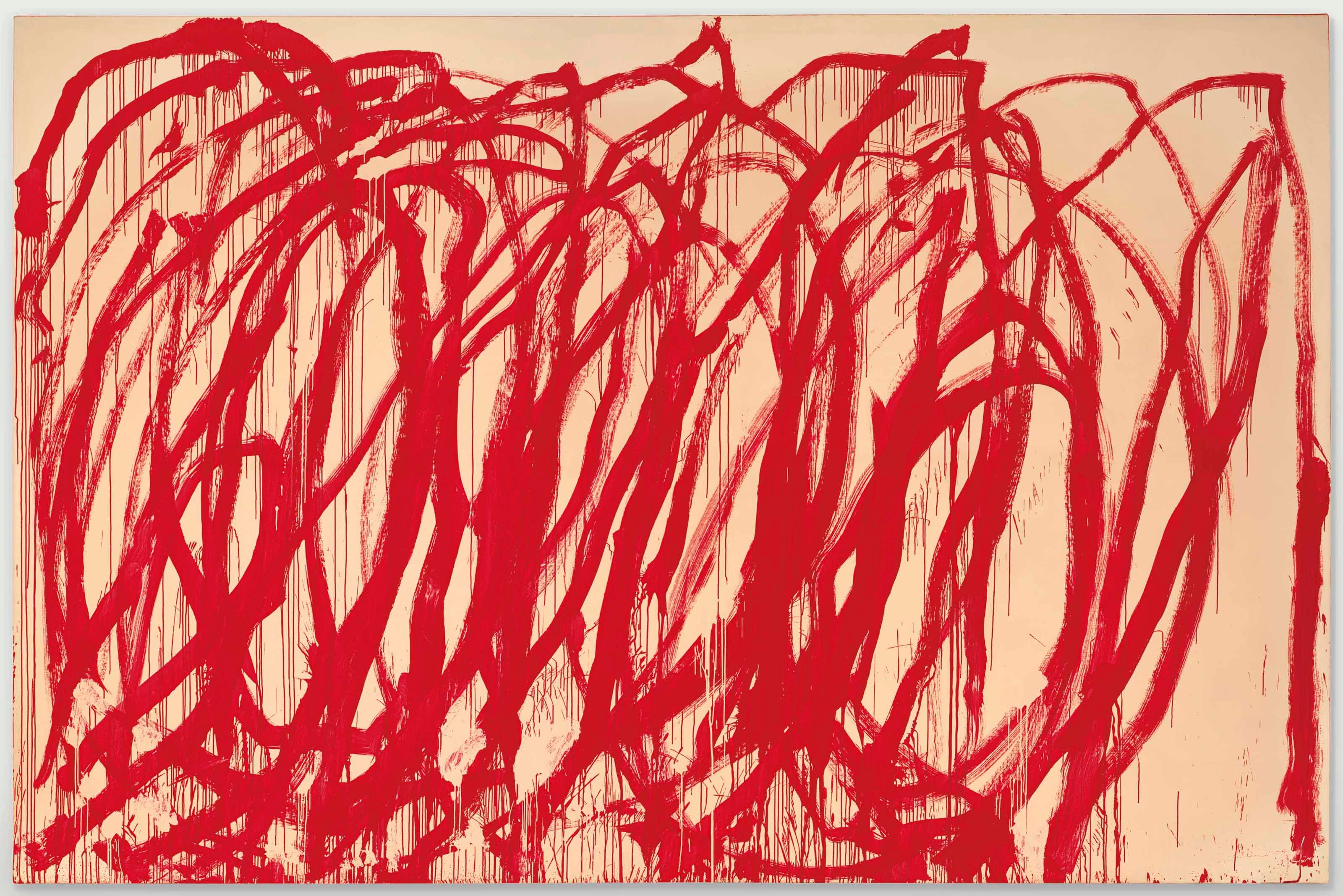
Cy Twombly (1928-2011), “Untitled” (acrylic on canvas, painted in 2005). “Untitled” sold at the Christie’s Post-War & Contemporary Art Evening Sale of 15 November 2017 in New York realizing a price of US$ 46,437,500
Over ten feet high and sixteen feet in length, “Untitled” is the largest example from a group of giant-scaled paintings that Twombly created beginning in 2003 at age 75.
Twombly makes use of spirals of linear loops, culminating fifty years of regularly invoking scrawls, whirls, and writing/drawing.
“In his catalogue essay, “Fire in the Water” that accompanied the first exhibition of Twombly’s Bacchus series in 2005, Malcolm Bull argued that the abiding theme of these paintings was that of an elemental Dionysian force of madness rising, like a “fire that rises from the depths of the sea” (M. Bull, “Fire in the Water,” in Cy Twombly Bacchus Psilax Mainonmenos, exh. cat., New York, 2005, p. 55).’ – Lot Essay
Like Dionysian forces of madness, we are all experiencing the dislocation caused by the current COVID-19 pandemic.
Individuals, families, supply chains, industries, markets, businesses, nations – all are affected.
This pandemic, however terrible, unexpected, and unprepared for, may in part be an outcome of behaviors that we have, however unwittingly, engaged in over decades.
We are all – individuals, peoples, cultures, animals, plants, functional objects and works of art, buildings, systems of transportation, agriculture, and education, etc. etc. etc. – inextricably embedded in nature. We are part and parcel of and subject to the forces of physics. Part and parcel of and subject to the elements and interactions of chemistry.
As living, breathing creatures, moreover, and complex systems of systems. we are part and parcel of and subject to the complex forces of biology. We are calibrated precisely, over long periods of time, to our biosphere.
If and should we take our biosphere for granted, fundamentally alter the composition of our atmosphere, and tamper with our climate, the unexpected can occur. Mayhem may let loose,
And so it has.
Yet, in the arts we are global. We reach across time, across space, across borders, across cultures, across nations. We represent mind and passion, interests and preferences. We come from an abundance of backgrounds and industries.
We may lead, each in our own place, taking steps to realize our ambitions anew.
Together we will have impact.
While we work in our many spheres of activity, what steps, however simple, might we take to realize our objectives while mitigating risks of future such dislocations?
If we want “to do something to prevent disease emergence, first of all we need to seriously reconsider how we do business with the biosphere.”
“We need to hear what nature is trying to tell us, which is clear: let’s be smarter about how we do business with the biosphere and stop disrupting the climate we depend on.”
Excerpts follow, giving us some idea of what we probably already know but don’t always think about or consider in the decisions we make on a daily basis:
“The bottom line here is that if you wanted to prevent the spread of pathogens, the emergence of pathogens, … you wouldn’t transform the climate.”
“The separation of health and environmental policy is a dangerous delusion. Our health entirely depends on the climate and the other organisms we share the planet with.”
Simply put, “The likelihood is high that this [a next pandemic] will happen. This has happened through human history but the data we have shows that the pace is accelerating. That’s not terribly surprising. We’re living in highly dense urban places. Air travel is much more prevalent than it used to be. And climate is a part of what is fundamentally reshaping our relationship with the natural world.”
“You look at climate change, we have transformed the nature of the Earth. We have fundamentally changed the composition of the atmosphere, and, as such, we shouldn’t be surprised that that affects our health.”
“If you look at the emerging infectious diseases that have moved into people from animals or other sources over the last several decades,the vast majority of those are coming from animals. And the majority of those are coming from wild animals. We have transformed life onEarth. We are having a massive effect on how the relationships between all life on Earth operate and also with ourselves. We shouldn’t be surprised that these emerging diseases pop up.
“The principle is that we’re really changing how we relate to other species on Earth and that matters to our risk for infections.”
“Historically, we have grown as a species in partnership with the plants and animals we live with. So, when we change the rules of the game by drastically changing the climate and life on earth, we have to expect that it will affect our health.”
How
might we in our private and business capacities be smarter about how
we do business with the biosphere and stop disrupting the climate we
depend on?
First, think.
All industries, markets, and economies, including the arts, the art market, and the art economy, are interconnected and all are viable only within our shared biosphere.
“Art” is not self-existent. Art as a phenomenon, culture as a phenomenon, works of art, cultures, collections of works of art, collectors, and all parties to art are inextricably embedded in and dependent on nature.
Take time and steps to learn about and understand the biosphere. Take steps to reconsider how we, in every sphere of work and activity, do business with the biosphere.
We have an opportunity to consider ways to optimize connections, culture, art, the business of art, and the biosphere jointly.
Some
simple steps that can be taken:
Minimize travel
Whether curator, museum director, staff, or trustee, collector, dealer, gallerist, advisor, interested party – vet travel requirements.
Minimize travel powered by combustion of hydrocarbons.
“We need to drastically decrease our greenhouse gas emissions from fossil fuels like coal, oil and natural gas.”
It goes without saying that travel by foot or by bike is encouraged. Travel by electric-powered cars, buses, and trains – especially insofar as the electricity is generated from renewable, non-hydrocarbon sources – is also encouraged.
Amsterdam-based art dealer Jan Six XI, for instance, bikes to and from work, and across town to consult with experts. (Russell Shorto, “Rembrandt in the Blood: AnObsessive Aristocrat, Rediscovered,” The New York Times Magazine, 27 February 2019)
Work with local partners
We are
all somewhere. We do not need to be everywhere.
If you need to do work or close a transaction somewhere else, research, identify, vet, and work with local partners.
Optimize resources and connections made available online
Information, images, and opportunities to meet and discuss face-to-face, even in groups, abound online. As we are now seeing in abundance, education and research can be conducted online. Relationships developed through written and verbal communications optimized online, by mail (even mail that goes through the post office), and by telephone.
As much activity is migrating online, vet also your online service partners and their delivery options.
This website, for instance, is hosted by AISO.net. AISO.net is powered 100% by solar energy generated on site. The company does not make use of carbon credits. Members of staff are knowledgeable, of course, very personable, and extraordinarily helpful. They are great to work with.
Reduce carbon dioxide and greenhouse gas emissions from ongoing operations of physical plants
Galleries,museums, homes, businesses, offices, schools and universities, hotels,hospitals – all house works and collections of art.
Real-life
steps can be taken to reduce use of hydrocarbon-based energy sources
and achieve net-zero energy.
Expert and experienced stakeholders including architects, engineers, designers, builders, energy consultants, and sources of finance are able and ready to assist.
Allow time for foot and bike travel. Schedule meetings and work requirements accordingly.
Enjoy
the great outdoors en route to work, home, meetings, and shopping.
Enjoy your locality
See:
Cy Twombly (1928 – 2011), “Untitled” (acrylic on canvas, painted in 2005), Christie’s, Post-War & Contemporary Art Evening Sale, New York, 15 November 2017, Lot 15 B
The global art market generated sales of about $65 billion in 2016 according to the TEFAF Art Market Report 2017.
The growing, global network of facilities to store art now generates revenues of over $1 billion a year. Many of these spaces serve multiple objectives – including security, environmental protections, and trade: Sto
security
video surveillance
retinal scanning
space | collectors have too much to keep at home
protection
climate-controlled environments
fire-resistant walls
air-filtration
flood control
LEED and BREEAM building certifications
investment purchases
tax benefits
tax-suspended transport to and from galleries | as long as works of art return to storage no duty is payable, even if ownership of the art has changed
“1031 exchange” friendly
gallery inventory between shows and art fairs
storage of art taken by banks as collateral against loans
viewing rooms that can be rented on a more permanent basis | in-house, private sales and transfers of ownership
passport free access (freeports within airport perimeters)
Simon Hornby, the president of Crozier Fine Arts, estimates that 80% or even more of all the world’s art is in storage at any one time.
The art storage business has doubled in size in eight years and continues to grow.
“Until about ten years ago, Modern and contemporary art collectors were mainly made up of art enthusiasts and amateurs, they had a real passion, spending their money on what they liked; they collected in order to simply enjoy the work in their home environment. Today you have to work with an increasing number of art funds or speculators buying art for investment. Art buying has become accessible to a much larger audience than before and is considered an asset. The result of this is that more work sleeps in warehouses rather than hanging in collectors’ homes.”
Stephane Custot, Waddington Custot Gallery, London
“In the last year, I only physically saw one piece of art that I negotiated. Everything else was bought and sold via jpegs and remained in storage. It was all for investment.”
New York dealer and appraiser
In order to protect the assets, moreover, built environment investment is attempting to keep up with the evolution of demand, including security and environmental protections.
A state-of-the-art storage facility with “foreign trade zone” (FTZ) status (a freeport), ARCIS Fine Art & Collection Care, is under construction on Manhattan’s West 146th Street. Developed by Cayre Equities, the project has taken two years and over $40 million. Executive Director Tom Sapienza and Tom Lay, both formerly with Crozier Fine Arts, were recruited by art collector, real estate developer, and Crozier founder Ken Cayre to manage the project.
The five-story, 110,000 square foot is scheduled to open next month (July 2017). ARCIS is Latin for “fortress”. The facility is designed and engineered to provide and enhance both environmental and security protections.
With the objective of constructing a museum-quality, sustainable, state-of-the-art secure building, Sapienza and Lay took crash courses in thermal dynamics and consulted with the professional services branch of the Van Gogh Museum in Amsterdam. Works of art will be scanned as they move through the building. State-of-the-art air filters are installed; air will change three to six times an hour. LEED and BREEAM certifications are to be achieved for the building.