
IEA: Coronavirus ‘accelerating closure’ of ageing fossil-fuelled power plants

IEA: Coronavirus ‘accelerating closure’ of ageing fossil-fuelled power plants

Josh Gabbatiss, Carbon Brief, 27 May 2020

***

This year will see the largest ever drop globally in both investment and consumer spending on energy as the coronavirus pandemic hits every major sector, according to the International Energy Agency (IEA).

The crisis is accelerating the shutdown of older fossil-fuelled power plants and refineries, with the agency saying it could provide an opportunity to push the global energy sector onto a “more resilient, secure and sustainable path”.

In the latest edition of the World Energy Investment report, which Carbon Brief has covered in previous years, the IEA has gone beyond its usual remit of reviewing annual trends. 

Its analysis looks ahead to the coming year and estimates the impact of this year’s economic turmoil on energy investment, which was expected to grow by around 2% prior to Covid-19. It is now expected to drop by 20%, or almost $400bn.

Meanwhile, as demand and prices collapse, consumer spending on oil is expected to drop by more than $1tn, prompting a “historic switch” as spending on electricity exceeds oil for the first time.

Here, Carbon Brief has picked out some key charts to illustrate the economic repercussions of the pandemic across the energy sector.

Energy investment will drop by a fifth

The “baseline expectation” for 2020 is a global recession resulting from widespread lockdowns, according to the IEA. Last month, the agency estimated this will also lead to CO2 emissions dropping by 8% this year in the largest decline ever recorded.

Based on the latest investment data and project information, announcements from companies and governments, interviews with industry figures and its own analysis, the IEA concludes such a recession will see energy investment drop by a fifth. This can be seen in the chart below.
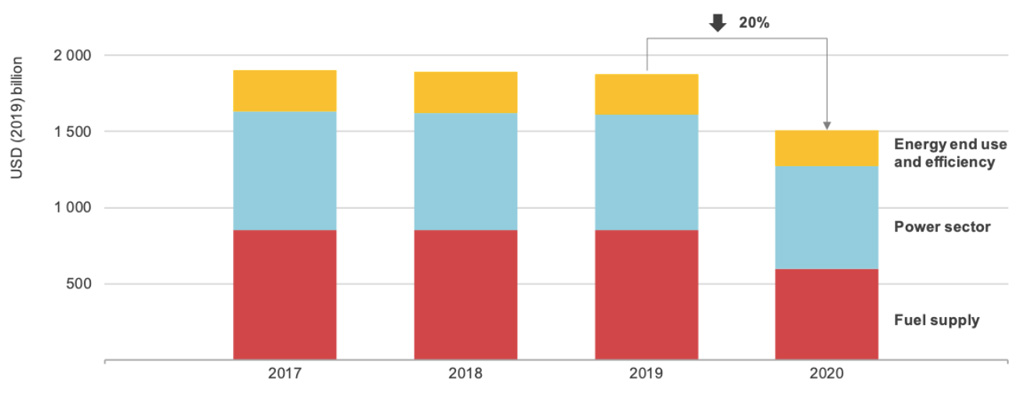
Energy investment is set to fall by a fifth in 2020 due to the coronavirus pandemic. Fuel supply (red) includes all investments associated with the production and provision of fuels to consumers, consisting mainly of oil, gas and coal investments. Power sector (blue) includes spending on power-generation technologies, grids and storage. Energy end use and efficiency (yellow) includes the investment in efficiency improvements across all end-use sectors. Source: IEA

These estimates are based on assumptions about the duration of lockdowns and coronavirus recovery trajectories.

The IEA notes that “almost all” investment activity has been disrupted by these measures, as a result of restrictions to the movement of people, goods and equipment. 

However, the largest impacts are the result of declines in revenues due to falling demand and prices, with the clearest example coming from the oil sector. Analysis of daily data until mid-April suggests countries in full lockdown have seen energy demand drop by a quarter.

As a result, the agency also estimates that these factors, combined with a rise in cases of people not paying their energy bills, will see revenues going to both governments and industry fall by over $1tn this year.

Crisis ‘accelerating’ shift from low-efficiency technologies

Every year energy infrastructure is retired and replaced with new equipment. Typically, the replacement technologies will be cleaner and more efficient, although this is not always the case. 

The coronavirus crisis is expected to have an impact on this rate of turnover and, indeed, it is already contributing to the retirement of some older power plants and facilities, as the chart below illustrates.
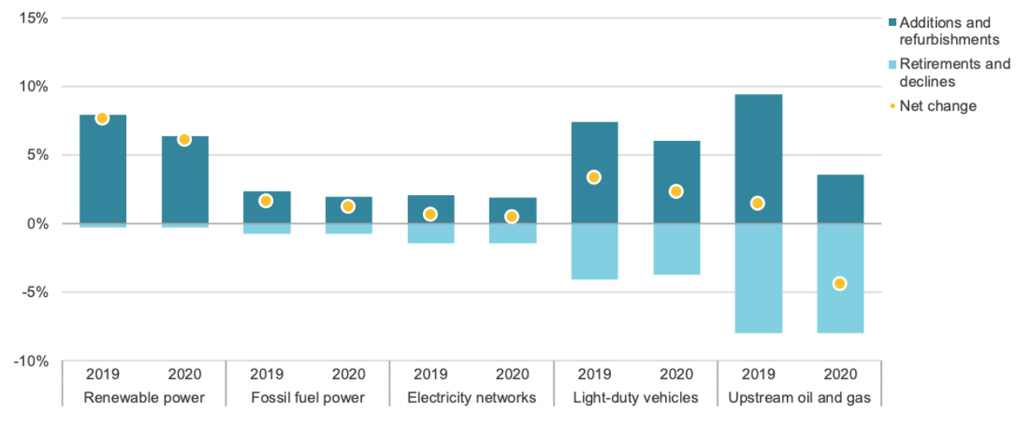
The Covid-19 crisis is hastening the retirement (light blue) of some older plants and facilities, but also impacting consumer spending on new and more efficient technologies (dark blue), with the potential for a net decrease (yellow dot) in upstream oil-and-gas facilities. Source: IEA.

The economic downturn and “surfeit of productive capacity in some areas” as overall demand plummets is already “accelerating” the closure and idling or inefficient technologies, including refineries and some coal-fired power plants.

However, the IEA warns that equally governments might respond to the pandemic by underinvesting in new technologies and remaining reliant on inefficient, older technology. The agency estimates efficiency investment could drop by 10-15% as spending is cut back.

The report warns that policymakers should keep these elements in mind and “combine economic recovery with energy and climate goals”. Dr Fatih Birol, executive director of the IEA, said in a statement that while the pandemic has brought lower emissions it has been “for all the wrong reasons”:

“The response of policymakers – and the extent to which energy and sustainability concerns are integrated into their recovery strategies – will be critical.”

Clean energy spending ‘relatively resilient’

The share of global energy spending going towards clean energy, including renewables as well as nuclear and efficiency improvements, has been flat-lining at around one-third for the past few years.

As the chart below shows, this is likely to change this year as clean energy’s share edges closer to two-fifths of overall spending.
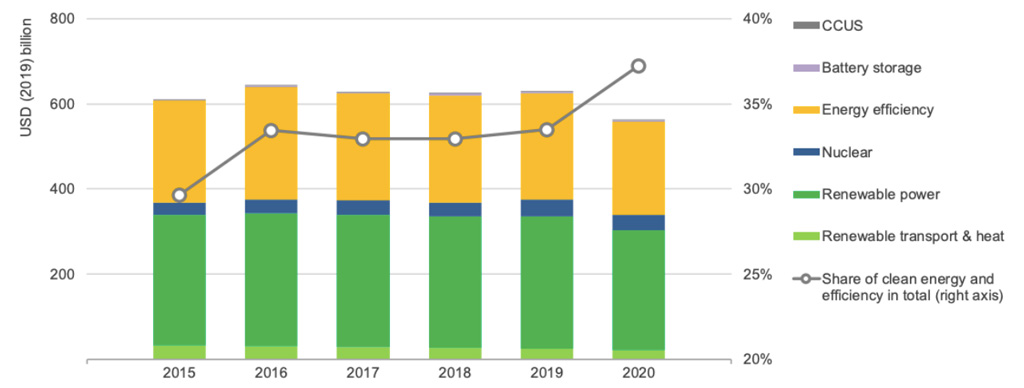
Breakdown of clean energy investment by sector in USD (left x-axis), with the % overall share (right x-axis) of spending indicated by a grey line. Source: IEA.

Clean energy investment is expected to remain “relatively resilient” this year, with spending on renewable projects falling by a comparatively small 10%. 

However, according to the IEA, the main reason for clean energy increasing its share is that fossil fuels are set to take such a “heavy hit”. In absolute terms, spending on these technologies is “far below levels” required to accelerate energy transitions.

The agency notes that investment trends have long been “poorly aligned” with the world’s needs and are still set to fall short of the future it has outlined in its benchmark Sustainable Development Scenario (SDS).

Last year’s edition of the World Energy Investment report concluded that investment in low-carbon energy sources must more than double by 2030 if the world is to meet its Paris Agreement targets.

While the slowdown in clean energy spending is less significant, it still “risks undermining the much-needed transition to more resilient and sustainable energy systems,” according to Birol.

Power sector hit hard

International power investment is set to drop by 10% as a result of the Covid-19 pandemic, according to the agency. 

Virtually every component of the sector is expected to see a decline in investment, with hydro the only exception, as the chart below demonstrates.
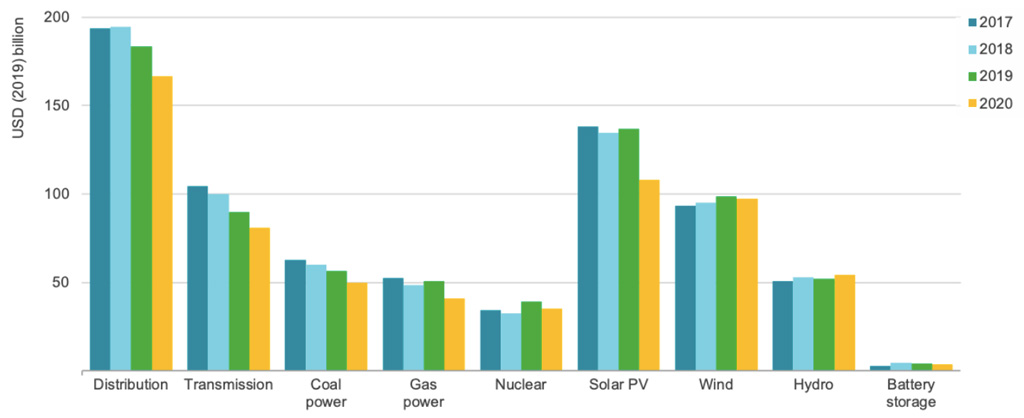
Global investment in the power sector by technology, with figures from the previous three years and estimates for 2020 (yellow). Source: IEA.

Increases in residential electricity demand around the world during lockdown are being “far outweighed” by reductions in commercial and industrial operations, the agency reports. A 9% decline in spending on electricity networks this year is also expected.

The IEA says some parts of power investment are more exposed, specifically fossil fuel-based generation. 

Meanwhile, higher shares of renewables are being dispatched due to low operating costs and priority access to networks. Nevertheless, renewables are still taking a hit, particularly distributed solar photovoltaics (PV) as households and companies cut back on spending.

Technologies with a longer lead time, notably offshore wind and hydropower, are expected to do better despite some delays.

Electricity spending pulls ahead of oil

Oil accounts for most of the decline in revenues expected this year. Furthermore, in a “historic switch” consumer spending on electricity could exceed spending on oil for the first time ever. 

While power-sector revenues are expected to fall by $180bn, oil spending will likely drop by at least $1tn. This can be seen in the chart on the left below. Taken together, investment in oil and gas is expected to fall by almost a third in 2020. 
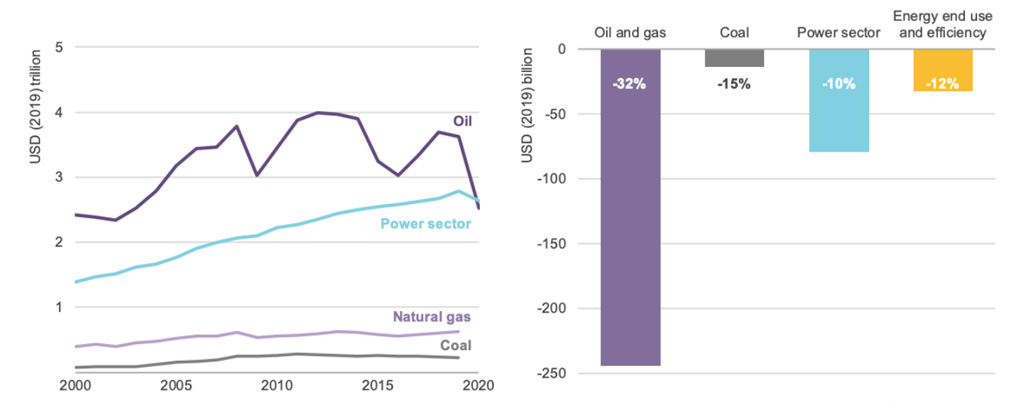
Both global end-use spending by consumers on energy (left) and estimated 2020 investment compared to 2019 show oil is expected to see the biggest decline in investment activity this year. Source: IEA.

The decline in aviation and road transport, which represent nearly 60% of oil demand, are responsible for this disproportionate decline.

Meanwhile, the impact on gas has so far been more moderate, but could fall further due to reduced demand in power and industry settings.

The report also highlights the global shale sector, which was already under pressure, as being particularly vulnerable. 

With investor confidence and access to capital in decline, the IEA predicts shale investment will halve in 2020 and notes the outlook for “highly leveraged shale players in the US” is now “bleak”.

Coal decline given a ‘floor’ by China

Coal is estimated to be the fuel hardest hit by the crisis after oil. Coal demand could drop by 8% this year, investment in coal supply is set to fall by a quarter and spending on new coal-fired plants is set to fall by around 11%.

However, any decline in coal’s fortunes may be curtailed by the recovery of demand for the fossil fuel in China. According to the IEA, investment activity there “may put a floor” under further reductions in coal-power investment this year.

The nation’s focus on coal is illustrated in the chart below, which shows final investment decisions (FIDs) dropping to their lowest levels in a decade, but China providing virtually all of them in the year so far.
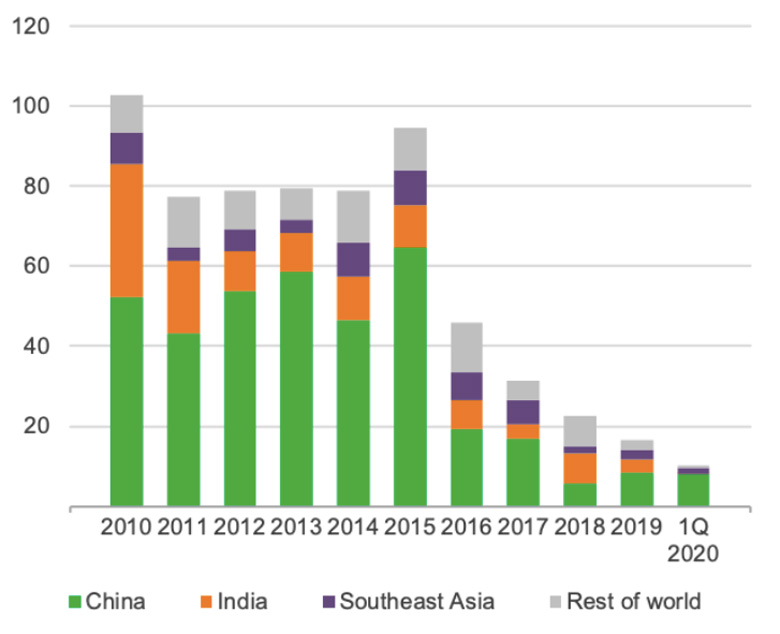
Coal-fired power generation capacity (GW) subject to a final investment decision (FID), with China coloured in green. Source: IEA.

Using data available so far, the IEA notes that approvals for new coal plants in the first quarter of 2020, were “running at twice the rate observed over 2019 as a whole”, primarily in China.

Electric vehicle sales rising as overall market contracts

Last year was a difficult time for the car industry, with total sales growth slowing in all major regions and turning negative in China and the US.

However, this “turbulent” period for the industry is “likely to appear mild” in comparison with 2020, according to the IEA. 

Lockdowns have already severely impacted sales and, across the year, the agency estimates a drop of around 15% – dramatic even compared to the 10% drop that followed the 2008 financial crisis. Negative trends in overall car sales can be seen in the right-hand chart below.
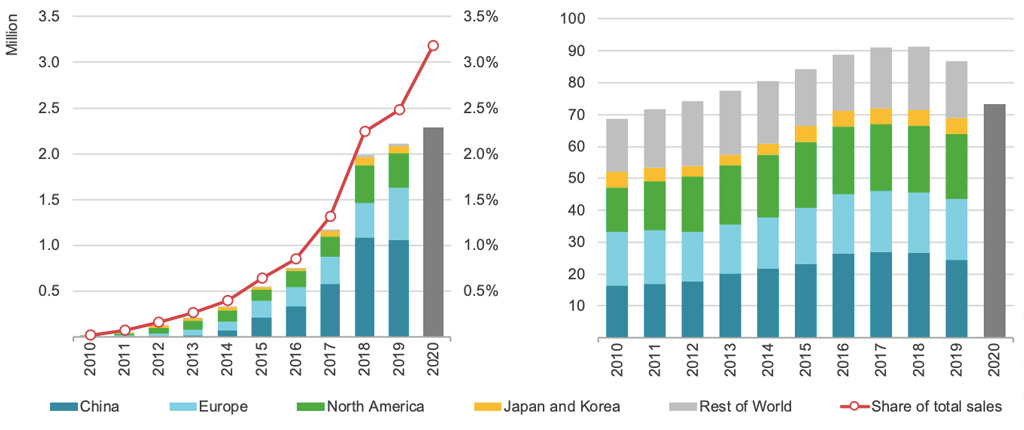
Global sales of electric passenger vehicles – cars, vans and small trucks – and market share, indicated by a red line (left chart). Total light-duty vehicle sales (right). Source: IEA.

However, even though electric vehicle sales followed wider patterns and stalled in 2019 largely due to declining Chinese purchases, their overall market share continued to climb. 

This can be seen in the chart on the left, which shows that electric cars are expected to go against the broader trend in 2020. The IEA estimates that owing to policy support, particularly in Europe, electric vehicle sales will increase this year, as will their share of the market (indicated by the red line).

Battery storage spending fell as prices dropped

Investment in battery storage fell for the first time last year, as the chart below shows. Overall, spending on grid-scale and behind-the-meter batteries fell by 15%, with overall investment just above $4bn.
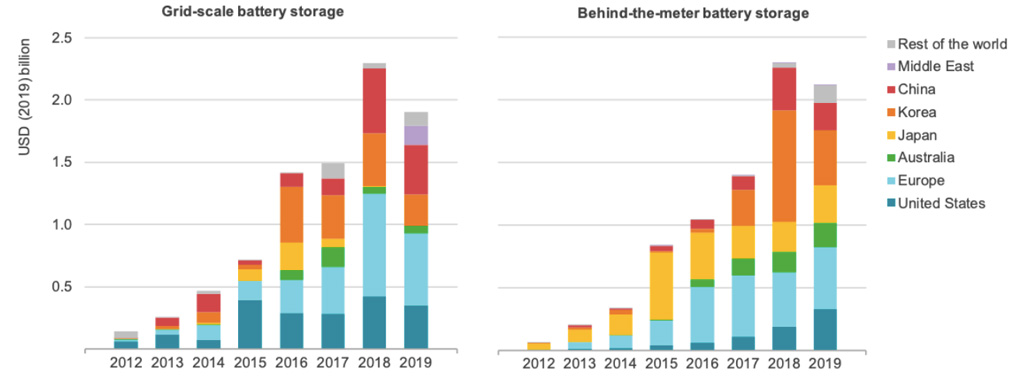
Investment in both grid-scale (left) and behind-the-meter battery storage (right). Source: IEA.

The IEA states this decline took place as costs for battery storage fell rapidly, a trend the agency attributes to maturing supply chains and markets, more efficient production and competition within the sector.

The report mentions fires at energy storage installations in South Korea and regulation uncertainty in China as some of the factors behind the decline in interest last year.

Declining behind-the-meter battery spending also reflects the distributed solar PV market, for which investment slowed last year in a trend expected to continue as consumer spending drops off due to coronavirus.

The agency notes that grid-scale battery investments are also expected to decline this year against the backdrop of a general decrease in power activity. 

However, it says this setback “is likely to be shortlived” due to the technology’s growing importance for system security and flexibility. 

***

IEA: Coronavirus ‘accelerating closure’ of ageing fossil-fuelled power plants

Josh Gabbatiss, Carbon Brief, 27 May 2020

Published under a CC license. Carbon Brief welcomes the reproduction of unadapted material in full for non-commercial use, credited ‘Carbon Brief’ with a link to the article.

art, philanthropy, energy: in transition

· renewable energy sources are set to account for nearly 21 percent of the electricity the United States uses for the first time this year, up from about 18 percent last year and 10 percent in 2010

· renewable energy provides 18% of total U.S. power generation, up from 10% in 2010

· corporate PPA’s for renewal energy accelerated from 0.1 GW in 2010 to33.6 GW by year-end 2019, with a record breaking 13.6 GW in 2019 alone.

· the carbon intensity of the power sector continues to decline. From 2010 to 2019, power sector emissions fell nearly 25%

· total U.S. greenhouse gas (GHG) emissions have fallen 4.1% over thepast decade, and now sit at roughly 12% below 2005 levels

2020 Sustainable Energy in America Factbook”, produced for the Business Council for Sustainable Energy by BloombergNEF

Art, philanthropy, energy. The relationships between them have history. As the way we generate energy evolves, the relationships between art, philanthropy, and energy will, in all likelihood, evolve as well.

Yves Tanguy (French, 1900-1955), “What” (oil on canvas, 1940), in the collection of the Museum of Fine Arts, Houston. The Joseph and Sylvia Slifka Collection. Object Number: 2004.146

“Houston,” observed Gary Tinterow, Director of the Museum of Fine Arts, Houston, in 2019, “is a cultural capital largely thanks to the discovery of oil.” (Houston Chronicle)

Yet, the energy economy is shifting in Texas. Renewable energy constitutes an ever increasing percentage of energy produced and used in Texas. 

Texas, a competitive rather than regulated energy market, is first in the United States in wind power capacity and near to having the second-most capacity for solar PV after California.

Solar energy has a significant (“marvelous”) cost advantage over gas-fired power plants: the marginal cost of solar is zero. Texas is on course to build a quarter of the record new industrial-scale solar capacity being installed across the United States in 2020.

As the energy economy evolves, how will the philanthropy that supports so many museums and cultural institutions evolve?

Let’s begin our quest for understanding by taking a look at relationships between art, philanthropy, and energy. We’ll start by looking to Texas.

The U.S. state of Texas consumes the most electricity in the United States. Demand for energy in Texas has grown over five percent over the past five years even as it has declined nationwide (EIA as reported in the FT).

Adding solar power through the incentives of a competitive electricity market, Texas is near to having the second-most capacity for solar PV after California. Texas, further, now ranks first in the United States in wind power capacity.

Texas is home to the Museum of Fine Arts, Houston (MFAH). The MFAH is one of the largest museums in the United States. As of late 2011 it had the third-largest museum endowment.

The permanent collection of the MFAH consists of nearly 70,000 works from throughout the world, from antiquity to the present day (MFAH) .

Gary Tinterow, Director of the MFAH, grew up in Houston. He worked at New York’s Metropolitan Museum of Art for 28 years, serving from 2008 until his departure for Houston as chairman of the department of 19th-century, modern and contemporary art. Mr. Tinterow’s appointment as Director of the MFAH was finalized by the museum’s board of trustees in late November 2011. He started his new position in early 2012.

Richard D. Kinder, co-founder (February 1997) and now Executive Chairman of Kinder Morgan, Inc., one of North America’s largest energy infrastructure companies, serves as Life Trustee of the museum and Chairman of the Board of Trustees. Mr. Kinder served as chairman of the museum’s search committee that identified Mr. Tinterow as a candidate for the directorship of the museum.

The business of Kinder Morgan is involved primarily with oil, gas, and petroleum products. Kinder Morgan “owns an interest in or operates 83,000 miles of pipelines and 147 terminals. The company’s pipelines transport primarily natural gas, refined petroleum products, CO2 and crude oil and its terminals store, transfer and handle such products as gasoline, ethanol, coal, petroleum coke and steel.” (Kinder Morgan)

Mr. Kinder commended Mr. Tinterow: “Gary’s passion for the job and his encyclopedic knowledge were what convinced us. He has so many good ideas, and there is so much potential to make this one of the outstanding museums of the world.” (NYTimes)

For his part, Mr. Tinterow explained, “As sorry as I will be to leave the Met after 28 years, I think I’ve landed the best job in the world. It’s a matchless combination: a committed board, a passionate audience, a fine collection and an institution with the third-largest endowment in the country.” (NYTimes)

Mr. Tinterow observed that the endowment of the Museum of Fine Arts, Houston stood at $1 billion in December 2011 after the J. Paul Getty Trust in Los Angeles, which oversees the J. Paul Getty Museum (endowment: $4.8 billion) and the Metropolitan Museum of Art, New York (endowment: $2.6 billion).

Asked in June 2019 after the relationship of the museum to energy companies and oil, Mr. Tinterow replied that he has “enormous respect for the energy industry.”

“Houston,” he continued, “is a cultural capital largely thanks to the discovery of oil.” (Houston Chronicle)

Indeed.

As of June 30, 2018, the Kinder Foundation had donated more than $50,000,000 to the Campaign for the Museum of Fine Arts, Houston (“The Museum of Fine Arts, Houston, Annual Report 2017 – 2018,”p. 17). This followed $50+ million reported by the museum as donated by the Foundation to the capital campaign as of the years ending June 30, 2017, June 30, 2016, and June 30, 2015.

The Nancy and Rich Kinder Building, dedicated to art after 1900 from the MFAH collections, is scheduled to open in November 2020. Consisting of two floors and more than 100,000 square feet of exhibition space,the building will increase overall MFAH exhibition space by nearly 75%. (MFAH)

While the MFAH has benefited, and continues to benefit, from the business of oil, the mix of Texas energy is changing.

First in the United States in wind power capacity and near to having the second-most capacity for solar PV after California, Texas will build a quarter of the record new industrial-scale solar capacity being installed across the US in 2020 (EIA, FT).

The cost of solar has plummeted, with the average industrial-scale PV project just $0.80 per installed watt last year compared to $3.53/Win 2010, according to the “2020 Sustainable Energy in America Factbook”, produced for the Business Council for Sustainable Energy by BloombergNEF, that looks at the U.S. energy transition over the decade 2010 – 2020.

Solar has a significant cost advantage over gas-fired power plants. The marginal cost of solar is zero. “The key thing is they have a magnificent cost advantage over gas-fired power plants,” observes Edward Hirs, energy fellow at the University of Houston. “The marginal cost of solar is zero.” (FT)

Investors in renewable energy, with time horizons of more than a decade, moreover, like the stable returns of projects backed by long-term contracts. (FT)

Corporations are taking advantage of falling costs to sign long-term solar power purchase agreements. Of the record 13,600MW of clean energy deals that companies completed in the US in 2019, 5,500MW of deals were generated in Texas. The majority of the deals closed were based on solar energy according to the “2020 Sustainable Energy in America Factbook”.

Google, for instance, is committing to buy power from Texas solar plants.

Neha Palmer, Google’s director of operations and head of energy strategy, observes that “[Texas] is a large, deregulated market. Users of electricity have a choice in who they buy electricity from and the type of energy that they buy. I think that’s been another driver of the large uptake of renewables in the state.”

The solar energy travels from the Permian Basin in west Texas, where much of the investment in solar energy is taking place, to cities such as Dallas and Houston aided by special transmission lines. The state of Texas authorized the lines 15 years ago. Designed to handle wind power, they are now enabling the flow of solar also.

Largely disconnected from the interstate transmission networks to the east and west of Texas, the grid is exempted from federal oversight. It is operated by the non-profit body Ercot (Electric Reliability Council of Texas.

“The Ercot power market is designed to be the ultimate competitive market,” Mr Archer says. Chris Archer, head of Americas at Macquarie’s Green Investment Group, a solar and wind developer with projects in Texas.

“Generators are only paid for the energy that they sell, not for having capacity at the ready. Wholesale prices that average about $40 per megawatt-hour are allowed to climb as high as $9,000 per MWh when demand surges on the hottest afternoons, a potential windfall for generators. Solar farms’ output crests when the sun is highest, enabling them to participate in these sales.” (FT)

As renewables grow as a percentage of the energy mix in Texas, and elsewhere, we will follow the evolution of the relationship between art, philanthropy, and energy.

See:

Ivan Penn, “Oil Companies Are Collapsing, but Wind and Solar Energy Keep Growing,” The New York Times, 7 April 2020, updated 8 April 2020

Gregory Meyer, “Texas: how the home of US oil and gas fell in love with solar power,” Financial Times, 7 April 2020

2020, Sustainable Energy in America Factbook, Understanding the U.S. EnergyTransition,” the2020 edition of the Sustainable Energy in America Factbook – produced for the Business Council for Sustainable Energy by BloombergNEF

The Museum of Fine Arts, Houston, Annual Report 2017 – 2018

Richard D. Kinder, Kinder Morgan

Erin Douglas, “Museum of Fine Arts Houston director putting final brushstrokes on $450 million expansion,” Houston Chronicle, 7 June 2019

Carol Vogel, “Met Veteran Named Director of Houston Art Museum,” TheNew York Times, 1 December 2011

Stephanie Cash, “Gary Tinterow leaves the Met for Houston,” artnews.com, 1December 2011

Business Council for Sustainable Energy

BloombergNEF (Bloomberg New Energy Finance)

Amazon selects New York & Arlington, VA for HQ2 ・people, mass transit, sustainability

Amazon has selected New York City (the Long Island City neighborhood of the borough of Queens) and Arlington,Virginia (the Crystal City neighborhood, across the Potomac from Washington, DC) for its HQ2.

In agreements with the local and state governments, Amazon stipulates that the two locations will house at least 25,000 employees each. The new sites will require $5 billion in construction and other investments.

Direct access to rail, train, subway/metro, bus routes (mass transit) at site has been a core preference of Amazon, stipulated in the Amazon HQ2 RFP.

Significantly, Amazon’s HQ2 RFP stipulates that it will develop HQ2 with a dedication to sustainability:

Sustainability: Amazon is committed to sustainability efforts. Amazon’s buildings in its current Seattle campus are sustainable and energy efficient. The buildings’ interiors feature salvaged and locally sourced woods, energy efficient lighting, composting and recycling alternatives as well as public plazas and pockets of green space. Twenty of the buildings in our Seattle campus were built using LEED standards. Additionally, Amazon’s newest buildings use a ‘District Energy’ system that utilizes recycled heat from a nearby non-Amazon data center to heat millions of square feet of office space – a system that is about 4x more efficient than traditional heating. This system is designed to allow Amazon to warm just over 4 million square feet of office space on Amazon’s four-block campus, saving 80 million kilowatt hours over 20 years, or about 4 million kilowatt-hours a year. We also invest in large solar and wind operations and were the largest corporate purchaser of renewable energy in the U.S. in 2016.

Amazon will develop HQ2 with a dedication to sustainability.

Of the cities selected, Emily Badger of The New York Times observes:

Tech companies feed on highly educated and specialized workers, specifically dense clusters of them where workers and companies interacting with one another are more likely to produce new ideas. Washington and New York, as it turns out, are two of the most highly educated regions in the country, with already large pools of tech workers.

Drop a big Amazon headquarters into Washington or New York, and economists expect the 50,000 workers there to be more productive than if the same 50,000 jobs were dropped into Indianapolis. Simply putting them in New York, near so many other tech workers, increases the likelihood that Amazon invents more services, connects to more markets, makes more money.

Those added benefits are so strong, economists say, that it’s worth it to companies like Amazon to pay more — a lot more — for office space and employee salaries in New York City.

‘If you are in the business of making new things — whether it’s a new product, or a new way of delivering things, or a new service — and it’s something that is unique, and it keeps changing and it needs updating, the most important factor of all is human capital,” said Enrico Moretti, an economist at the University of California, Berkeley. “It’s not like making soap, or like making textiles.’”

See:

Amazon HQ2 RFP

Amazon Announces New York and Virginia as HQ2 Picks,” Karen Weise, Technology | The New York Times, 13 November 2018

In Superstar Cities, the Rich Get Richer, and They Get Amazon,” Emily Badger, The New York Times, 7 November 2018

global investment in renewable energy & energy-smart technologies

Annual figures from Bloomberg New Energy Finance (BNEF) show that global investment in renewable energy and energy-smart technologies reached $333.5 billion last year, up 3% from a revised $324.6 billion in 2016, and only 7% short of the record figure of $360.3 billion, reached in 2015.

Chinese investment in all the clean energy technologies was $132.6 billion, up 24% setting a new record. The next biggest investing country was the U.S., at $56.9 billion, up 1% on 2016.

Solar led the way, as mentioned above, attracting $160.8 billion – equivalent to 48% of the global total for all of clean energy investment.

Wind was the second-biggest sector for investment in 2017, at $107.2 billion. Down 12% on 2016 levels.

The third-biggest sector was energy-smart technologies, where asset finance of smart meters and battery storage, and equity-raising by specialist companies in smart grid, efficiency, storage and electric vehicles, reached $48.8 billion in 2017, up 7% on the previous year and the highest ever.

See:

Runaway 53GW Solar Boom in China Pushed Global Clean Energy Investment Ahead in 2017” | Bloomberg New Energy Finance, 16 January 2018

#cleanenergy #renewableenergy #energy #finance #solar #wind #energy-smarttech #tech #investments #luxury #smartluxury  #realestate #commercialrealestate #resilience #CO2


elegance in design & engineering meets recycling

Ten years in the making, a public-private partnership between the New York City Economic Development Corporation and Sims Municipal Recycling, a division of Sims Metal Management, designed and master-planned by Selldorf Architects, New York City’s 11-acre South Brooklyn Sunset Park Material Recovery Facility performs.

Opened in December of 2013, the 140,000-square-foot facility is the principal processing facility for all of New York City’s residential metal, glass, and plastic recyclables. The facility has the capacity to process 1,000 tons of recyclable material every day.

Selldorf Architects (architect to museums and galleries worldwide, including the Museum of Contemporary Art San Diego) organized the buildings to create the site’s own urban context and designed the facility to optimize environmental performance.

The buildings are made from 99% recycled American-made steel. The buildings, wharf, recycling equipment, and electrical substations are elevated four feet – using a blend of recycled glass and crushed stone from Second Avenue subway tunneling operations – to prevent damage from sea level rise and storm surges. New York City’s first commercial-scale (100 kW) wind turbine and the City’s largest solar installation (600 kW) generate energy on site. On-site storm water management is included as are two acres of native plantings.

Access by barge will help eliminate 150,000 annual truck trips (240,000 truck miles). Newly-renovated freight rail will be used for the export of processed recyclables.

See:

Sustainability and Design Tour of Sunset Park Material Recovery Facility” | AtlasObsura, May 2017

Selldorf Architects’ Sunset Park recycling facility in Brooklyn sets a new standard in sustainable design” | Pei-Ruh Keh, Wallpaper, 13 December 2013

Mayor Bloomberg, Deputy Mayor Holloway and Sanitation Commissioner Doherty Announce Opening of New State-of-the-Art Recycling Facility – Able to Process Metal, Glass and All Plastics in One Location” | Office of the Mayor, City of New York, 12 December 2013

Sunset Park Material Recovery Facility” | Selldorf Architects

Sims Municipal Recycling

Sims Recyling Solutions

Sims Metal Management

#sunsetparkmaterialrecoveryfacility #Brooklyn #NewYork #NewYorkCity #SimsMetalManagement #SimsMunicipalRecycling #SelldorfArchitects #NYCEconomicDevelopmentCorporstion #recycling #architecture #design #art #museums #galleries #luxury #smartluxury #urbanluxury #resilience #energy #solar #solarenergy #windenergy #engineering #construction #buildingtech #tech #sealevelrise #stormsurge #CO2 #H2O #realestate #commercialrealestate #CRE #finance #ROI

clean air & energy | no longer infinite commodities?

“My generation, as a baby-boomer, looks at clean air and energy as infinite commodities. The generation coming up looks at it totally differently.”

Tony Milikin, Chief Sustainability Officer, Anheuser-Busch InBev

Some American firms are taking climate change so seriously that they are surprising even former critics.

Such commitment includes energy-efficiency measures and new wind and solar projects that companies are helping to build around the world.

Rather than buy the bulk of their power from utilities, which can rarely guarantee 100% clean energy to their customers, companies are using power-purchase agreements (PPAs). Through PPAs companies sign long-term contracts to buy clean electricity at agreed prices from firms that develop solar and wind farms.

See:

Big business sees the promise of clean energy” | The Economist, 10 June 2017

#PPA #powerpurchaseagreement #energy #cleanenergy #windenergy #solarenergy #cleanelectricity #AnheuserBusch

Market Solutions for Environmental Challenges

Goldman Sachs today signed a long-term Power Purchase Agreement (PPA) with a subsidiary of NextEra Energy Resources, LLC.

The agreement will enable the investment and development of a new 68 megawatt wind project in Pennsylvania. The wind project is expected to facilitate up to 150 construction jobs and, once operational, result in the reduction of more than 200,000 tons of greenhouse gas emissions every year.

Goldman Sachs reiterates its commitment to market solutions for environmental challenges.

 “We are committed to being a leader in the development of renewable energy. By enabling this new wind project to come online, the agreement will help grow the renewable grid and contribute to the momentum behind a lower carbon economy.”

Lloyd C. Blankfein, chairman and chief executive officer of Goldman Sachs

The PPA with NextEra Energy Resources is a collaborative effort between Goldman Sachs’ commodities trading group (J. Aron) and its Corporate Services and Real Estate department.

Goldman Sachs has achieved its carbon neutrality commitment. The company is working towards achieving its goal of 100 percent power for its global electricity needs by the year 2020.

Goldman Sachs is a member of the RE100 initiative, “the world’s most influential companies, committed to 100% renewable power.”

See:

Goldman Sachs Signs Long-Term Power Purchase Agreement to Spur Renewable Energy Growth and Jobs” | Press Release, 12 June 2017

Our Operational Impact” | Goldman Sachs Environmental Stewardship

RE100

#realestate #resilience #cleanpower #renewableenergy #windenergy #PPA #GoldmanSachs #tech #greenhousegasemissions #climatechange #market #marketsolutions