Art Basel to Offer Online Viewing Rooms

As latent risks emerge, industry, business, and individuals adapt. Opportunities, and benefits, are discovered in and developed from such adaptation. Opportunities and benefits are discovered also in forward-looking mitigation.

Inaugurated in 1970 by Basel gallerists Ernst Beyeler, Trudi Bruckner and Balz Hilt, owned and managed by Switzerland-based MCH Group, art fair giant Art Basel, facing health, travel, and concomitant business risks posed by the emergent Covid-19 virus, cancelled Art Basel Hong Kong 2020.

The Art Basel fairs, offered in Basel, Miami Beach, and Hong Kong, have succeeded as an effective venue for introducing galleries, works of art, and collectors to each other.

The fairs, while offering face-to-face interactions, are, however, premised on travel, often long-distance. The fairs are premised further on the gathering of large numbers of people together in one place at one time.

The travel and costs (staff, booth rentals, insurance, hotels and lodging, shipping of works of art, …) involved with the fair – and the many art fairs that have developed over the years – are expensive for galleries and collectors alike.

The travel, further, can increase risk. Combustion of hydrocarbon-based fuels releases carbon dioxide into the atmosphere. 

Carbon dioxide molecules are precisely calibrated to attract and retain, in our atmosphere, photons of thermal energy that reach the earth from the sun. (See infographic.) Increasing levels of carbon dioxide in our atmosphere leads therefore to greater thermal energy (heat) in the atmosphere.

Acidification of the oceans, that themselvesabsorb about 30% of the carbon dioxide released into the atmosphere, also takes place.

Increased atmospheric heat leads to consequences such as melting of arctic permafrost, melting of glaciers, sea level rise, fires, storms, the release of pathogens and concomitant health risks. (See infographic developed by Zurich-based reinsurance giant Swiss Re.)

 With regard to large numbers of people gathering together in one place at one time, this currently may pose a risk of transmission of the emergent coronavirus (COVID-19).

To reduce such risk, the Swiss Federal Council, on 28 February 2020, issued an ordinance forbidding the holding of public or private events in Switzerland where more than 1,000 people are present at the same time.

MCH Group has, accordingly, not only cancelled Art Basel Hong Kong 2020 but has also postponed further events and trade shows such as the Baselworld Watch and Jewellery Show 2020 (until January-February 2021), the garden exhibition Giardina in Zurich, and Habitat-Jardin in Lausanne.

Fortunately there are means of bringing galleries, works of art, and collectors together that are premised neither on long-distance travel nor on the gathering in one place of multitudes of people.

Art Basel has been developing such a means, an initiative that, as “the art market continues to evolve, exemplifies its longstanding commitment to fostering a healthy art world ecosystem by creating new ways for its galleries to reach collectors from across the globe.”

The initiative is a digital-only platform for Art Basel’s galleries and collectors. The inaugural edition of Art Basel’s Online Viewing Rooms are planned to go live on 20 March 2020.

“Online Viewing Rooms will give visitors the opportunity to browse thousands of artworks presented by Art Basel participating galleries, many of which will be online exclusives. The exhibiting gallery can then be contacted directly for sales inquiries. The Viewing Rooms will run in parallel to the three shows in Basel, Miami Beach, and Hong Kong.”


Art Basel to launch Online Viewing Rooms,” Art Basel

While recognizing “’the essential personal interactions that continue to underlie the  art market,’” Art Basel Global Director Marc Spiegler notes that “’the Online Viewing Rooms will provide galleries with a further possibility for engaging with our global audiences.'”

All the galleries that were accepted for the cancelled 2020 Art Basel Hong Kong have been invited to participate, at no cost, in the launch of the Online Viewing Rooms.

Art Basel is not the first to organization to provide a means for galleries, works of art, and collectors to meet online. New York-based Artsy has been doing so for several years.

The process of selecting works of art, acquiring them, and developing a collection requires intent, effort, patience, and work. Such work is conducted in increments over a long-term.

Relationships of mutual trust and reliance, between collectors, galleries, and dealers, some private, are developed.

Qualifications of all parties are established. Buyers and sellers alike vet each other for acknowledgement and understanding of contract law as well as willingness to agree and adhere to contractual terms.

As works of art are identified for purchase, high-resolution images taken from multiple angles can be shared. Condition reports, provenance, and valuations provided.

The process enables collectors to learn and value not only the aesthetic, historical, and, increasingly, financial qualities of such works of art but also the supply chain logistics.

Supply chain logistics are themselves complex, often crossing cultures, history, collections, sovereign entities such as cities, states, and nations, and laws.

Supply chain logistics and the logistics of collections management evolving to include collaborations not only with art professionals but also with those with in a variety of industries. These industries include science, tech, law, engineering, energy, water, design, architecture, finance, and, insurance.

Insurance especially in a new iteration: in regard to transparent, data-driven identification of risk together with public/private collaborations structured to foster preemptive mitigation of risk.

See:

Art Basel to launch Online Viewing Rooms,” Art Basel

Anny Shaw, “MCH Group postpones Baselworld watch fair as Swiss authorities ban large events over coronavirus fears,” The Art Newspaper, 28 February2020

Christian Jecker, “MCH Group postpones forthcoming events,” MCH Group Media Release, 28 February 2020

Carbon Dioxide Absorbs and Re-Emits Infrared Radiation,” UCAR Center for Science Education

Swiss Re, “Special Feature: It’s existential – climate change and life & health,” 22 May 2019

NOAA, “Ocean Acidification

Trio of gallery greats commence sales of works from the Donald B. Marron Family Collection

Good contemporary art reflects the society, and great contemporary art anticipates.

Donald B. Marron (quoted by Pace Gallery, “Acquavella Galleries, Gagosian and Pace to Handle Sale of Donald B. MarronFamily Collection”)

Kelly Crow of the Wall Street Journal has reported that two works by Pablo Picasso, “Femme au beret et la collerette” (Woman with Beret and Collar,” 1937) and “Seated Woman (Jacqueline)” (1962) have been sold from the Donald B. Marron Family Collection to collector Stephen Wynn. It is reported that Mr. Wynn paid approximately $105 million for the two paintings.

Sales of works from the family collection are being conducted by a collaboration of gallery greats – Pace Gallery, Gagosian, and Acquavella Galleries. Bill Acquavella (son of Acquavella Galleries founder Nicholas Acquavella), Larry Gagosian (founder of Gagosian), and Arne Glimcher (founder of Pace Gallery) each worked with Mr. Marron in the development of the collection.

The collaboration, “the first of its kind, signals a new way for families to handle the sales of their collections” (Gagosian).

Under the terms of the collaboration, the galleries are charged to work jointly and privately to place and sell the works in the market. They are charged, further, neither to disclose publicly what is or is not available for sale nor to disclose an estimate for the collection.

The collaboration appears to have been the brainchild of Marc Glimcher, son of Arne Glimcher and president of Pace Gallery.

Eileen Kinsella of Artnet News, reporting that the plan came together quickly, quotes Mr. Glimcher:

“’I heard that [the Marron family] were considering going to auction and I just picked up the phone and called Larry [Gagosian] and said, ‘We should really present an alternative to the family. It’s tragic for this collection to go to auction,’” Glimcher recalled.

“After reaching out to Bill Acquavella, who also had a longstanding relationship with Marron, “’we all came and presented an idea to the family of how we would do it” around a month ago.’”

The Acquavella family – sister, brothers, and father – came on board. Eleanor Acquavella, Bill Acquavella’s daughter, reports that they“’ liked the idea of competing with the auctions on a great estate.’” They acknowledged, however, that “it would be hard to pull off.'” The galleries would be required to “’compete financially,'” and otherwise, to win to the business.

Indeed. Financial guarantees for the collection, in the amount of $300 million, had been offered by auction houses Christie’s, Sotheby’s, and Phillips.

Especially in the face of those guarantees, “’“the key,’” observed Gagosian’s COO Andrew Fabricant, “’was to meet the fiduciary requirements of an estate, which is complicated.

“‘We had to convince the family and the lawyers. The challenge was to be in line and competitive and still have some daylight for running with an exhibition and sales.”

A joint New York exhibition of May and June, is being organized by the three galleries. Including works from the family collection together with loans from institutions,  the exhibition “will chronicle Marron’s collecting activities, including his early acquisitions in the 1960s and 1970s, his museum stewardship, and his pioneering work reinventing how corporations build art collections around a singular vision.”

See:

Kelly Crow, “Steve Wynn Pays $105 Million for Pair of Picassos,” The Wall Street Journal, 24 February 2020

Eileen Kinsella, “The $450 Million Marron Collection Is the Art Market’s Ultimate Prize. Now, Three of the World’s Top Rival Galleries Are Joining Forces to Sell It,” Artnet, 19 February 2020

Acquavella Galleries, Gagosian, and Pace to Handle Sale of Donald B. MarronFamily Collection,” Gagosian

Acquavella Galleries, Gagosian and Pace to Handle Sale of Donald B. Marron Family Collection,” Pace Gallery

Acknowledging risk, Sotheby’s revises 2020 Hong Kong Spring Sale

“Monitoring the impact of the Covid-19 virus and the resulting travel restrictions” – in effect acknowledging, and attempting to manage, the health, travel, and business risks that the coronavirus poses – Sotheby’s has revised its 2020 Hong Kong Spring Sale.

The Modern Art Evening Sale, the Contemporary Art Evening Sale, and the Contemporary Art Day Sale will take place in New York on 16 April.

Further 2020 Hong Kong Spring sales have been re-scheduled from April to July. The plan is that they will take place in Hong Kong.

The revised schedule can be found here: “Revised Schedule For Sotheby’s Hong Kong 2020 Spring Auction Series Announced.”

Sotheby’s publishes a message from Kevin Ching, CEO of Sotheby’s Asia:

“We have been closely monitoring the impact of the Covid-19 virus and the resulting travel restrictions.

“After careful consideration and reflection on nearly 50 years of working with our clients in Asia, we have made the strategic decision to continue to hold our major Modern and Contemporary Art auctions in April but relocate them to New York and to postpone the balance of our spring auctions to early July in Hong Kong.

“April in New York represents the best possible venue and timing for our consignors of Modern and Contemporary art. We have scheduled these sales at times that will make it easy for our clients in Asia to participate and our global team stands ready to activate the international market for the great works of art we have assembled.

“Similarly, given the nature of the property and collectors in our other categories, we have decided to postpone those auctions until early July when we can safely hold a traveling exhibition across Asia and present our sale week in Hong Kong.”

Kevin Ching, CEO, Sotheby’s Asia

See:

Revised Schedule for Sotheby’s Hong Kong Spring Auction Series Announced,” Sotheby’s, 24 February 2020

Revised Schedule For Sotheby’s Hong Kong 2020 Spring Auction Series Announced” and “Sale Calendar,” Sotheby’s

Pace, Gagosian, and Acquavella selected to sell – jointly and privately – works from the Donald B. Marron Family Collection

Three galleries – Pace, Gagosian, and Acquavella – have been selected to sell, jointly and privately, works from the Donald B. Marron Family Collection. The arrangement was agreed on 18 February by Donald Marron’s widow, Catherine. The galleries expect the majority of the works to be placed with new owners, representing great collections, this spring.

Works from the Marron collection will be exhibited from April 24 to May 16 at Pace and Gagosian in Chelsea (New York). The timing, not coincidentally, coincides with Tefaf New York Spring and Frieze New York.

 Works to be exhibited include Pablo Picasso’s “Femme au beret et la collerette” (“Woman With Beret and Collar,” 1937; already sold) and Mark Rothko’s “Number 22 (Reds)” (1957). Select works will be loaned from institutions to highlight those from the Marron family collection.

Asking prices will be publicized only for works that remain unsold by the time of the exhibition.

Observes Marc Glimcher, president of Pace, “One of the responsibilities of our galleries—and we represent many or most of the artists that are in the collection—is to see that these works move from one great collection to another.”

Donald B. Marron passed away on 6 December 2019 at the age of 85. He had served as President, CEO, and Chairman of the Board of PaineWebber. While at PaineWebber he helped initiate the company’s corporate art collection. PaineWebber, founded in Boston, Massachusetts in 1880, was acquired by Swiss banking giant (and sponsor of Art Basel) UBS in 2000. From 1985 to 1991 Mr. Marron served as president of the board of trustees of New York’s Museum of Modern Art.

Over the course of decades a collection of approximately 300 works, with a reported worth of upwards of $450 million, was assembled. The collection includes paintings by Pablo Picasso, Mark Rothko, Cy Tombly, Henri Matisse, Fernand Léger, Brice Marden, Willem de Kooning, Ellsworth Kelly, and Gerhard Richter amongst others.

Reflects Pace’s Marc Glimcher, “All three galleries were very close to Don, and all participated in building that collection with him.”

Eleanor Acquavella told Artnet News that “when Marc called, I really liked the idea of competing with the auctions on a great estate. My father and brothers and I talked about it and thought it would be hard to pull off. … We certainly had to compete financially and otherwise.”

Said Andrew Fabricant, COO of Gagosian, “The key was to meet the fiduciary requirements of an estate, which is complicated. We had to convince the family and the lawyers. The challenge was to be in line and competitive and still have some daylight for running with an exhibition and sales.”

Sales have commenced. Kelly Crow of The Wall Street Journal reports that billionaire former casino-resort magnate Steve Wynn, who appears on ARTnews‘ list of Top 200 Collectors, has paid around $105 million for two paintings by Pablo Picasso, “Woman with Beret and Collar” (1937) and “Seated Woman (Jacqueline)” (1962).

See:

Eileen Kinsella, “The $450 Million Marron Collection Is the Art Market’s Ultimate Prize.Now, Three of the World’s Top Rival Galleries Are Joining Forces to Sell It,” Artnet, 19 February 2020

Tim Schneider, “The Gray Market: Why History Equipped the Mega-Dealers to Win the $450 Million Marron Estate (and Other Insights),” Artnet News, 24 February 2020

Margaret Carrigan, “Donald B. Marron’s $450m collection to be sold by Acquavella, Gagosian and Pace galleries in New York,” The Art Newspaper, 19 February 2020

KellyCrow, “SteveWynn Pays $105 Million for Pair of Picassos,” The Wall StreetJournal,  24 February 2020

Tessa Solomon, “Embattled Billionaire Collector Stephen Wynn Buys Two Picassos From the Marron Estate for $105 M.: Report,” ArtNews, 24 February 2020

collecting Old Masters

From quattrocento to early 19th century Europe, the term “Old Master” generally refers to artists of skill who, in theory, were fully trained “Masters” of their local artists’ guilds and worked independently.

In practice, works produced by pupils, workshops, and studios of Masters are included in the term.

The term does not refer to a specific art historical style or movement.

Christie’s, using the term “Old Masters” to denote a category of painting that spans 500 years, is “redefining old masters for the 21st century global art market.”

Redefining, and re-positioning, the category for the 21st century global art market, the auction house is drawing interest from buyers in the contemporary art market and from around the world.

From artist to condition to subject to provenance, Christie’s has produced a helpful guide for buyers and prospective buyers in the Old Masters painting market: “Old Master paintings: 5 things for a new buyer to consider.

Pointers follow.

Price

Prices for Old Masters paintings realized at Christie’s range from a few thousand dollars to the hundreds of millions.

An exceptional $450,312,500 /£342,182,751 (including buyer’s premium) was realized in New York on 15 November 2017 for “Salvator Mundi”.

“Salvator Mundi” (c. 1500), attributed to Leonardo da Vinci, was sold to Prince Bader bin Abdullah bin Mohammed bin Farhan al-Saud of Saudi Arabia, friend and associate of crown prince Mohammed bin Salman. The painting was earlier included in the National Gallery’s 2011-12 exhibition of Leonardo’s surviving paintings.

Artist

“Is the artist an established name? Is the work from a good or particularly pivotal moment in the artist’s career or development? Is the attribution given in full (or qualified as ‘Studio’/‘Circle’/ ‘Follower’ of the artist)? Is the work included inthe key literature on the artist — and if not, have the currentexperts been consulted? Has the work been included in any recentseminal exhibitions on the artist?”

Christie’s, “Old Master paintings: 5 things for a new buyer to consider”

Provenance

Which collectors have been drawn to the work and “considered it worthy of their collections”?

Which exhibitions has the work been included in and where?

Restored? “Slightly neglected?” Rare?

“It is better to invest in a slightly neglected work, which can be treated relatively easily with sensitive restoration, than in one that has been subjected to numerous campaigns of restoration in the past, some of which may have resulted in the original surface beingabraded and over-painted. If in doubt, consult a restorer.”

Christie’s, “Old Master paintings: 5 things for a new buyer to consider”

In terms of rarity, research how prolific the artist was and how frequently his work appears on the market.

When excellent condition and rarity combine, magic happens. Works can realize exceptional prices.

Subject matter

Subject matter includes royal sitters, historical figures, topographical views, city views, university towns, landscapes, still lifes.

See:

Old Master paintings: 5 things for a new buyer to consider,” Christie’s, 25 November 2019

Old Masters,” Artsy

Old Masters,” Christie’s

Old Master,” Wikipedia

Leonardo’s Salvator Mundi makes auction history”, Christie’s, 15 November 2017

David D. Kirkpatrick,“Mystery Buyer of $450 Million ‘Salvator Mundi’ Was a Saudi Prince,”New York Times, 6 December 2017

is sexy really a measure?

With Art Basel Hong Kong 2020 cancelled, art institutions and openings in China delayed, important spring art auctions in New York postponed, New York’s Art Week 2020 postponed, private museums closing, travel impeded by the COVID-19 virus, wildfires raging in Australia, and floods in Venice, we may rightly ask what the heck is going on.

Henry Moore: Two Piece Reclining Figure No. 5

Behaviors and institutions that we may have taken for granted – art fairs, travel, museums, museum openings, art loans, traveling exhibitions, gallery openings, the buildings that house works and collections of art, cities, heritage – show themselves as vulnerable.

Vulnerable to various risks – geopolitical, natural (flood, fire), illness, travel (viruses are clever particles, requiring host cells in order to replicate; when host cells travel, so do viruses), funding, disengagement, generational change, wrongdoing, and “art-washing” among them.

In a country where there has always been more space than people, where the land and wildlife are cherished like a Picasso, nature is closing in. Fueled by climate change and the world’s refusal to address it, the fires that have burned across Australia … are forcing Australians to imagine an entirely new way of life.”

(Damien Cave and Matthew Abbot writing in The New York Times, The End of Australia as We Know It, 15 February 2020)

Buildings are deteriorating faster than ever before. It’s indicative of the changing environment and climate.”

Syfur Rahman, Department of Archeology of Bangladesh, quoted in
Heritage on the Edge, How people around the world are protecting their cultural sites against climate change,”
Google Arts & Culture in collaboration with CyArt and ICOMOS

Our shared history is at risk”

(“Heritage on the Edge, How people around the world are protecting their cultural sites against climate change,” Google Arts & Culture in collaboration with CyArt and ICOMOS)

The thousand-year equilibrium long maintained in Venice may, in the space of a century, have been destroyed. With little regard for the safeguards balance provides, risks of flooding, loss of habitats, and loss of livelihoods are increasing.

Venice is “a city that for over a thousand years has built a wonderful equilibrium between a human component, ecological component, art, nature. And in the last century, we have basically almost destroyed that balance.”

(Shaul Bassi, director of the Center for Humanities and Social Change at Ca’ Foscari University of Venice, quoted in Sylvia Poggioli, “With Waters Rising And Its Population Falling, What Is Venice’s Future?”, NPR, 30 November 2019).

In the face of protests, coronavirus, and the cancellation of Art Basel Hong Kong 2020, Tim Schneider of Artnet News asks

Did the coronavirus merely provide a politically agnostic opportunity to call off an event that many Western exhibitors alleged had already lost viability after the ongoing pro-democracy protests convinced a significant number of their buyers and artists to opt out months earlier? 

“And if so, did the organization take until February 6 to decide strictly because its international galleries were facing shipping deadlines? Or was something else entirely at work?”

He suggests that

“To decipher the answers, it turns out that we may have to look in what many, if not most, people view as the single unsexiest realm of arcana in the entire art market: insurance policies.”

(Tim Schneider, “The Gray Market: Why the Coronavirus Canceled Art Basel Hong Kong When the Protests Couldn’t (and Other Insights),” Artnet News, 10 February 2010)

Is sexy really a measure? Is insurance so arcane?

Let’s for a moment look at insurance, and risk, from another angle: able to track perils in real time, Swiss Re is changing the way it understands and models risk. Assessing risk and underwriting risk using real-time data rather than past data, Swiss Re will offer insurance products structured not only as ex ante compensation products but also as anticipative risk management services.

“With new insights from an ability to track perils in real time, we are able to change the way we model and understand risk. This will allow new means of risk assessment and underwriting, augmenting our traditional process of using past data. These shifts will see the nature of insurance products begin to change from ex ante compensation packages to anticipative risk management services.”

(“Underwriting: The Next Generation,” Edi Schmid, Chairman Swiss Re Institute and Group Chief Underwriting Officer, 30 April 2019)

Real value may be developed through collaboration with stakeholders, public and private, globally, together with expertise and capital offered by organizations such as Swiss Re.

What are forward-looking modeling and understanding of risk? What might a shift from ex ante compensation packages to the provision of anticipative risk management services enable?

How might long-term value be developed while using real-time data to anticipate and manage risk?

Let us work to better understand risk and risk management. We might then position ourselves to better enable long-term protections of works and collections of art together with the heritage, information, and value they represent.

See:

Virus,” Science Daily

Underwriting: The Next Generation,” Edi Schmid, Chairman Swiss Re Institute and Group Chief Underwriting Officer, 30 April 2019,

Damien Cave and Matthew Abbott, “The End of Australia as We Know It,” The New York Times, 15 February 2020

Georgina Adam, “Not here to stay: what makes private art museums suddenly close,” The Art Newspaper, 13 February 2020

Elizabeth A. Harris, “As Virus Tightens Grip on China, the Art World Feels the Squeeze,” The New York Times, 13 February 2020

You Want to Pull Your Hair Out’: Artists and Gallerists Respond to the Long-Awaited Cancellation of Art Basel Hong Kong,” Ysabelle Cheung, Artnet News, 7 February 2020

Tim Schneider, “The Gray Market: Why the Coronavirus Canceled Art Basel Hong Kong When the Protests Couldn’t (and Other Insights),” Artnet News, 10 February 2020

Alexander Walter, “Opening of Tadao Ando’s He Art Museum in China delayed due to coronavirus fears,” Archinect, 3 February 2020

Heritage on the Edge, How people around the world are protecting their cultural sites against climate change,” Google Arts & Culture in collaboration with CyArt and ICOMOS

Sylvia Poggioli, “With Waters Rising And Its Population Falling, What Is Venice’s Future?”, NPR, 30 November 2019

Image: Henry Moore’s “Two Piece Reclining Figure No. 5” (bronze, 1963-1964) overlooking the Øresund at the Louisiana Museum of Modern Art, Humlebæk, Denmark. Donated to the museum by the Ny Carlsbergfondat.


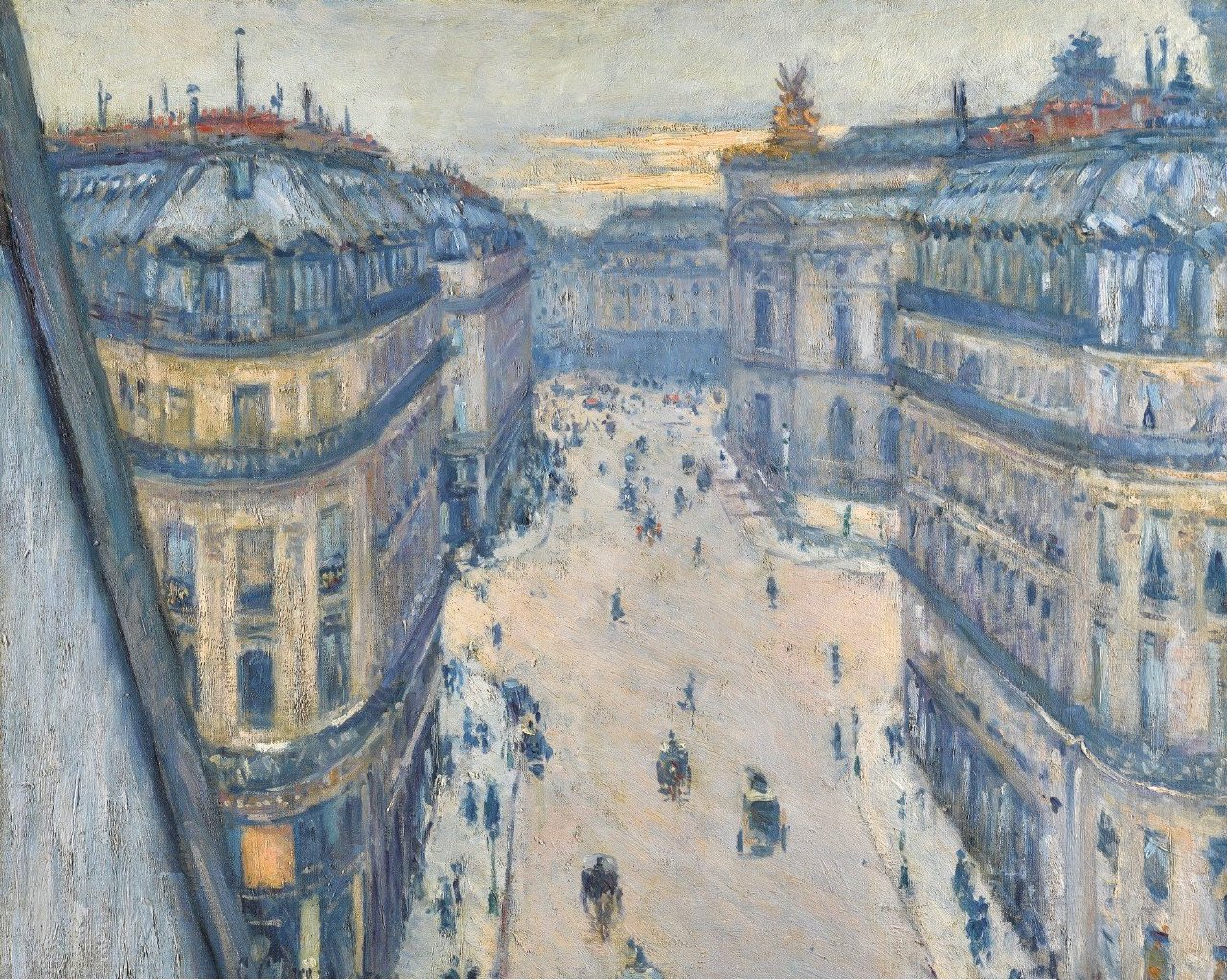
Gustave Caillebotte (1848-1894): “La Rue Halévy, vue du sixième étage”

Offered at the Sotheby’s New York Impressionist & Modern Art Evening Sale of 14 May 2019 with an estimate of US $6 – $8 million, Gustave Caillebotte’s “La Rue Halévy, vue du sixième étage” (oil on canvas, 1878) sold for US $13,932,000 (with fees).

Hasso Plattner, co-founder of the German software company SAP, SE, is said by The Canvas to have purchased the painting. Mr. Platter founded the Barberini Museum that opened in Potsdam in 2017. A member of “The Giving Pledge” established by Bill Gates and Warren Buffett, per Forbes magazine he is the 94th richest person in the world.

Gustave Caillebotte, “La Rue Halévy, vue du sixième étage” (oil on canvas, 1878)

Hasso Plattner’s collecting focus is the art both of the Impressionists and of the German Democratic Republic. He is said to be the buyer also of Monet’s “Meules” of 1890. “Meules” remained in the collection of Bertha Honoré Palmer and her family for nearly a century, also selling at Sotheby’s Impressionist & Modern Art Evening Sale of 14 May 2019 for $97 million (hammer) / $110,747,000 (with fees).

Caillebotte (1848 – 1884) exhibited “La Rue Halévy, vue du sixième étage” in the Fourth Impressionist Exhibition of 1879.

Napoleon III had introduced ambitious reforms during the 1860s, charging Georges-Eugène Haussmann with a radical reconfiguration of the then medieval city.

Space was created by razing many parts of Paris, developing a grid of straight roads, avenues, boulevards, and modern apartment buildings with grand balconies and large windows that faced the street, offering views of the boulevards below.

Caillebotte – lawyer and engineer by training as well as artist – explored the modern Paris in his work, adopting viewpoints high above the busy city streets.

The elevated vantage point of “La Rue Halévy, vue du sixième étage” afforded Caillebotte the freedom to view and manipulate perspective, tilting the ground of the picture plane in a manner that has been considered characteristic of his work and one of his greatest contributions in the move towards Modernism.

See:

Art Industry News: Did a German Software Billionaire Buy Monet’s $111 Million Haystacks? + Other Stories,” Artnet News, 16 May 2019

Gustave Caillebotte, “La Rue Halévy, vue du sixième étage,” Lot 17, Impressionist & Modern Art Evening Sale, 14 May 2019, Sotheby’s New York, Catalogue Note

Kelly Crow,”Monet Sells for $110.7 Million, Setting Artist and Impressionist Records,” Wall Street Journal, 14 May 2019

Kelly Crow, @KellyCrow, Tweet, 14 May 2019;

Kelly Crow, @KellyCrowWSJ, Tweet, 15 May 2019

Katya Kazakina, @theartdetective, Tweet, 14 May 2019

Catherine Hickley, “Software billionaire plans to turn decaying Potsdam restaurant into museum for East German art,” The Art Newspaper, 2 April 2019

your money, your life, your choice ・ Harvard invests in water

‘Because we believe its physical products are going to be in increasing demand in the global economy over the coming decades,”

Harvard Management Co., the Harvard University endowment manager, likes the natural-resources asset class.

In a warming planet, few resources will be more affected than water, as droughts, storms and changes in evaporation alter a flow critical for drinking, farming, and industry.

Even though there aren’t many ways to make financial investments in water, investors are starting to place bets.

“Buying arable land with access to it is one way.

“In California’s Central Coast, ‘the best property with the best water will sell for record-breaking prices,’ says JoAnn Wall, a real-estate appraiser specializing in vineyards, ‘and properties without adequate water will suffer in value.'”

The Harvard Management Co. has, since 2012, been buying agricultural land, with rights to sources of water, on California’s Central Coast. The idea was pitched to Harvard by agricultural investment advisory firm Grapevine Capital Partners LLC, founded by Matt Turrentine, formerly of his family’s Central Coast grape-brokerage business, and James Ontiveros, a local vineyard manager.

Harvard’s investing guidelines say respecting local resource rights are of increasing importance ‘in the coming decades as competition for scarce resources, such as arable land and water, intensifies due to increasing global population, climate change, and food consumption.’”

Investors who see agriculture as a proxy for betting on water include Michael Burry, a hedge-fund investor who wager against the U.S. housing market was chronicled in the book and movie ‘The Big Short.’ In a 2015 New York Magazine interview, Mr. Burry was quoted as saying: ‘What became clear to me is that food is the way to invest in water. That is, grow food in water-rich areas and transport it for sale in water-poor areas.'”

In California vineyards, the water-proxy math is compelling. When grapes are harvested, about 75% of their weight is water. Owning vineyards effectively turns water into revenue.”

Kat Taylor, an environmentalist and wife of hedge-fund billionaire and liberal activist Tom Steyer, resigned earlier this year from Harvard’s board of overseers in protest of the endowment’s investments in things such as fossil fuels and water holdings she says threaten the human right to water.

‘It may, in the short run, be about developing vineyard properties,’ she says of Harvard’s California investments. ‘In the long run, it was a claim on water.'”

See:

Harvard Amasses Vineyards – and Water. A bet on climate change in California gives it agricultural land and the rights below it,” Russell Gold, The Wall Street Journal, 11 December 2018

In Drought-Stricken Central California, Harvard Hopes to Turn Water Into Wine,” Eli W. Burnes and William L. Wang, The Harvard Crimson, 13 April 2018

Michael Burry, Real-Life Market Genius From The Big Short, Thinks Another Financial Crisis Is Looming,” Jessica Pressler, New York Magazine, 28 December 2018

your money, your life, your choice ・ the painting that did not sell

The painting that did not sell.

While there may be a well-established “cartel of taste” (see Anna Louie Sussman’s article “Why You Can’t Always Buy a Work of Art Just Because You Have the Cash,” @artsy, 12 December 2018), market stakeholders can and sometimes do display independent judgment.

Gerhard Richter’s “Schädel” (oil on canvas), the first of a series of eight skull paintings painted in 1983, was held in the same collection for 30 years after a last public exhibition in 1988.

Based on a photograph taken by Richter himself, the painting demonstrates a “dialogue between painterly abstraction and photo-realist representation that had been simmering across separate stands of Richter’s practice for nearly two decades.”

This painting led the Post-War and Contemporary Art Evening Sale held at Christie’s London on 4 October 2018.

With an unpublished estimate, the painting was expected to sell for between £12 and £18 million (US$15 – US$23 million).

Bidding reached £11.5 million. The painting was not allowed to change hands.

Note also the instance of Edward Hopper’s 1972 painting, “Portrait of an Artist (Pool with Two Figures)” that sold at Christie’s in New York on 15 November. It closed narrowly, at what may have been a precisely agreed threshold of $80 million – with what appeared to be Christie’s bidding against itself to reach the sales price.

See:

Why You Can’t Always Buy a Work of Art Just Because You Have the Cash,” Anna Louie Sussman, Artsy, 12 December 2018

Seen for the first time in 30 years: Gerhard Richter’s ‘Schädel’ (‘Skull’),” Christie’s

Gerhard Richter ‘Skull’ to Headline Christie’s Sale in London,” Fang Block, Barron’s, 4 September 2018

Rare Richter’s a Bust, but Christie’s Moves $25.9 M. Bacon, $21 M. Fontana at London Sales,” Judd Tully, Artnews, 4 October 2018


your money, your life, your choice | fashion & CO2

It’s really about bringing everyone together as an industry, and instead of having a few people talk about it, it’s having everyone talk about it and the leaders… actually taking responsibility, putting our money where our mouth is and making an amazing change together.”

Stella McCartney, founder of eponymous fashion company and brand

Consumers, investors, and the fashion industry, when deciding how to spend and where to put their money, are demonstrating a commitment to changing lifestyle choices, changing behaviors, redefining value, reducing emissions of atmospheric CO2 and greenhouse gases, and mitigating human-induced climate change.

The broader textile, clothing and fashion industry have worked during 2018 to specify ways in which, drawing on methodologies from the Science-Based Targets Initiative, they can direct themselves towards a holistic commitment to climate action, achieving net-zero emissions of atmospheric CO2 and greenhouse gases by 2050, while expanding economic opportunity and driving economic competitiveness and innovation.

The apparel and footwear industries together accounted in 2016 for an estimated 8.1% of global climate impacts with emissions of 3,990 million metric tons CO2eq (including emissions generated by processes used for raw material extraction, raw material processing, manufacturing, assembly, packaging production, transportation/distribution, and end-of-life).

The Ellen Macarthur Foundation estimates that “if nothing changes, by 2050 the fashion industry will use up a quarter of the world’s carbon budget.”

It’s really about bringing everyone together as an industry, and instead of having a few people talk about it, it’s having everyone talk about it and the leaders… actually taking responsibility, putting our money where our mouth is and making an amazing change together.”

So observes Stella McCartney while attending an 11 December gala dinner hosted in London by Bloomberg and Vanity Fair. The gala was held to highlight fashion, climate change, climate change mitigation, and the Fashion Industry Charter for Climate Change Action, signed in early December.

There is no shortage of capital in the world that wants to go in this direction. The hearts and minds argument of the common man on the street, has been won. My feeling is that what the financial services business needs to do, is to be working with the real innovative companies of today,” said David Fass, Macquarie Group CEO for Europe the Middle East and Africa.

The founding signatories to the Fashion Industry Charter for Climate Change Action are: adidas, Aquitex, Arcteryx, Burberry Limited, Esprit, Guess, Gap Inc., H&M Group, Hakro Gmbh., Hugo Boss, Inditex, Kering Group, Lenzing AG, Levi Strauss & Co., Mammut Sports Group AG, Mantis World, Maersk, Otto Group, Pidigi S.P.A, PUMA SE, re:newcell, Schoeller Textiles AG, Peak Performance, PVH Corp., Salomon, Skunkfunk, SLN Textil, Stella McCartney, Sympatex Technologies, Target and Tropic Knits Group.

Fashion Industry Charter for Climate Change Action, excerpts:

· the Paris Agreement represents a global response to the scientific consensus that human activity is causing global average temperatures to rise at unprecedented rates

· goals agreed in the Paris Agreement translate to reaching climate neutrality [read: reduced to zero emissions of atmospheric CO2 and other greenhouse gases from sourcing, manufacturing, distribution, use, and end-of-life of materials and products; reduced to zero use of hydrocarbon-based sources of energy in operations, manufacturing, distribution, retail, transport, etc.] in the second half of the twenty-first century. The fashion industry, as a major global player, needs to take an active part in contributing to the realization of these goals

· all companies, within fashion, retail and textile global value chain, regardless of size and geography, have opportunities to take actions that will result in a measurable reduction in greenhouse gas (GHG) emissions

· establish a closer dialogue with consumers to increase awareness about the GHG emissions caused in the use and end-of-life phases of products, building towards changed consumer behaviors that reduce environmental impacts and extend the useful life of products

· current solutions and business models will not be sufficient to deliver on the current climate agenda. Fashion industry needs to embrace a deeper, more systemic change and scale low-carbon solutions

· the fashion industry stakeholders have a role to play in reducing climate emissions resulting from their operations, with an awareness that the majority of climate impact within the industry lies in manufacturing of products and materials

· all companies, within fashion, retail and the textile global value chain, regardless of size and geography, have opportunities to take actions that will result in a measurable reduction in greenhouse gas (GHG) emissions

· actions that reduce GHG emissions are consistent with, among other things, expanding economic opportunity, using resources more efficiently, driving economic competitiveness and innovation, and strengthening resilience

· responding to climate change requires action on both mitigation and adaptation

[Signatories agree to]

11. Establish a closer dialogue with consumers to increase awareness about the GHG emissions caused in the use and end-of-life phases of products, building towards changed consumer behaviors that reduce environmental impacts and extend the useful life of products;

12. Partner with the finance community and policymakers to catalyse scalable solutions for a low-carbon economy throughout the sector

Stella McCartney and friends hit Bloomberg and Vanity Fair gala dinner,” Stephanie Takyi, The Standard, 13 December 2018

Stella McCartney Slams Fast Fashion as a Threat to the Environment,” Lucca de Paoli, Bloomberg, 12 December 2018

Inside the Bloomberg Vanity Fair Climate Exchange,” VF X Bloomberg, 11 December 2018

Milestone Fashion Industry Charter for Climate Action launched,” UNFCCC, 10 December 2018

About the Fashion Industry Charter for Climate Action,” UNFCCC

Fashion Industry Charter for Climate Action,” UNFCC

Measuring Fashion, Environmental Impact of the Global Apparel and Footwear Industries Study,” Quantis, 2018

A New Textiles Economy: Redesigning Fashion’s Future,” November 2017, The Ellen MacArthur Foundation & Circular Fibers Initiative

Report: A positive vision for a system that works, and summons the creative power of the fashion industry to build it,” Ellen MacArthur Foundation