coronavirus, climate change, the environment, & the arts: positive steps forward

“To my mind, one does not put oneself in place of the past; one only adds a new link.”

 Cy Twombly, quoted by Gagosian

“an elemental Dionysian force of madness rising, like a ‘fire that rises from the depths of the sea'”

Malcolm Bull, “Fire in the Water,” in Cy Twombly Bacchus Psilax Mainonmenos, exh. cat., New York, 2005, p. 55), quoted in Lot Essay, Cy Twombly (1928-2011), “Untitled” (acrylic on canvas, painted in 2005), Christie’s, Post-War & Contemporary Art Evening Sale, New York, 15 November 2017, Lot 15 B
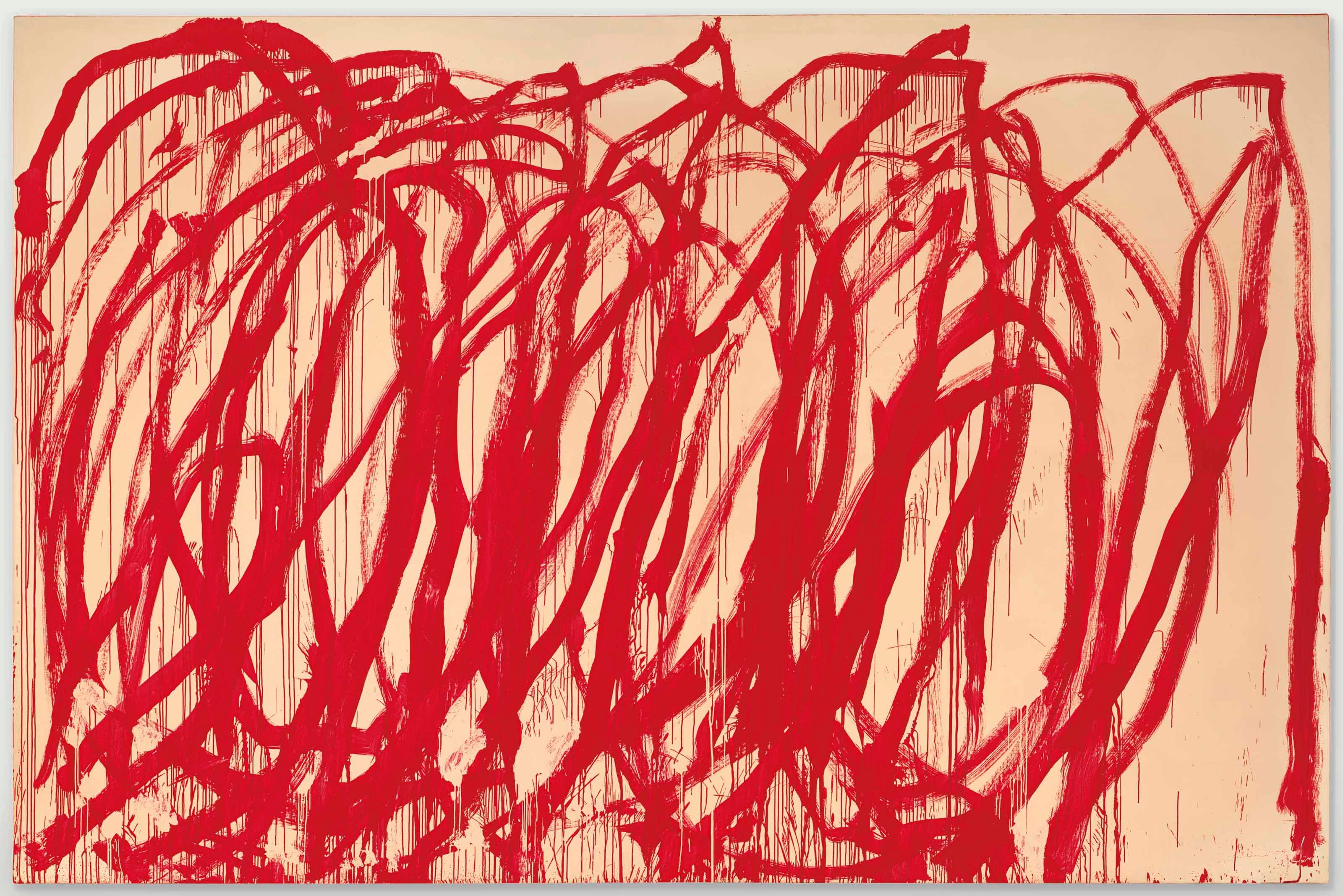
Cy Twombly (1928-2011), “Untitled” (acrylic on canvas, painted in 2005). “Untitled” sold at the Christie’s Post-War & Contemporary Art Evening Sale of 15 November 2017 in New York realizing a price of US$ 46,437,500

Over ten feet high and sixteen feet in length, “Untitled” is the largest example from a group of giant-scaled paintings that Twombly created beginning in 2003 at age 75.

Twombly makes use of spirals of linear loops, culminating fifty years of regularly invoking scrawls, whirls, and writing/drawing.

In his catalogue essay, “Fire in the Water” that accompanied the first exhibition of Twombly’s Bacchus series in 2005, Malcolm Bull argued that the abiding theme of these paintings was that of an elemental Dionysian force of madness rising, like a “fire that rises from the depths of the sea” (M. Bull, “Fire in the Water,” in Cy Twombly Bacchus Psilax Mainonmenos, exh. cat., New York, 2005, p. 55).’ – Lot Essay

Like Dionysian forces of madness, we are all experiencing the dislocation caused by the current COVID-19 pandemic.  

Individuals, families, supply chains, industries, markets, businesses, nations – all are affected.

This pandemic, however terrible, unexpected, and unprepared for, may in part be an outcome of behaviors that we have, however unwittingly, engaged in over decades.

We are all – individuals, peoples, cultures, animals, plants, functional objects and works of art, buildings, systems of transportation, agriculture, and education, etc. etc. etc. – inextricably embedded in nature. We are part and parcel of and subject to the forces of physics. Part and parcel of and subject to the elements and interactions of chemistry. 

As living, breathing creatures, moreover, and complex systems of systems. we are part and parcel of and subject to the complex forces of biology.  We are calibrated precisely, over long periods of time, to our biosphere.

If and should we take our biosphere for granted, fundamentally alter the composition of our atmosphere, and tamper with our climate, the unexpected can occur. Mayhem may let loose,

And so it has.

Yet, in the arts we are global. We reach across time, across space, across borders, across cultures, across nations. We represent mind and passion, interests and preferences. We come from an abundance of backgrounds and industries. 

We may lead, each in our own place, taking steps to realize our ambitions anew.

Together we will have impact.

While we work in our many spheres of activity, what steps, however simple, might we take to realize our objectives while mitigating risks of future such dislocations?

If we want “to do something to prevent disease emergence, first of all we need to seriously reconsider how we do business with the biosphere.”

Q & A: A Harvard Expert on Environment and Health Discusses Possible Ties Between COVID and Climate,”

“We need to hear what nature is trying to tell us, which is clear: let’s be smarter about how we do business with the biosphere and stop disrupting the climate we depend on.” 

 Conversation on COVID-19 with Dr. Aaron Bernstein, Director of Harvard C-CHANGE

Two recently published articles are insightful. In them, Dr. Aaron Bernstein, MD, MPH, Director of The Center for Climate, Health, and the Global Environment at Harvard’s T.H. Chan School of Public Health (Harvard C-CHANGE) offers guidance.

Please take a few minutes to read them in full:

Neela Banerjee, “Q & A: A Harvard Expert on Environment and Health Discusses Possible Ties Between COVID and Climate,” Inside Climate News, 12 March 2020

A Conversation on COVID-19 with Dr. Aaron Bernstein, Director of Harvard C-CHANGE, ” Harvard C-CHANGE  

Excerpts follow, giving us some idea of what we probably already know but don’t always think about or consider in the decisions we make on a daily basis:

The bottom line here is that if you wanted to prevent the spread of pathogens, the emergence of pathogens, … you wouldn’t transform the climate.”

Q & A: A Harvard Expert on Environment and Health Discusses Possible Ties Between COVID and Climate,”

The separation of health and environmental policy is a dangerous delusion. Our health entirely depends on the climate and the other organisms we share the planet with.”

A Conversation on COVID-19 with Dr. Aaron Bernstein, Director of Harvard C-CHANGE

Simply put, “The likelihood is high that this [a next pandemic] will happen. This has happened through human history but the data we have shows that the pace is accelerating. That’s not terribly surprising. We’re living in highly dense urban places. Air travel is much more prevalent than it used to be. And climate is a part of what is fundamentally reshaping our relationship with the natural world.”

Q & A: A Harvard Expert on Environment and Health Discusses Possible Ties BetweenCOVID and Climate

You look at climate change, we have transformed the nature of the Earth. We have fundamentally changed the composition of the atmosphere, and, as such, we shouldn’t be surprised that that affects our health.”

If you look at the emerging infectious diseases that have moved into people from animals or other sources over the last several decades,the vast majority of those are coming from animals. And the majority of those are coming from wild animals. We have transformed life onEarth. We are having a massive effect on how the relationships between all life on Earth operate and also with ourselves. We shouldn’t be surprised that these emerging diseases pop up.

The principle is that we’re really changing how we relate to other species on Earth and that matters to our risk for infections.”

Q & A: A Harvard Expert on Environment and Health Discusses Possible Ties Between COVID and Climate”

Historically, we have grown as a species in partnership with the plants and animals we live with. So, when we change the rules of the game by drastically changing the climate and life on earth, we have to expect that it will affect our health.

A Conversation on COVID-19 with Dr. Aaron Bernstein, Director of Harvard C-CHANGE

How might we in our private and business capacities be smarter about how we do business with the biosphere and stop disrupting the climate we depend on?

First, think.

All industries, markets, and economies, including the arts, the art market, and the art economy, are interconnected and all are viable only within our shared biosphere.

“Art” is not self-existent. Art as a phenomenon, culture as a phenomenon, works of art, cultures, collections of works of art, collectors, and all parties to art are inextricably embedded in and dependent on nature.

Take time and steps to learn about and understand the biosphere. Take steps to reconsider how we, in every sphere of work and activity, do business with the biosphere.

We have an opportunity to consider ways to optimize connections, culture, art, the business of art, and the biosphere jointly.

Some simple steps that can be taken:

Minimize travel

Whether curator, museum director, staff, or trustee, collector, dealer, gallerist, advisor, interested party – vet travel requirements.

Minimize travel powered by combustion of hydrocarbons.

“We need to drastically decrease our greenhouse gas emissions from fossil fuels like coal, oil and natural gas.”

A Conversation on COVID-19 with Dr. Aaron Bernstein, Director of Harvard C-CHANGE

It goes without saying that travel by foot or by bike is encouraged. Travel by electric-powered cars, buses, and trains – especially insofar as the electricity is generated from renewable, non-hydrocarbon sources – is also encouraged.

Amsterdam-based art dealer Jan Six XI, for instance, bikes to and from work, and across town to consult with experts. (Russell Shorto, “Rembrandt in the Blood: AnObsessive Aristocrat, Rediscovered,” The New York Times Magazine, 27 February 2019)

Work with local partners

We are all somewhere. We do not need to be everywhere.

If you need to do work or close a transaction somewhere else, research, identify, vet, and work with local partners.

Optimize resources and connections made available online

Information, images, and opportunities to meet and discuss face-to-face, even in groups, abound online. As we are now seeing in abundance, education and research can be conducted online. Relationships developed through written and verbal communications optimized online, by mail (even mail that goes through the post office), and by telephone.

As much activity is migrating online, vet also your online service partners and their delivery options.

This website, for instance, is hosted by AISO.net. AISO.net is powered 100% by solar energy generated on site. The company does not make use of carbon credits. Members of staff are knowledgeable, of course, very personable, and extraordinarily helpful. They are great to work with.

Reduce carbon dioxide and greenhouse gas emissions from ongoing operations of physical plants

Galleries,museums, homes, businesses, offices, schools and universities, hotels,hospitals – all house works and collections of art.

Real-life steps can be taken to reduce use of hydrocarbon-based energy sources and achieve net-zero energy.

Expert and experienced stakeholders including architects, engineers, designers, builders, energy consultants, and sources of finance are able and ready to assist.

Information about service providers will follow.

Amsterdam’s Van Gogh Museum can serve as a model. The Van Gogh Museum operates 100% on renewable (wind)energy. (See Van Gogh Museum, sustainability, and accompanying infographic.)

Change habits of mind and behavior

Allow time for foot and bike travel. Schedule meetings and work requirements accordingly. 

Enjoy the great outdoors en route to work, home, meetings, and shopping.

Enjoy your locality

See:

Cy Twombly (1928 – 2011), “Untitled” (acrylic on canvas, painted in 2005), Christie’s, Post-War & Contemporary Art Evening Sale, New York, 15 November 2017, Lot 15 B 

Coronavirus, climate change, and the environment, A Conversation on COVID-19 with Dr. Aaron Bernstein, Director of Harvard C-CHANGE”, Harvard C-Change, 20 March 2020

Aaron Bernstein, MD, MPH, C-Change,Center for Climate, Health, and the Global Environment, Harvard T.H. Chan School of Public Health

Neela Banerjee, “Q&A:A Harvard Expert on Environment and Health Discusses Possible TiesBetween COVID and Climate,” Inside Climate News, 12 March 2020

Russell Shorto, “Rembrandt in the Blood: An Obsessive Aristocrat,Rediscovered,” The New York Times Magazine, 27 February 2019
Art Basel to Offer Online Viewing Rooms

As latent risks emerge, industry, business, and individuals adapt. Opportunities, and benefits, are discovered in and developed from such adaptation. Opportunities and benefits are discovered also in forward-looking mitigation.

Inaugurated in 1970 by Basel gallerists Ernst Beyeler, Trudi Bruckner and Balz Hilt, owned and managed by Switzerland-based MCH Group, art fair giant Art Basel, facing health, travel, and concomitant business risks posed by the emergent Covid-19 virus, cancelled Art Basel Hong Kong 2020.

The Art Basel fairs, offered in Basel, Miami Beach, and Hong Kong, have succeeded as an effective venue for introducing galleries, works of art, and collectors to each other.

The fairs, while offering face-to-face interactions, are, however, premised on travel, often long-distance. The fairs are premised further on the gathering of large numbers of people together in one place at one time.

The travel and costs (staff, booth rentals, insurance, hotels and lodging, shipping of works of art, …) involved with the fair – and the many art fairs that have developed over the years – are expensive for galleries and collectors alike.

The travel, further, can increase risk. Combustion of hydrocarbon-based fuels releases carbon dioxide into the atmosphere. 

Carbon dioxide molecules are precisely calibrated to attract and retain, in our atmosphere, photons of thermal energy that reach the earth from the sun. (See infographic.) Increasing levels of carbon dioxide in our atmosphere leads therefore to greater thermal energy (heat) in the atmosphere.

Acidification of the oceans, that themselvesabsorb about 30% of the carbon dioxide released into the atmosphere, also takes place.

Increased atmospheric heat leads to consequences such as melting of arctic permafrost, melting of glaciers, sea level rise, fires, storms, the release of pathogens and concomitant health risks. (See infographic developed by Zurich-based reinsurance giant Swiss Re.)

 With regard to large numbers of people gathering together in one place at one time, this currently may pose a risk of transmission of the emergent coronavirus (COVID-19).

To reduce such risk, the Swiss Federal Council, on 28 February 2020, issued an ordinance forbidding the holding of public or private events in Switzerland where more than 1,000 people are present at the same time.

MCH Group has, accordingly, not only cancelled Art Basel Hong Kong 2020 but has also postponed further events and trade shows such as the Baselworld Watch and Jewellery Show 2020 (until January-February 2021), the garden exhibition Giardina in Zurich, and Habitat-Jardin in Lausanne.

Fortunately there are means of bringing galleries, works of art, and collectors together that are premised neither on long-distance travel nor on the gathering in one place of multitudes of people.

Art Basel has been developing such a means, an initiative that, as “the art market continues to evolve, exemplifies its longstanding commitment to fostering a healthy art world ecosystem by creating new ways for its galleries to reach collectors from across the globe.”

The initiative is a digital-only platform for Art Basel’s galleries and collectors. The inaugural edition of Art Basel’s Online Viewing Rooms are planned to go live on 20 March 2020.

“Online Viewing Rooms will give visitors the opportunity to browse thousands of artworks presented by Art Basel participating galleries, many of which will be online exclusives. The exhibiting gallery can then be contacted directly for sales inquiries. The Viewing Rooms will run in parallel to the three shows in Basel, Miami Beach, and Hong Kong.”


Art Basel to launch Online Viewing Rooms,” Art Basel

While recognizing “’the essential personal interactions that continue to underlie the  art market,’” Art Basel Global Director Marc Spiegler notes that “’the Online Viewing Rooms will provide galleries with a further possibility for engaging with our global audiences.'”

All the galleries that were accepted for the cancelled 2020 Art Basel Hong Kong have been invited to participate, at no cost, in the launch of the Online Viewing Rooms.

Art Basel is not the first to organization to provide a means for galleries, works of art, and collectors to meet online. New York-based Artsy has been doing so for several years.

The process of selecting works of art, acquiring them, and developing a collection requires intent, effort, patience, and work. Such work is conducted in increments over a long-term.

Relationships of mutual trust and reliance, between collectors, galleries, and dealers, some private, are developed.

Qualifications of all parties are established. Buyers and sellers alike vet each other for acknowledgement and understanding of contract law as well as willingness to agree and adhere to contractual terms.

As works of art are identified for purchase, high-resolution images taken from multiple angles can be shared. Condition reports, provenance, and valuations provided.

The process enables collectors to learn and value not only the aesthetic, historical, and, increasingly, financial qualities of such works of art but also the supply chain logistics.

Supply chain logistics are themselves complex, often crossing cultures, history, collections, sovereign entities such as cities, states, and nations, and laws.

Supply chain logistics and the logistics of collections management evolving to include collaborations not only with art professionals but also with those with in a variety of industries. These industries include science, tech, law, engineering, energy, water, design, architecture, finance, and, insurance.

Insurance especially in a new iteration: in regard to transparent, data-driven identification of risk together with public/private collaborations structured to foster preemptive mitigation of risk.

See:

Art Basel to launch Online Viewing Rooms,” Art Basel

Anny Shaw, “MCH Group postpones Baselworld watch fair as Swiss authorities ban large events over coronavirus fears,” The Art Newspaper, 28 February2020

Christian Jecker, “MCH Group postpones forthcoming events,” MCH Group Media Release, 28 February 2020

Carbon Dioxide Absorbs and Re-Emits Infrared Radiation,” UCAR Center for Science Education

Swiss Re, “Special Feature: It’s existential – climate change and life & health,” 22 May 2019

NOAA, “Ocean Acidification

Trio of gallery greats commence sales of works from the Donald B. Marron Family Collection

Good contemporary art reflects the society, and great contemporary art anticipates.

Donald B. Marron (quoted by Pace Gallery, “Acquavella Galleries, Gagosian and Pace to Handle Sale of Donald B. MarronFamily Collection”)

Kelly Crow of the Wall Street Journal has reported that two works by Pablo Picasso, “Femme au beret et la collerette” (Woman with Beret and Collar,” 1937) and “Seated Woman (Jacqueline)” (1962) have been sold from the Donald B. Marron Family Collection to collector Stephen Wynn. It is reported that Mr. Wynn paid approximately $105 million for the two paintings.

Sales of works from the family collection are being conducted by a collaboration of gallery greats – Pace Gallery, Gagosian, and Acquavella Galleries. Bill Acquavella (son of Acquavella Galleries founder Nicholas Acquavella), Larry Gagosian (founder of Gagosian), and Arne Glimcher (founder of Pace Gallery) each worked with Mr. Marron in the development of the collection.

The collaboration, “the first of its kind, signals a new way for families to handle the sales of their collections” (Gagosian).

Under the terms of the collaboration, the galleries are charged to work jointly and privately to place and sell the works in the market. They are charged, further, neither to disclose publicly what is or is not available for sale nor to disclose an estimate for the collection.

The collaboration appears to have been the brainchild of Marc Glimcher, son of Arne Glimcher and president of Pace Gallery.

Eileen Kinsella of Artnet News, reporting that the plan came together quickly, quotes Mr. Glimcher:

“’I heard that [the Marron family] were considering going to auction and I just picked up the phone and called Larry [Gagosian] and said, ‘We should really present an alternative to the family. It’s tragic for this collection to go to auction,’” Glimcher recalled.

“After reaching out to Bill Acquavella, who also had a longstanding relationship with Marron, “’we all came and presented an idea to the family of how we would do it” around a month ago.’”

The Acquavella family – sister, brothers, and father – came on board. Eleanor Acquavella, Bill Acquavella’s daughter, reports that they“’ liked the idea of competing with the auctions on a great estate.’” They acknowledged, however, that “it would be hard to pull off.'” The galleries would be required to “’compete financially,'” and otherwise, to win to the business.

Indeed. Financial guarantees for the collection, in the amount of $300 million, had been offered by auction houses Christie’s, Sotheby’s, and Phillips.

Especially in the face of those guarantees, “’“the key,’” observed Gagosian’s COO Andrew Fabricant, “’was to meet the fiduciary requirements of an estate, which is complicated.

“‘We had to convince the family and the lawyers. The challenge was to be in line and competitive and still have some daylight for running with an exhibition and sales.”

A joint New York exhibition of May and June, is being organized by the three galleries. Including works from the family collection together with loans from institutions,  the exhibition “will chronicle Marron’s collecting activities, including his early acquisitions in the 1960s and 1970s, his museum stewardship, and his pioneering work reinventing how corporations build art collections around a singular vision.”

See:

Kelly Crow, “Steve Wynn Pays $105 Million for Pair of Picassos,” The Wall Street Journal, 24 February 2020

Eileen Kinsella, “The $450 Million Marron Collection Is the Art Market’s Ultimate Prize. Now, Three of the World’s Top Rival Galleries Are Joining Forces to Sell It,” Artnet, 19 February 2020

Acquavella Galleries, Gagosian, and Pace to Handle Sale of Donald B. MarronFamily Collection,” Gagosian

Acquavella Galleries, Gagosian and Pace to Handle Sale of Donald B. Marron Family Collection,” Pace Gallery

Acknowledging risk, Sotheby’s revises 2020 Hong Kong Spring Sale

“Monitoring the impact of the Covid-19 virus and the resulting travel restrictions” – in effect acknowledging, and attempting to manage, the health, travel, and business risks that the coronavirus poses – Sotheby’s has revised its 2020 Hong Kong Spring Sale.

The Modern Art Evening Sale, the Contemporary Art Evening Sale, and the Contemporary Art Day Sale will take place in New York on 16 April.

Further 2020 Hong Kong Spring sales have been re-scheduled from April to July. The plan is that they will take place in Hong Kong.

The revised schedule can be found here: “Revised Schedule For Sotheby’s Hong Kong 2020 Spring Auction Series Announced.”

Sotheby’s publishes a message from Kevin Ching, CEO of Sotheby’s Asia:

“We have been closely monitoring the impact of the Covid-19 virus and the resulting travel restrictions.

“After careful consideration and reflection on nearly 50 years of working with our clients in Asia, we have made the strategic decision to continue to hold our major Modern and Contemporary Art auctions in April but relocate them to New York and to postpone the balance of our spring auctions to early July in Hong Kong.

“April in New York represents the best possible venue and timing for our consignors of Modern and Contemporary art. We have scheduled these sales at times that will make it easy for our clients in Asia to participate and our global team stands ready to activate the international market for the great works of art we have assembled.

“Similarly, given the nature of the property and collectors in our other categories, we have decided to postpone those auctions until early July when we can safely hold a traveling exhibition across Asia and present our sale week in Hong Kong.”

Kevin Ching, CEO, Sotheby’s Asia

See:

Revised Schedule for Sotheby’s Hong Kong Spring Auction Series Announced,” Sotheby’s, 24 February 2020

Revised Schedule For Sotheby’s Hong Kong 2020 Spring Auction Series Announced” and “Sale Calendar,” Sotheby’s

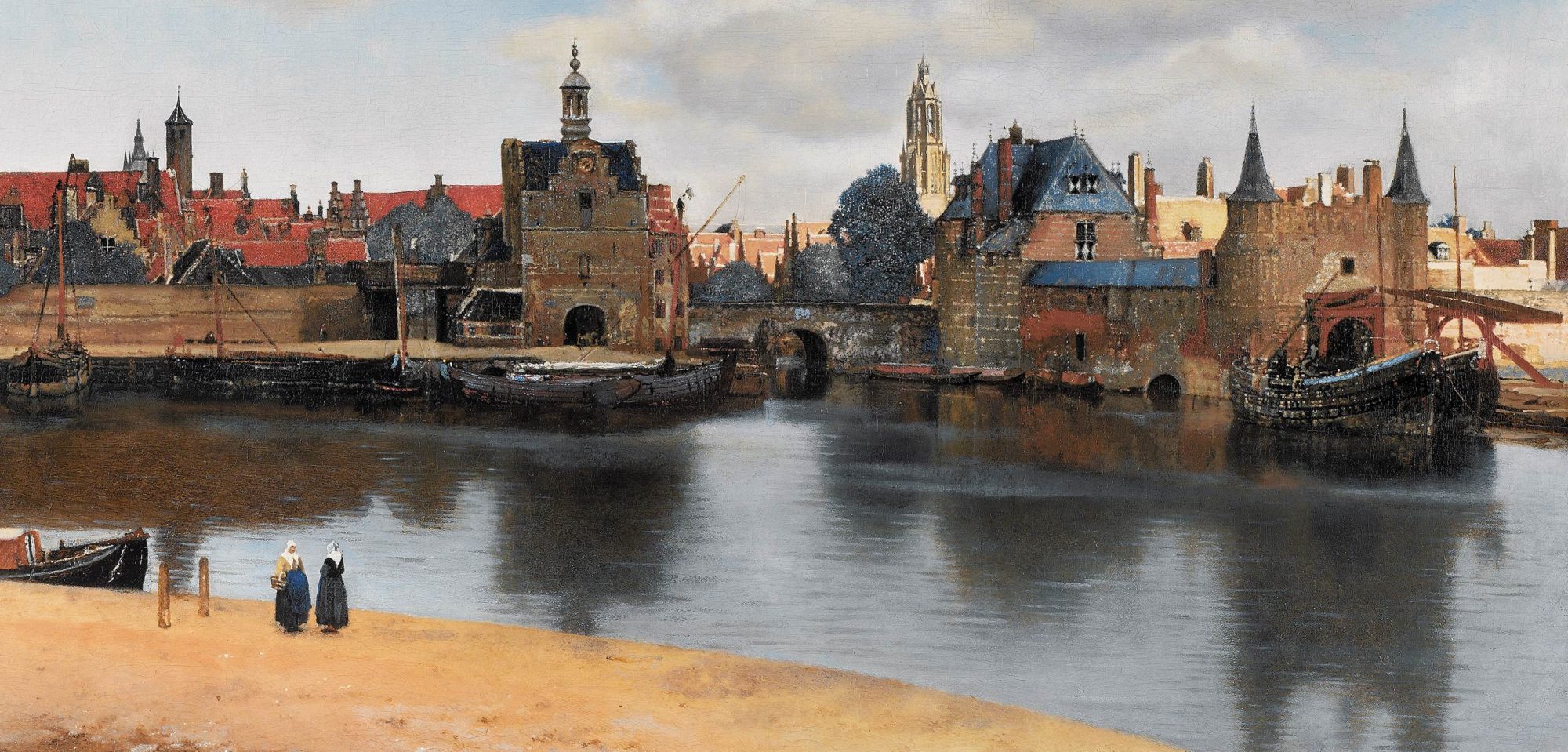
collecting Old Masters

From quattrocento to early 19th century Europe, the term “Old Master” generally refers to artists of skill who, in theory, were fully trained “Masters” of their local artists’ guilds and worked independently.

In practice, works produced by pupils, workshops, and studios of Masters are included in the term.

The term does not refer to a specific art historical style or movement.

Christie’s, using the term “Old Masters” to denote a category of painting that spans 500 years, is “redefining old masters for the 21st century global art market.”

Redefining, and re-positioning, the category for the 21st century global art market, the auction house is drawing interest from buyers in the contemporary art market and from around the world.

From artist to condition to subject to provenance, Christie’s has produced a helpful guide for buyers and prospective buyers in the Old Masters painting market: “Old Master paintings: 5 things for a new buyer to consider.

Pointers follow.

Price

Prices for Old Masters paintings realized at Christie’s range from a few thousand dollars to the hundreds of millions.

An exceptional $450,312,500 /£342,182,751 (including buyer’s premium) was realized in New York on 15 November 2017 for “Salvator Mundi”.

“Salvator Mundi” (c. 1500), attributed to Leonardo da Vinci, was sold to Prince Bader bin Abdullah bin Mohammed bin Farhan al-Saud of Saudi Arabia, friend and associate of crown prince Mohammed bin Salman. The painting was earlier included in the National Gallery’s 2011-12 exhibition of Leonardo’s surviving paintings.

Artist

“Is the artist an established name? Is the work from a good or particularly pivotal moment in the artist’s career or development? Is the attribution given in full (or qualified as ‘Studio’/‘Circle’/ ‘Follower’ of the artist)? Is the work included inthe key literature on the artist — and if not, have the currentexperts been consulted? Has the work been included in any recentseminal exhibitions on the artist?”

Christie’s, “Old Master paintings: 5 things for a new buyer to consider”

Provenance

Which collectors have been drawn to the work and “considered it worthy of their collections”?

Which exhibitions has the work been included in and where?

Restored? “Slightly neglected?” Rare?

“It is better to invest in a slightly neglected work, which can be treated relatively easily with sensitive restoration, than in one that has been subjected to numerous campaigns of restoration in the past, some of which may have resulted in the original surface beingabraded and over-painted. If in doubt, consult a restorer.”

Christie’s, “Old Master paintings: 5 things for a new buyer to consider”

In terms of rarity, research how prolific the artist was and how frequently his work appears on the market.

When excellent condition and rarity combine, magic happens. Works can realize exceptional prices.

Subject matter

Subject matter includes royal sitters, historical figures, topographical views, city views, university towns, landscapes, still lifes.

See:

Old Master paintings: 5 things for a new buyer to consider,” Christie’s, 25 November 2019

Old Masters,” Artsy

Old Masters,” Christie’s

Old Master,” Wikipedia

Leonardo’s Salvator Mundi makes auction history”, Christie’s, 15 November 2017

David D. Kirkpatrick,“Mystery Buyer of $450 Million ‘Salvator Mundi’ Was a Saudi Prince,”New York Times, 6 December 2017

Gustave Caillebotte (1848-1894): “La Rue Halévy, vue du sixième étage”

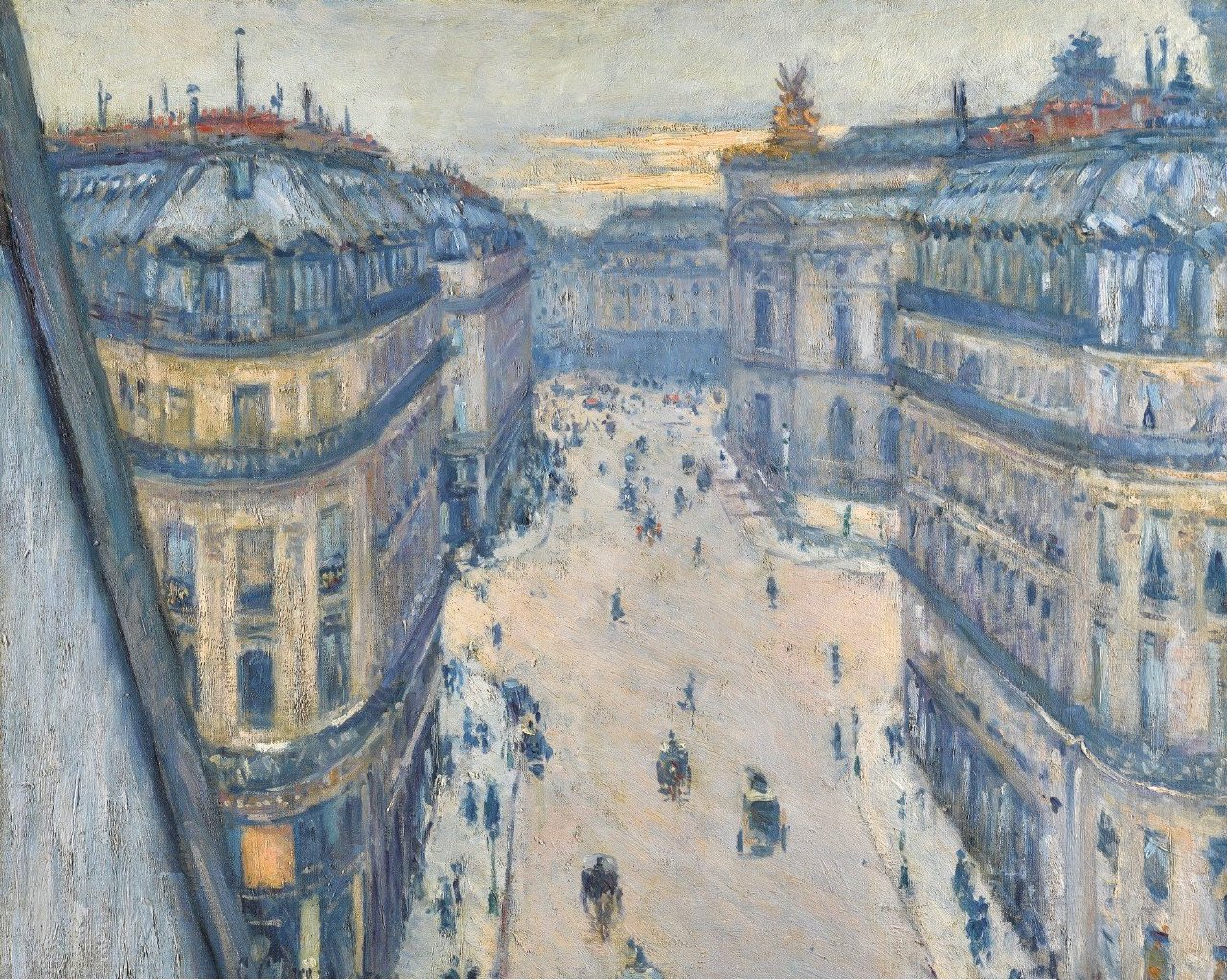
Offered at the Sotheby’s New York Impressionist & Modern Art Evening Sale of 14 May 2019 with an estimate of US $6 – $8 million, Gustave Caillebotte’s “La Rue Halévy, vue du sixième étage” (oil on canvas, 1878) sold for US $13,932,000 (with fees).

Hasso Plattner, co-founder of the German software company SAP, SE, is said by The Canvas to have purchased the painting. Mr. Platter founded the Barberini Museum that opened in Potsdam in 2017. A member of “The Giving Pledge” established by Bill Gates and Warren Buffett, per Forbes magazine he is the 94th richest person in the world.

Gustave Caillebotte, “La Rue Halévy, vue du sixième étage” (oil on canvas, 1878)

Hasso Plattner’s collecting focus is the art both of the Impressionists and of the German Democratic Republic. He is said to be the buyer also of Monet’s “Meules” of 1890. “Meules” remained in the collection of Bertha Honoré Palmer and her family for nearly a century, also selling at Sotheby’s Impressionist & Modern Art Evening Sale of 14 May 2019 for $97 million (hammer) / $110,747,000 (with fees).

Caillebotte (1848 – 1884) exhibited “La Rue Halévy, vue du sixième étage” in the Fourth Impressionist Exhibition of 1879.

Napoleon III had introduced ambitious reforms during the 1860s, charging Georges-Eugène Haussmann with a radical reconfiguration of the then medieval city.

Space was created by razing many parts of Paris, developing a grid of straight roads, avenues, boulevards, and modern apartment buildings with grand balconies and large windows that faced the street, offering views of the boulevards below.

Caillebotte – lawyer and engineer by training as well as artist – explored the modern Paris in his work, adopting viewpoints high above the busy city streets.

The elevated vantage point of “La Rue Halévy, vue du sixième étage” afforded Caillebotte the freedom to view and manipulate perspective, tilting the ground of the picture plane in a manner that has been considered characteristic of his work and one of his greatest contributions in the move towards Modernism.

See:

Art Industry News: Did a German Software Billionaire Buy Monet’s $111 Million Haystacks? + Other Stories,” Artnet News, 16 May 2019

Gustave Caillebotte, “La Rue Halévy, vue du sixième étage,” Lot 17, Impressionist & Modern Art Evening Sale, 14 May 2019, Sotheby’s New York, Catalogue Note

Kelly Crow,”Monet Sells for $110.7 Million, Setting Artist and Impressionist Records,” Wall Street Journal, 14 May 2019

Kelly Crow, @KellyCrow, Tweet, 14 May 2019;

Kelly Crow, @KellyCrowWSJ, Tweet, 15 May 2019

Katya Kazakina, @theartdetective, Tweet, 14 May 2019

Catherine Hickley, “Software billionaire plans to turn decaying Potsdam restaurant into museum for East German art,” The Art Newspaper, 2 April 2019

your money, your life, your choice ・ the painting that did not sell

The painting that did not sell.

While there may be a well-established “cartel of taste” (see Anna Louie Sussman’s article “Why You Can’t Always Buy a Work of Art Just Because You Have the Cash,” @artsy, 12 December 2018), market stakeholders can and sometimes do display independent judgment.

Gerhard Richter’s “Schädel” (oil on canvas), the first of a series of eight skull paintings painted in 1983, was held in the same collection for 30 years after a last public exhibition in 1988.

Based on a photograph taken by Richter himself, the painting demonstrates a “dialogue between painterly abstraction and photo-realist representation that had been simmering across separate stands of Richter’s practice for nearly two decades.”

This painting led the Post-War and Contemporary Art Evening Sale held at Christie’s London on 4 October 2018.

With an unpublished estimate, the painting was expected to sell for between £12 and £18 million (US$15 – US$23 million).

Bidding reached £11.5 million. The painting was not allowed to change hands.

Note also the instance of Edward Hopper’s 1972 painting, “Portrait of an Artist (Pool with Two Figures)” that sold at Christie’s in New York on 15 November. It closed narrowly, at what may have been a precisely agreed threshold of $80 million – with what appeared to be Christie’s bidding against itself to reach the sales price.

See:

Why You Can’t Always Buy a Work of Art Just Because You Have the Cash,” Anna Louie Sussman, Artsy, 12 December 2018

Seen for the first time in 30 years: Gerhard Richter’s ‘Schädel’ (‘Skull’),” Christie’s

Gerhard Richter ‘Skull’ to Headline Christie’s Sale in London,” Fang Block, Barron’s, 4 September 2018

Rare Richter’s a Bust, but Christie’s Moves $25.9 M. Bacon, $21 M. Fontana at London Sales,” Judd Tully, Artnews, 4 October 2018


your money, your life, your choice | fashion & CO2

It’s really about bringing everyone together as an industry, and instead of having a few people talk about it, it’s having everyone talk about it and the leaders… actually taking responsibility, putting our money where our mouth is and making an amazing change together.”

Stella McCartney, founder of eponymous fashion company and brand

Consumers, investors, and the fashion industry, when deciding how to spend and where to put their money, are demonstrating a commitment to changing lifestyle choices, changing behaviors, redefining value, reducing emissions of atmospheric CO2 and greenhouse gases, and mitigating human-induced climate change.

The broader textile, clothing and fashion industry have worked during 2018 to specify ways in which, drawing on methodologies from the Science-Based Targets Initiative, they can direct themselves towards a holistic commitment to climate action, achieving net-zero emissions of atmospheric CO2 and greenhouse gases by 2050, while expanding economic opportunity and driving economic competitiveness and innovation.

The apparel and footwear industries together accounted in 2016 for an estimated 8.1% of global climate impacts with emissions of 3,990 million metric tons CO2eq (including emissions generated by processes used for raw material extraction, raw material processing, manufacturing, assembly, packaging production, transportation/distribution, and end-of-life).

The Ellen Macarthur Foundation estimates that “if nothing changes, by 2050 the fashion industry will use up a quarter of the world’s carbon budget.”

It’s really about bringing everyone together as an industry, and instead of having a few people talk about it, it’s having everyone talk about it and the leaders… actually taking responsibility, putting our money where our mouth is and making an amazing change together.”

So observes Stella McCartney while attending an 11 December gala dinner hosted in London by Bloomberg and Vanity Fair. The gala was held to highlight fashion, climate change, climate change mitigation, and the Fashion Industry Charter for Climate Change Action, signed in early December.

There is no shortage of capital in the world that wants to go in this direction. The hearts and minds argument of the common man on the street, has been won. My feeling is that what the financial services business needs to do, is to be working with the real innovative companies of today,” said David Fass, Macquarie Group CEO for Europe the Middle East and Africa.

The founding signatories to the Fashion Industry Charter for Climate Change Action are: adidas, Aquitex, Arcteryx, Burberry Limited, Esprit, Guess, Gap Inc., H&M Group, Hakro Gmbh., Hugo Boss, Inditex, Kering Group, Lenzing AG, Levi Strauss & Co., Mammut Sports Group AG, Mantis World, Maersk, Otto Group, Pidigi S.P.A, PUMA SE, re:newcell, Schoeller Textiles AG, Peak Performance, PVH Corp., Salomon, Skunkfunk, SLN Textil, Stella McCartney, Sympatex Technologies, Target and Tropic Knits Group.

Fashion Industry Charter for Climate Change Action, excerpts:

· the Paris Agreement represents a global response to the scientific consensus that human activity is causing global average temperatures to rise at unprecedented rates

· goals agreed in the Paris Agreement translate to reaching climate neutrality [read: reduced to zero emissions of atmospheric CO2 and other greenhouse gases from sourcing, manufacturing, distribution, use, and end-of-life of materials and products; reduced to zero use of hydrocarbon-based sources of energy in operations, manufacturing, distribution, retail, transport, etc.] in the second half of the twenty-first century. The fashion industry, as a major global player, needs to take an active part in contributing to the realization of these goals

· all companies, within fashion, retail and textile global value chain, regardless of size and geography, have opportunities to take actions that will result in a measurable reduction in greenhouse gas (GHG) emissions

· establish a closer dialogue with consumers to increase awareness about the GHG emissions caused in the use and end-of-life phases of products, building towards changed consumer behaviors that reduce environmental impacts and extend the useful life of products

· current solutions and business models will not be sufficient to deliver on the current climate agenda. Fashion industry needs to embrace a deeper, more systemic change and scale low-carbon solutions

· the fashion industry stakeholders have a role to play in reducing climate emissions resulting from their operations, with an awareness that the majority of climate impact within the industry lies in manufacturing of products and materials

· all companies, within fashion, retail and the textile global value chain, regardless of size and geography, have opportunities to take actions that will result in a measurable reduction in greenhouse gas (GHG) emissions

· actions that reduce GHG emissions are consistent with, among other things, expanding economic opportunity, using resources more efficiently, driving economic competitiveness and innovation, and strengthening resilience

· responding to climate change requires action on both mitigation and adaptation

[Signatories agree to]

11. Establish a closer dialogue with consumers to increase awareness about the GHG emissions caused in the use and end-of-life phases of products, building towards changed consumer behaviors that reduce environmental impacts and extend the useful life of products;

12. Partner with the finance community and policymakers to catalyse scalable solutions for a low-carbon economy throughout the sector

Stella McCartney and friends hit Bloomberg and Vanity Fair gala dinner,” Stephanie Takyi, The Standard, 13 December 2018

Stella McCartney Slams Fast Fashion as a Threat to the Environment,” Lucca de Paoli, Bloomberg, 12 December 2018

Inside the Bloomberg Vanity Fair Climate Exchange,” VF X Bloomberg, 11 December 2018

Milestone Fashion Industry Charter for Climate Action launched,” UNFCCC, 10 December 2018

About the Fashion Industry Charter for Climate Action,” UNFCCC

Fashion Industry Charter for Climate Action,” UNFCC

Measuring Fashion, Environmental Impact of the Global Apparel and Footwear Industries Study,” Quantis, 2018

A New Textiles Economy: Redesigning Fashion’s Future,” November 2017, The Ellen MacArthur Foundation & Circular Fibers Initiative

Report: A positive vision for a system that works, and summons the creative power of the fashion industry to build it,” Ellen MacArthur Foundation

our daily bread (& rice) | wheat, rice, & CO2

Plants need carbon dioxide to live, but its effects on them are complicated.

As the level of carbon dioxide in the air continues to rise because of human activity, scientists are trying to understand how the plants we eat are being affected.

According to recent studies, rice, wheat, and other staple crops lose nutrients when exposed to levels of carbon dioxide in the atmosphere expected by 2050.

Samuel Myers, principal research scientist at Harvard’s School of Public Health and director of the Harvard-based Planetary Health Alliance and colleagues have conducted studies in which crops are grown bathed in air that simulates the predicted atmospheric conditions expected both by 2050 and by the end of the 21st century. The studies showed declines in protein, iron, and zinc in wheat, and declines in iron and zinc in soybeans and field peas.

The scientists compared nutrient levels in field crops grown in ambient CO2 levels, about 380-390 parts per milliion (ppm) at the time of the work, with those grown in the elevated CO2 levels expected by 2050. The latter level, 545-585ppm, is expected even if substantial curbs on emissions are put in place by the world’s governments. In order to take account of variable growing conditions, the researchers analysed 41 different strains grown in seven locations on three different continents.

Wheat grown in high CO2 levels had 9% less zinc and 5% less iron, as well as 6% less protein, while rice had 3% less iron, 5% less iron and 8% less protein. Maize saw similar falls while soybeans lost similar levels of zinc and iron but, being a legume not a grass, did not see lower protein.

The precise biological and physiological mechanisms that cause nutrient levels to fall when CO2 levels increase are not yet well understood.

See:

“Major crops lose nutrients when grown in elevated carbon dioxide levels,” Harvard School of Public Health, 19 June 2018

“As Carbon Dioxide Levels Rise, Major Crops Are Losing Nutrients,” Merrit Kennedy, NPR, 19 June 2018

“Climate change making food crops less nutritious, research finds,” Damian Carrington, The Guardian, 7 May 2014

Increasing CO2 threatens human nutrition,” Samuel S. Myers, Antonella Zanobetti, Itai Kloog, Peter Huybers, Andrew D. B. Leakey, Arnold J. Bloom, Eli Carlisle, Lee H. Dietterich, Glenn Fitzgerald, Toshihiro Hasegawa, N. Michele Holbrook, Randall L. Nels, Michael J. Ottman, Victor Raboy, Hidemitsu Sakai, Karla A. Sartor, Joel Schwartz, Saman Seneweera, Michael Tausz & Yasuhiro Usui, Nature, International Journal of Science, 7 May 2014

your money, your life, your choice | extra-virgin olive oil

While the olive tree was first domesticated in the Eastern Mediterranean between 8,000 and 6,000 years ago, the earliest written mention of olive oil that we have on record is on cuneiform tablets of the twenty-fourth century BC at Ebla (in today’s Syria, about 55 km southwest of Aleppo).

Olive oil took a central place in Greek sports, performed in the nude. Nigel Kennell, a specialist in ancient history at the American School of Classical Studies at Athens, links that centrality to the rise of bronze statuary in the sixth century B.C. “A tanned athlete, shining in the summer sun, covered with oil, would really resemble a statue of the gods.”

Olives were a cash crop in the Roman Empire by the first century AD, olive oil was traded internationally. The family of Septimus Severus, emperor of Rome from 193 to 211 AD, traded olive oil from Leptis Magna, a city in the Tripolitania region of North Africa (now Libya). Emperor Septimus Severus was the first to introduce regular free distribution of olive oil in Rome.

Today, demand for high-quality olive oil is on the rise. As of 2012, the American market, the largest outside Europe, was worth about $1.5 billion and growing at a rate of about 10% per year.

Over a five-year projection period of 2017-2022, the global olive oil market is projected to reach approximately US$11 billion by end-2022.

So, what is olive oil? What is meant by “extra-virgin” olive oil?

The olive is a “dupe.” A dupe is a stone fruit with a pit, like a cherry.

The olives are harvested at the moment of the invaiatura, when they begin to turn from green to black; ideally they are picked by hand and milled within hours, to minimize oxidation and enzymatic reactions, which leave unpleasant tastes and odors in the oil.

There are approximately seven hundred olive varieties, or cultivars, whose distinctive tastes and aromas are evident in oils that are made properly, just as different grape varietals are expressed in fine wines.

Slippery Business, The Trade in Adulterated Olive Oil,” Tom Mueller, The New Yorker, 13 August 2007

The best olive oils are unlike most vegetable oils that are extracted in a refinery from seeds or nuts, using solvents, heat, and intense pressure.

More like fresh-squeezed fruit juice, the best olive oils are made using a simple hydraulic press or centrifuge.

Extra-virgin olive oil, that must be totally unprocessed, is the highest-quality olive oil. During the physical extraction process, extra-virgin olive oil must be kept below 75 degrees Fahrenheit at all times. Extra-virgin olive oil must, further, meet strict chemical criteria as defined by the International Olive Oil Council and adopted by the European Union and USDA, and have flavor and aroma as determined by a certified tasting panel.

According to E.U. law, extra-virgin oil must be made exclusively by physical means (by a press or a centrifuge) and meet thirty-two chemical requirements, including having “free acidity” of no more than 0.8 per cent. (In olive oil, free acidity is an indicator of decomposition.)

According to the E.U. regulations, extra-virgin oil must have appreciable levels of pepperiness, bitterness, and fruitiness, and must be free of sixteen official taste flaws such as “musty,” “fusty,” “cucumber,” and “grubby.”

The next lower grade of olive oil is virgin oil. Virgin oil must have no more than two percent of free acidity. Oil that has a greater percentage of free acidity is classified as lampante.

New milling technologies—stainless steel mills, high-speed centrifuges, temperature- and oxygen-controlled storage tanks—are making it possible to produce the best extra-virgin olive oils in history: fresh, complex, and every bit as varied as wine varietals. (There are about seven hundred different kinds of olives.)

Olive Oil’s Dark Side,” Sally Errico, The New Yorker, 7 February 2012

There’s also massive output of low-grade olive oils. Some producers are selling these as extra-virgin olive oil even though these low-grade oils do not meet the requirements of the extra-virgin grade. (E.U. and U.S. trade standards require extra-virgin olive oil to be free of sensory defects, and these oils are deeply flawed.) This is creating a downward pressure on olive oil quality.

Given that so many “extra-virgin” oils are actually inferior oils cut with other products, where should the average shopper buy his oil?

Ideally, at a mill, where you can see the fresh olives turned into oil, and get to know the miller—in an industry where the label means so little, personal trust in the people who have made and sold it is important. Barring this, try to visit a store where you can taste before you buy; an increasing number of olive-oil specialty stores exists throughout America, even in small towns and unexpected corners of the country. In a conventional retail store, certain characteristics of labelling and bottling suggest (though they don’t guarantee) high quality: a harvest date (as opposed to a meaningless “best by” date), a specific place of production and producer, mention of the cultivar of olives used, dark glass bottles (light degrades olive oil), a D.O.P. seal on European oils, and a California Olive Oil Council seal on oil made in the U.S.

Olive Oil’s Dark Side,” Sally Errico, The New Yorker, 7 February 2012

Here are some helpful guides to selecting olive oil:

How to Buy Great Olive Oil,” Tom Mueller

About Olive Oil,” Olive Oil Lovers

See:

How to Buy Great Olive Oil,” Tom Mueller

About Olive Oil,” Olive Oil Lovers

Olive Oil Market Revenue to Approach US$ 11 Bn by 2022 despite Dire Supply-Demand-Pricing Setback, Unleashes the New Intelligence Study by Fact.MR,” Globe News Wire, 18 October 2018

Olive Oil’s Dark Side,” Sally Errico, The New Yorker, 7 February 2012

Slippery Business, The Trade in Adulterated Olive Oil,” Tom Mueller, The New Yorker, 13 August 2007

Besnard G, Khadari B, Navascues M, Fernandez-Mazuecos M, El Bakkali A, Arrigo N, Baali-Cherif D, Brunini-Bronzini de Caraffa V, Santoni S, Vargas P, Savolainen V. 2013, “The complex history of the olive tree: from Late Quaternary diversification of Mediterranean lineages to primary domestication in the Northern Levant,” Proc R Soc B 280: 20122833. http://dx.doi.org/10.1098/rspb.2012.2833