coronavirus, climate change, the environment, & the arts: positive steps forward

“To my mind, one does not put oneself in place of the past; one only adds a new link.”

 Cy Twombly, quoted by Gagosian

“an elemental Dionysian force of madness rising, like a ‘fire that rises from the depths of the sea'”

Malcolm Bull, “Fire in the Water,” in Cy Twombly Bacchus Psilax Mainonmenos, exh. cat., New York, 2005, p. 55), quoted in Lot Essay, Cy Twombly (1928-2011), “Untitled” (acrylic on canvas, painted in 2005), Christie’s, Post-War & Contemporary Art Evening Sale, New York, 15 November 2017, Lot 15 B
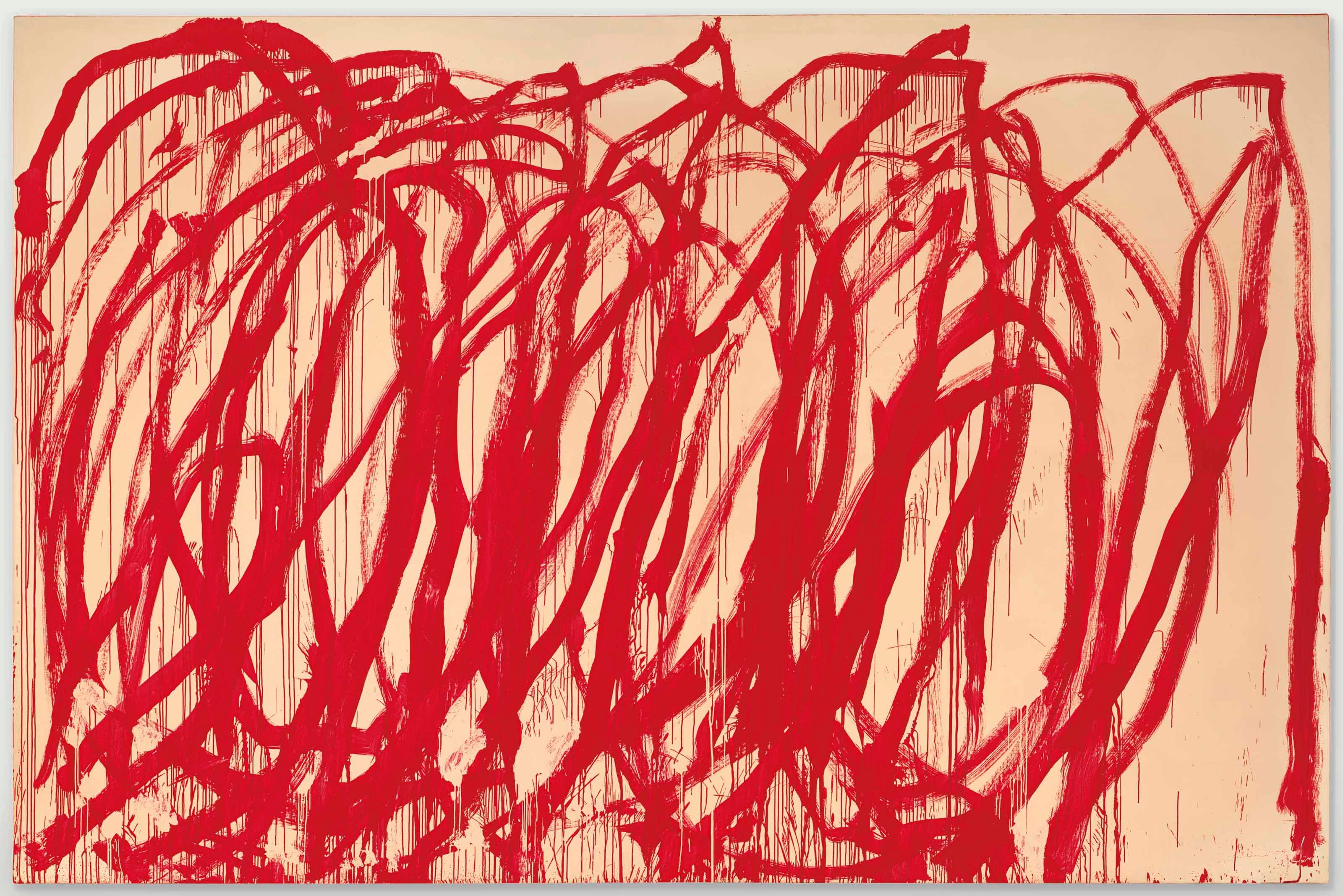
Cy Twombly (1928-2011), “Untitled” (acrylic on canvas, painted in 2005). “Untitled” sold at the Christie’s Post-War & Contemporary Art Evening Sale of 15 November 2017 in New York realizing a price of US$ 46,437,500

Over ten feet high and sixteen feet in length, “Untitled” is the largest example from a group of giant-scaled paintings that Twombly created beginning in 2003 at age 75.

Twombly makes use of spirals of linear loops, culminating fifty years of regularly invoking scrawls, whirls, and writing/drawing.

In his catalogue essay, “Fire in the Water” that accompanied the first exhibition of Twombly’s Bacchus series in 2005, Malcolm Bull argued that the abiding theme of these paintings was that of an elemental Dionysian force of madness rising, like a “fire that rises from the depths of the sea” (M. Bull, “Fire in the Water,” in Cy Twombly Bacchus Psilax Mainonmenos, exh. cat., New York, 2005, p. 55).’ – Lot Essay

Like Dionysian forces of madness, we are all experiencing the dislocation caused by the current COVID-19 pandemic.  

Individuals, families, supply chains, industries, markets, businesses, nations – all are affected.

This pandemic, however terrible, unexpected, and unprepared for, may in part be an outcome of behaviors that we have, however unwittingly, engaged in over decades.

We are all – individuals, peoples, cultures, animals, plants, functional objects and works of art, buildings, systems of transportation, agriculture, and education, etc. etc. etc. – inextricably embedded in nature. We are part and parcel of and subject to the forces of physics. Part and parcel of and subject to the elements and interactions of chemistry. 

As living, breathing creatures, moreover, and complex systems of systems. we are part and parcel of and subject to the complex forces of biology.  We are calibrated precisely, over long periods of time, to our biosphere.

If and should we take our biosphere for granted, fundamentally alter the composition of our atmosphere, and tamper with our climate, the unexpected can occur. Mayhem may let loose,

And so it has.

Yet, in the arts we are global. We reach across time, across space, across borders, across cultures, across nations. We represent mind and passion, interests and preferences. We come from an abundance of backgrounds and industries. 

We may lead, each in our own place, taking steps to realize our ambitions anew.

Together we will have impact.

While we work in our many spheres of activity, what steps, however simple, might we take to realize our objectives while mitigating risks of future such dislocations?

If we want “to do something to prevent disease emergence, first of all we need to seriously reconsider how we do business with the biosphere.”

Q & A: A Harvard Expert on Environment and Health Discusses Possible Ties Between COVID and Climate,”

“We need to hear what nature is trying to tell us, which is clear: let’s be smarter about how we do business with the biosphere and stop disrupting the climate we depend on.” 

 Conversation on COVID-19 with Dr. Aaron Bernstein, Director of Harvard C-CHANGE

Two recently published articles are insightful. In them, Dr. Aaron Bernstein, MD, MPH, Director of The Center for Climate, Health, and the Global Environment at Harvard’s T.H. Chan School of Public Health (Harvard C-CHANGE) offers guidance.

Please take a few minutes to read them in full:

Neela Banerjee, “Q & A: A Harvard Expert on Environment and Health Discusses Possible Ties Between COVID and Climate,” Inside Climate News, 12 March 2020

A Conversation on COVID-19 with Dr. Aaron Bernstein, Director of Harvard C-CHANGE, ” Harvard C-CHANGE  

Excerpts follow, giving us some idea of what we probably already know but don’t always think about or consider in the decisions we make on a daily basis:

The bottom line here is that if you wanted to prevent the spread of pathogens, the emergence of pathogens, … you wouldn’t transform the climate.”

Q & A: A Harvard Expert on Environment and Health Discusses Possible Ties Between COVID and Climate,”

The separation of health and environmental policy is a dangerous delusion. Our health entirely depends on the climate and the other organisms we share the planet with.”

A Conversation on COVID-19 with Dr. Aaron Bernstein, Director of Harvard C-CHANGE

Simply put, “The likelihood is high that this [a next pandemic] will happen. This has happened through human history but the data we have shows that the pace is accelerating. That’s not terribly surprising. We’re living in highly dense urban places. Air travel is much more prevalent than it used to be. And climate is a part of what is fundamentally reshaping our relationship with the natural world.”

Q & A: A Harvard Expert on Environment and Health Discusses Possible Ties BetweenCOVID and Climate

You look at climate change, we have transformed the nature of the Earth. We have fundamentally changed the composition of the atmosphere, and, as such, we shouldn’t be surprised that that affects our health.”

If you look at the emerging infectious diseases that have moved into people from animals or other sources over the last several decades,the vast majority of those are coming from animals. And the majority of those are coming from wild animals. We have transformed life onEarth. We are having a massive effect on how the relationships between all life on Earth operate and also with ourselves. We shouldn’t be surprised that these emerging diseases pop up.

The principle is that we’re really changing how we relate to other species on Earth and that matters to our risk for infections.”

Q & A: A Harvard Expert on Environment and Health Discusses Possible Ties Between COVID and Climate”

Historically, we have grown as a species in partnership with the plants and animals we live with. So, when we change the rules of the game by drastically changing the climate and life on earth, we have to expect that it will affect our health.

A Conversation on COVID-19 with Dr. Aaron Bernstein, Director of Harvard C-CHANGE

How might we in our private and business capacities be smarter about how we do business with the biosphere and stop disrupting the climate we depend on?

First, think.

All industries, markets, and economies, including the arts, the art market, and the art economy, are interconnected and all are viable only within our shared biosphere.

“Art” is not self-existent. Art as a phenomenon, culture as a phenomenon, works of art, cultures, collections of works of art, collectors, and all parties to art are inextricably embedded in and dependent on nature.

Take time and steps to learn about and understand the biosphere. Take steps to reconsider how we, in every sphere of work and activity, do business with the biosphere.

We have an opportunity to consider ways to optimize connections, culture, art, the business of art, and the biosphere jointly.

Some simple steps that can be taken:

Minimize travel

Whether curator, museum director, staff, or trustee, collector, dealer, gallerist, advisor, interested party – vet travel requirements.

Minimize travel powered by combustion of hydrocarbons.

“We need to drastically decrease our greenhouse gas emissions from fossil fuels like coal, oil and natural gas.”

A Conversation on COVID-19 with Dr. Aaron Bernstein, Director of Harvard C-CHANGE

It goes without saying that travel by foot or by bike is encouraged. Travel by electric-powered cars, buses, and trains – especially insofar as the electricity is generated from renewable, non-hydrocarbon sources – is also encouraged.

Amsterdam-based art dealer Jan Six XI, for instance, bikes to and from work, and across town to consult with experts. (Russell Shorto, “Rembrandt in the Blood: AnObsessive Aristocrat, Rediscovered,” The New York Times Magazine, 27 February 2019)

Work with local partners

We are all somewhere. We do not need to be everywhere.

If you need to do work or close a transaction somewhere else, research, identify, vet, and work with local partners.

Optimize resources and connections made available online

Information, images, and opportunities to meet and discuss face-to-face, even in groups, abound online. As we are now seeing in abundance, education and research can be conducted online. Relationships developed through written and verbal communications optimized online, by mail (even mail that goes through the post office), and by telephone.

As much activity is migrating online, vet also your online service partners and their delivery options.

This website, for instance, is hosted by AISO.net. AISO.net is powered 100% by solar energy generated on site. The company does not make use of carbon credits. Members of staff are knowledgeable, of course, very personable, and extraordinarily helpful. They are great to work with.

Reduce carbon dioxide and greenhouse gas emissions from ongoing operations of physical plants

Galleries,museums, homes, businesses, offices, schools and universities, hotels,hospitals – all house works and collections of art.

Real-life steps can be taken to reduce use of hydrocarbon-based energy sources and achieve net-zero energy.

Expert and experienced stakeholders including architects, engineers, designers, builders, energy consultants, and sources of finance are able and ready to assist.

Information about service providers will follow.

Amsterdam’s Van Gogh Museum can serve as a model. The Van Gogh Museum operates 100% on renewable (wind)energy. (See Van Gogh Museum, sustainability, and accompanying infographic.)

Change habits of mind and behavior

Allow time for foot and bike travel. Schedule meetings and work requirements accordingly. 

Enjoy the great outdoors en route to work, home, meetings, and shopping.

Enjoy your locality

See:

Cy Twombly (1928 – 2011), “Untitled” (acrylic on canvas, painted in 2005), Christie’s, Post-War & Contemporary Art Evening Sale, New York, 15 November 2017, Lot 15 B 

Coronavirus, climate change, and the environment, A Conversation on COVID-19 with Dr. Aaron Bernstein, Director of Harvard C-CHANGE”, Harvard C-Change, 20 March 2020

Aaron Bernstein, MD, MPH, C-Change,Center for Climate, Health, and the Global Environment, Harvard T.H. Chan School of Public Health

Neela Banerjee, “Q&A:A Harvard Expert on Environment and Health Discusses Possible TiesBetween COVID and Climate,” Inside Climate News, 12 March 2020

Russell Shorto, “Rembrandt in the Blood: An Obsessive Aristocrat,Rediscovered,” The New York Times Magazine, 27 February 2019

your money, your life, your choice ・ Harvard invests in water

‘Because we believe its physical products are going to be in increasing demand in the global economy over the coming decades,”

Harvard Management Co., the Harvard University endowment manager, likes the natural-resources asset class.

In a warming planet, few resources will be more affected than water, as droughts, storms and changes in evaporation alter a flow critical for drinking, farming, and industry.

Even though there aren’t many ways to make financial investments in water, investors are starting to place bets.

“Buying arable land with access to it is one way.

“In California’s Central Coast, ‘the best property with the best water will sell for record-breaking prices,’ says JoAnn Wall, a real-estate appraiser specializing in vineyards, ‘and properties without adequate water will suffer in value.'”

The Harvard Management Co. has, since 2012, been buying agricultural land, with rights to sources of water, on California’s Central Coast. The idea was pitched to Harvard by agricultural investment advisory firm Grapevine Capital Partners LLC, founded by Matt Turrentine, formerly of his family’s Central Coast grape-brokerage business, and James Ontiveros, a local vineyard manager.

Harvard’s investing guidelines say respecting local resource rights are of increasing importance ‘in the coming decades as competition for scarce resources, such as arable land and water, intensifies due to increasing global population, climate change, and food consumption.’”

Investors who see agriculture as a proxy for betting on water include Michael Burry, a hedge-fund investor who wager against the U.S. housing market was chronicled in the book and movie ‘The Big Short.’ In a 2015 New York Magazine interview, Mr. Burry was quoted as saying: ‘What became clear to me is that food is the way to invest in water. That is, grow food in water-rich areas and transport it for sale in water-poor areas.'”

In California vineyards, the water-proxy math is compelling. When grapes are harvested, about 75% of their weight is water. Owning vineyards effectively turns water into revenue.”

Kat Taylor, an environmentalist and wife of hedge-fund billionaire and liberal activist Tom Steyer, resigned earlier this year from Harvard’s board of overseers in protest of the endowment’s investments in things such as fossil fuels and water holdings she says threaten the human right to water.

‘It may, in the short run, be about developing vineyard properties,’ she says of Harvard’s California investments. ‘In the long run, it was a claim on water.'”

See:

Harvard Amasses Vineyards – and Water. A bet on climate change in California gives it agricultural land and the rights below it,” Russell Gold, The Wall Street Journal, 11 December 2018

In Drought-Stricken Central California, Harvard Hopes to Turn Water Into Wine,” Eli W. Burnes and William L. Wang, The Harvard Crimson, 13 April 2018

Michael Burry, Real-Life Market Genius From The Big Short, Thinks Another Financial Crisis Is Looming,” Jessica Pressler, New York Magazine, 28 December 2018

our daily bread (& rice) | wheat, rice, & CO2

Plants need carbon dioxide to live, but its effects on them are complicated.

As the level of carbon dioxide in the air continues to rise because of human activity, scientists are trying to understand how the plants we eat are being affected.

According to recent studies, rice, wheat, and other staple crops lose nutrients when exposed to levels of carbon dioxide in the atmosphere expected by 2050.

Samuel Myers, principal research scientist at Harvard’s School of Public Health and director of the Harvard-based Planetary Health Alliance and colleagues have conducted studies in which crops are grown bathed in air that simulates the predicted atmospheric conditions expected both by 2050 and by the end of the 21st century. The studies showed declines in protein, iron, and zinc in wheat, and declines in iron and zinc in soybeans and field peas.

The scientists compared nutrient levels in field crops grown in ambient CO2 levels, about 380-390 parts per milliion (ppm) at the time of the work, with those grown in the elevated CO2 levels expected by 2050. The latter level, 545-585ppm, is expected even if substantial curbs on emissions are put in place by the world’s governments. In order to take account of variable growing conditions, the researchers analysed 41 different strains grown in seven locations on three different continents.

Wheat grown in high CO2 levels had 9% less zinc and 5% less iron, as well as 6% less protein, while rice had 3% less iron, 5% less iron and 8% less protein. Maize saw similar falls while soybeans lost similar levels of zinc and iron but, being a legume not a grass, did not see lower protein.

The precise biological and physiological mechanisms that cause nutrient levels to fall when CO2 levels increase are not yet well understood.

See:

“Major crops lose nutrients when grown in elevated carbon dioxide levels,” Harvard School of Public Health, 19 June 2018

“As Carbon Dioxide Levels Rise, Major Crops Are Losing Nutrients,” Merrit Kennedy, NPR, 19 June 2018

“Climate change making food crops less nutritious, research finds,” Damian Carrington, The Guardian, 7 May 2014

Increasing CO2 threatens human nutrition,” Samuel S. Myers, Antonella Zanobetti, Itai Kloog, Peter Huybers, Andrew D. B. Leakey, Arnold J. Bloom, Eli Carlisle, Lee H. Dietterich, Glenn Fitzgerald, Toshihiro Hasegawa, N. Michele Holbrook, Randall L. Nels, Michael J. Ottman, Victor Raboy, Hidemitsu Sakai, Karla A. Sartor, Joel Schwartz, Saman Seneweera, Michael Tausz & Yasuhiro Usui, Nature, International Journal of Science, 7 May 2014

HouseZero ・retrofitting a 1924-era wood-frame house

Harvard University’s Center for Green Buildings and Cities, in collaboration with international architecture and design firm Snøhetta, is retrofitting a wood frame house built in 1924 in what is now an historic district of Cambridge, Massachusetts. The house now serves as the Center’s headquarters.

The retrofit is intended to fulfill multiple objectives:

A focus on inefficient existing buildings. In the United States, buildings consume around 40% of energy produced annually. This equates to more than $230 billion spent annually by property owners heating, cooling, and powering the nation’s 123.6 million homes. Housing consumes 18-23% of that.

A focus on using current technologies together with better design.

The use of zero energy for heating and cooling. A retrofitted building that produces more energy than it consumes.

100% natural ventilation and daylight autonomy

Zero CO2 emissions, including embodied energy in materials

A positive rather than a negative impact on the surrounding environment. A house conducive to occupant health, encouraging productivity and creativity.

Use of self-generated data that will allow the building to self-adjust. The house will adjust itself seasonally and daily to achieve thermal comfort targets.

The development of ideas and a working model that can be used by homeowners as they seek to renovate existing houses towards significant energy and carbon use improvements without costly or wasteful tear-downs.

The Center for Green Buildings and Cities will not seek any kind of independent certification, such as USGBC LEED, WELL, or Living Building certification. The intent is, rather, to exceed those standards’ criteria.

The renovation, says Ali Malkawi, professor of architectural technology and founding director of the CGBC, is guided not only by the goal of net zero energy consumption with 100% natural light and ventilation but also by the understanding that a green building is “a sustainable building, which means it has the lowest impact on its surrounding environment as possible. It might have a positive effect on its environment—the surrounding as well as the global.” Such a building is, furthermore, “healthy for its occupants” and encourages productivity and creativity.

See:

Harvard Center for Green Buildings and Cities unveils HouseZero project, an ambitious retrofit of its Cambridge headquarters” | Travis Dagenais, Harvard Graduate School of Design, 25 May 2017

Harvard’s ‘HouseZero’” | Alisha Ukani, Harvard Magazine, 3 August 2017

Future Home: HouseZero” | Harvard Center for Green Buildings and Cities”

#architecture #architecturaltechnology #buildingtechnology #technology #design #engineering #netzero #energy #resilience #CO2 #home #luxury #smartluxury #retrofit #homeownership #realestate #commercialrealestate #culturalrealestate #culturalheritage #art #collectionsmanagement #museums #galleries #snøhetta #harvard #harvardcenterforgreenbuildingsandcities #Cambridge #data #health #wellness #family

real estate investment & climate change futures ・ the next dry neighborhood

If there’s anything more complicated than the global forces of thermal expansion, ice sheet melt and ocean circulation that contribute to worldwide sea-level rise, it might be the forces of real estate speculation.

Real estate investment may no longer be just about the next hot neighborhood, it may also now be about the next dry neighborhood.

“‘That’s it, it’s that simple. To be on the beach and to be on the water costs a lot more money, and the cheaper parts of town were furthest from the beach — but it just turns out that the cheapest parts of town farthest from the beach are the highest elevation, and now they’re worth a lot more than they used to be.'”

Jesse M. Keenan, Harvard Graduate School of Design

“‘The real issue is: Are people making real estate decisions based on climate change futures, rather than sort of normal speculation?'” observes Hugh Gladwin, an anthropologist at Florida International University in Miami. Gladwin’s specialty is using geographic information system mapping to understand large, diverse urban settings.

Jesse M. Keenan is a lawyer who teaches climate change adaptation at Harvard University’s Graduate School of Design. Mr. Keenan formerly served as the co-founder and research director of Columbia University’s Center for Urban Real Estate (CURE). His family roots are in Miami and he owns a house and has an office and parking space in Miami. He thinks people are making real estate decisions based on climate change futures.

Using survey data, Mr. Keenan is beginning to see see evidence that middle-income people are leaving Miami Beach and other places with nuisance flooding. Such flooding makes  it difficult to get around at high tides or insure a car.

Mr. Keenan observes, “‘Everybody I know that is a small owner of real estate that isn’t within the billionaire class — average middle-class, upper-middle-class Miamians who have real estate on the beach — is in the process of selling their properties and moving to the mainland.'”

Sea-level rise is exacerbating the effects of coastal flooding in South Florida. A 2016 University of Miami study finds that coastal flooding is accelerating. The coastal flooding is coinciding with an accelerated rate of sea-level rise in South Florida. The average rate of sea-level rise jumped from an increase of 3 millimeters a year before 2006 to an increase of 9 millimeters a year on average after 2006. Over the course of one decade, from 2006 to 2016, that’s about 3.5 inches of sea-level rise.

Sam Purkis, a marine geologist at the University of Miami, observes,

“‘What will happen, more than likely, is that you’ll have one big hurricane, and you’ll get a big inundation into the city. And that will serve to rot out the infrastructure — the sewer lines, the electricity, the telecoms. Everything that’s under the road. That becomes very costly to keep replacing every time this happens.'”

“‘That’s it, it’s that simple,'” says Harvard’s Jesse Keenan.

“‘To be on the beach and to be on the water costs a lot more money, and the cheaper parts of town were furthest from the beach — but it just turns out that the cheapest parts of town farthest from the beach are the highest elevation, and now they’re worth a lot more than they used to be.'”

Local governments are considering  what sea-level rise means for all those mortgage holders who pay taxes.

Coral Gables released an analysis of how it would pay for infrastructure investment in the face of a shrinking tax base if people leave.

“We’re concerned about it, we’re planning for it, we’re spending money on vulnerability studies trying to know what our vulnerabilities are in terms of our essential infrastructure, and planning to build up and save our communities as long as we can,” Jim Cason, Mayor of Coral Gables, said.

See:

High Ground Is Becoming Hot Property As Sea Level Rises” | Erika Bolstad, ClimateWire, 1 May 2017, re-printed from ClimateWire by Scientific American with permission from E&E News

Hugh Gladwin, Steven J. Green School of International & Public Affairs, Florida International University

Jesse M. Keenan, Harvard University Graduate School of Design

Center for Urban Real Estate, Columbia University GSAPP

Sam Purkis, Professor & Chair, Department of Marine Geosciences, Rosenstiel School of Marine & Atmospheric Science, University of Miami

#realestate #realestatedevelopment #realestatespeculation #art  #ArtBaselMiamiBeach #Miami #MiamiBeach #climatechange #sealevelrise #resilience #Harvard #Columbia #FloridaInternationalUniversity #UniversityofMiami